
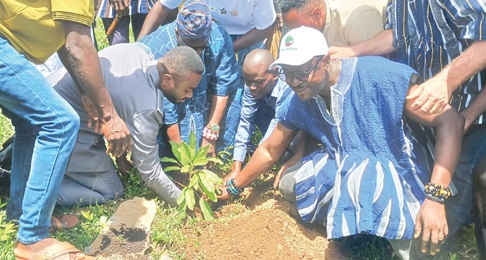
An initiative aimed at restoring degraded landscapes, enhancing biodiversity, strengthening climate resilience and sustainable livelihoods for local communities has been launched in Damongo in the Savannah Region.
Initiated by Eco Restore, a regenerative restoration social enterprise in partnership with Golden Forest, seeks to plant 12,000 indigenous tree species such as shea, mahogany, rosewood, dawadawa, kapok, baobab and tamarind.
Dubbed “Golden Forest/Eco Restore Indigenous Tree Restoration Project”, the three-year initiative is expected to strengthen stakeholder participation, institutional collaboration, and community ownership of tree planting.
The beneficiary communities are Singa, Tari No. 1, Tari No. 2 and Ayanto, all in the North Gonja District.
The beneficiary communities are among the areas increasingly experiencing severe drought and erratic rainfall due to the depletion of the forest cover.
The situation has also affected livelihoods, particularly for women who depend on shea collection and processing as a major source of income. In addition, rising demand for charcoal production has further accelerated vegetation loss, contributing to environmental stress and climate vulnerability in the area.
Restoration
Launching the initiative in Damongo last Friday, a Co-Director of Eco Restore Limited, Senyo Kpelly, said the overall goal of the intervention was to restore the degraded savannah landscape through a blend of scientific approaches, indigenous knowledge systems and community participation.
He explained that the project target was to plant all 12,000 seedlings by the end of 2026, with the remaining two years dedicated to nurturing and monitoring the trees to ensure high survival rates.
He said environmental restoration was a shared responsibility and, therefore, urged all stakeholders to actively support the initiative to ensure its success.
Commitment
For his part, the Head of Department for Procurement and Agricultural Raw Materials at Golden Forest, Vlad Kolesink, said the restoration initiative formed part of the company’s commitment to preserving the ecosystem for future generations while empowering rural women who depended on indigenous economic trees.
He explained that the company considered tree restoration as both an environmental and economic intervention that supported sustainable value chains, particularly in the shea industry.
The Deputy Chief Executive Officer of the Tree Crop Development Authority, Rich Kofi Kofituo, raised concerns about the increasing destruction of shea and other economic trees for charcoal production in parts of the region.
Mr Kofituo added that the authority had signed agreements with several partners, including Golden Forest, aimed at promoting sustainable tree crop development, protecting economic trees and improving production systems across key ecological zones to improve value chain development and enhance rural livelihoods and environmental sustainability
Commendation
The Paramount Chief of Damongo Traditional Area, Damongo Wura Seidu Kelly Boresa I, commended the organisations for the intervention, describing it as timely and important for restoring the depleted landscape.
Writer’s email:
