
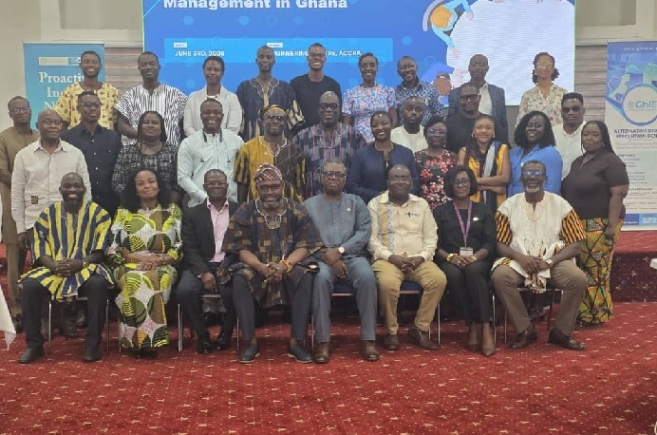
Built environment professionals have called for urgent reforms to Ghana’s metropolitan governance system to better address challenges associated with rapid urbanisation, including infrastructure deficits, transportation inefficiencies, sanitation concerns, flooding, and poor land-use management.
The call was made during the Built Environment Professionals Breakfast Roundtable on “Greater Metropolitan Area Management in Ghana: Towards Integrated Planning, Governance and Infrastructure Delivery,” organised by the Ghana Institution of Engineering (GhIE), Ghana Institute of Architects (GIA), Ghana Institute of Planners (GIP), and Ghana Institution of Surveyors (GhIS).
The forum brought together engineers, architects, planners, surveyors, governance experts, and urban development practitioners to deliberate on practical solutions for managing Ghana's rapidly expanding metropolitan areas, including Greater Accra, Greater Kumasi, and Greater Sekondi-Takoradi.
Participants noted that while decentralisation has expanded the number of Metropolitan, Municipal and District Assemblies (MMDAs), it has also created fragmented governance structures that often undermine coordinated planning and service delivery across growing metropolitan regions such as Greater Accra, Greater Kumasi, and Greater Sekondi-Takoradi.
Keynote speaker Felix Agyei Amakye, a governance expert and lecturer at the Institute of Local Government Studies, stressed the need for integrated metropolitan governance frameworks capable of coordinating planning, transportation, housing, sanitation, infrastructure development, and environmental management across multiple jurisdictions.
The forum highlighted that challenges such as traffic congestion, flooding, waste management, unplanned urban growth, and inadequate infrastructure require collaborative solutions that transcend administrative boundaries.
Participants called for stronger institutional coordination, improved implementation of existing laws, long-term metropolitan planning, integrated transport systems, climate-resilient infrastructure, and stricter enforcement of development regulations.
The professionals also urged broader stakeholder consultations on proposed amendments to the Local Governance Act, 2016 (Act 936), particularly regarding the criteria for the creation and classification of MMDAs and their implications for metropolitan governance.
The meeting concluded with an agreement to develop a Joint Position Paper on Greater Metropolitan Area Management in Ghana, outlining policy recommendations to strengthen governance, improve infrastructure delivery, enhance urban resilience, and support sustainable development.
Participating institutions also committed to establishing a collaborative platform for continued engagement on metropolitan governance and urban development issues.
