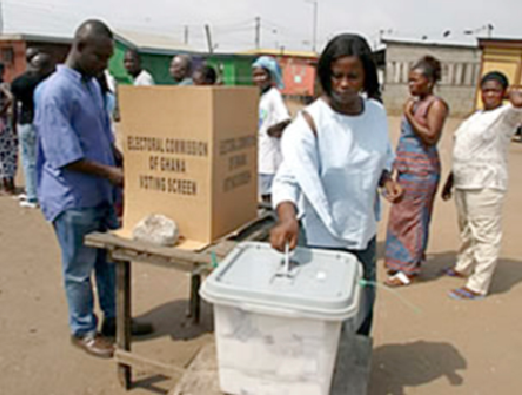
Ghana has a record in Africa as one among nations that have successfully conducted free and fair elections

The European Union and Ghana’s elections

However, there are some problems that have lingered over the period.

Such problems had, in a few times, compelled some political parties to send cases to the court for adjudication.

The notable and memorable one is the New Patriotic Party’s petition to the Supreme Court of Ghana at the end of the 2012 elections.

Although the Supreme Court ruled in favour of the respondents in the case, the Electoral Commission, the president-elect and the National Democratic Party, the apex court made very important recommendations that exposed some of the weaknesses of Ghana’s political and electoral systems.

Ghana’s Electoral Commission (EC), the body that organises and conducts national elections, came under close scrutiny and the court recommended that the EC and its operations should be reformed.

Implementations of the Supreme Court recommendations helped conduct of the 2016 elections greatly but that was not enough to avoid pre-election bottlenecks in the December, 2016 elections.

The court had to come in again, upon petitions from some political parties, to give consequential orders on – for example: the voters register, disqualification by the EC of some presidential candidates, alleged electoral offences and others.


It should be noted that such problems that still confront Ghana’s electoral system and processes do not exist in the advanced countries.

There are scarcely occurrences of vote rigging, ballot-box snatching, alleged EC bias or prejudice against some political parties and problems with the voters’ register.

It is in this light that I should suggest that recommendations by the European Union’s Election Observation Mission (EOM) to Ghana for the December 2016 elections should be looked at seriously and be implemented.

During the EOM’s visit to Ghana late last month, the team led by Dr Tamas Meszerics, made, among others, the following key recommendations:

• Ghana should establish a mechanism to work against the open bias and partiality of the state-owned mass media, especially the Ghana Broadcasting Corporation (GBC), in favour of the ruling political party – particularly during national elections.

“We believe that GBC should be reformed to ensure it fulfils its obligation as a public broadcaster.”

• Abuse of incumbency by the ruling political party before elections. This problem is seen as a major threat to free, fair and transparent elections and needed solution;

• Filling fees for parliamentary and presidential candidates – the EOM regards the fees for the 2016 elections as exorbitant. It recommended a review;

• On membership of the EC, the EOM recommended that selection of members of the commission must be done by parliament and not the president.

• For the tenure of the EC members – the EOM suggested that that should be spelt out clearly. Presently, EC members leave office at retiring age. The chairman or woman of the EC retires at the age of 70 and the two deputies, at 65. It appears the EOM favours a fixed tenure, for example, a term of four years or more for each member;  

• The EC has been asked to find ways to make its operations more transparent to all stakeholders and the generality of Ghanaians; and

• The Right to Information Bill should be passed to increase confidence in Ghana’s electoral processes.

Commenting on the EOM’s recommendations, Mr Meszerics, leader of the team, said the recommendations should not be construed as interference in Ghana’s electoral processes, because “it only means well for the future of Ghana’s democracy”.

He expressed the hope that the EOM’s recommendations would strengthen the country’s democracy and make future elections free and fair.

On the EOM’s recommendations, Professor Atsu Ayee of the Political Science Department, University of Ghana, said, at a public lecture on the theme: “Dealing with Basic Challenges of Elections in Ghana: Lessons from Europe?”, that he expected that the recommendations would be implemented.

He said it was prudent for Ghana to accept and adopt best democratic practices and recommendations to deepen public and political party confidence in future elections.

According to him, the EOM’s recommendations are positive and their implementation would help curb lack of confidence and suspicion that always follow general elections in Ghana.

At the same function, Professor Ransford Gyampo, Director for the Centre for European Studies of the University, said Ghana should learn from best practices from democratic countries of Europe and other nations of the world.

The European Union contributes to the cost of conducting national elections in Ghana every four years. Ghana runs the risk of losing that support – if the recommendations are not implemented.


Our newsletter gives you access to a curated selection of the most important stories daily. Don't miss out. Subscribe Now.

Connect With Us : 0242202447 | 0551484843 | 0266361755 | 059 199 7513 |