
From South Africa as well as America, the definition of xenophobia is not being rewritten; it is being given its real (hidden) origin.
In these two countries, xenophobia is a series of actions by a people or group against foreign citizens when their governments run out of ideas about how to provide food, shelter and jobs that they promised their own citizens but are unable to.
Somebody must be found to blame.
In 1969, Ghana, reeling under severe economic hardships, passed the Aliens Compliance Order, an executive order expelling aliens from the country.
The majority of the victims of Ghana’s Aliens Order happened to be Yoruba from South-Western Nigeria.
It is estimated that some 191,000 Nigerians were involved.
Nothing about our economy changed; if anything at all, it grew worse.
Seventeen years later, Nigeria retaliated. In January 1983, President Shehu Shagari issued an executive order requiring undocumented West African migrants to leave.
More than one million Ghanaians were affected.
The checkered bags they carried gave rise to the iconic "Ghana Must Go" bags.
In spite of the oil boom, the economic conditions of the average Nigerian grew no better.
The real cause of the bad economy was discovered later: corruption.
The oil money was going into the pockets of military commanders.
And now South Africa. This June, ordinary South Africans took to the streets in anti-immigrant unrest in parts of the country to demand the expulsion of African aliens.
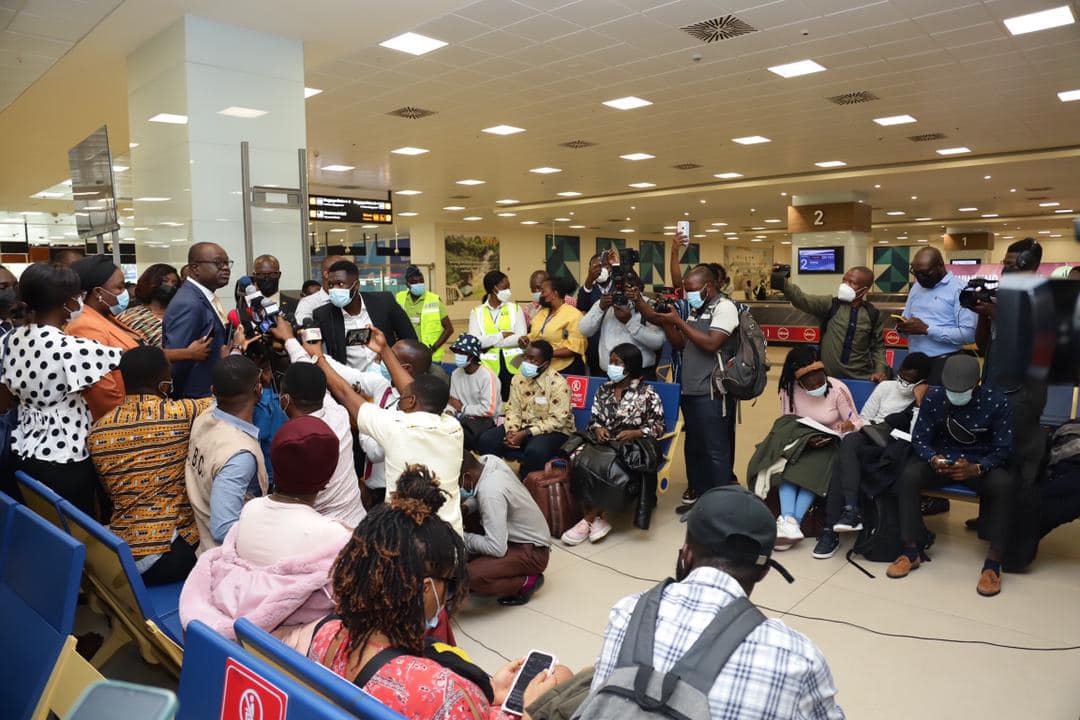
Many migrants from countries including Nigeria, Ghana, Malawi, Zimbabwe, and Mozambique have opted for voluntary return amid growing safety concerns, looting and threats. Some 2,700 foreign nationals were repatriated in just one week.
The government said it did not operate refugee camps and had no intention of establishing them, even temporarily.
That is the lot of ordinary Africans.
The citizens have been eating rhetoric all our lives as politicians, in three-piece suits, jet around the world, First and Business Class, cap in hand for loans or to attend endless conferences in Western capitals. African governments do not know how to create jobs.
Then something happened. On television news this week, a small group of South Africans took to the streets.
Through the media, they were appealing to their government to bring back the expelled Africans.
Apparently, these were the “employees” of the so-called undocumented immigrants.
The truth was that there had been no jobs in the first place, which the African foreigners were accused of taking from South Africans.
The African foreigners may not have owned factories like multinational mining companies, Mobile Network Operations or Fintech and Digital Services, but they owned barbering shops, etc., and these South Africans had been their shop assistants, barbers, etc.
Having been expelled, the businesses of the so-called undocumented immigrants and other businesses were gone.
It is on record that sky-high unemployment (particularly among youth), crippling corruption, and escalating xenophobic unrest dominated the national landscape.
Over a third of working-age adults are unemployed, and youth joblessness approaches roughly 60 per cent.
Every continent has experienced its share of hunger and unemployment.
However, when Africa continues to grapple with persistent poverty and hunger six to seven decades after independence, with no clear end in sight, it becomes a continental challenge that demands a collective response.
It is an issue that should bring the entire continent to the same table to find lasting solutions. If we, as citizens, have a voice, then it must be raised loudly enough for Africa's presidents to hear and act upon.
To the large populations of Africans drowning as they attempt to cross the Mediterranean to Europe, we are now adding the humiliations at the hands of our own kith and kin? What have we elected leaders to do? Something must change on this continent.
Did Kwame Nkrumah foresee this when he promised the world that the African was capable of solving their own problems? Unfortunately, he had counted on leaders whose only care is their comfort, leaders who have no clue beyond IMF/World Bank prescriptions.
The situation in Africa is not what Marcus Garvey envisaged when he called people of African descent to unite, build their own economies and relocate to the African continent.
To make this physical return possible, he established the Black Star Line, a fleet of merchant ships meant to transport passengers and trade across the Atlantic.
That is a man with vision: he knew that political freedom meant nothing without the economics.
It is South Africa today; it was Ghana and Nigeria yesterday.
IBRAHIM MAHAMA
But hope is springing from the horizon. In Ghana, I see it coming from her private sector players, philanthropists with a heart as big as business mogul Ibrahim Mahama, Osei Kwame Despite, among others.
Ibrahim has offered jobs to 100 of the Ghanaian returnees through his construction company, Engineers & Planners.
This hope, however, comes with a prayer that we shall view such acts of philanthropy purely through non-partisan political lenses.
Of course, I can understand the concerns of Ghanaians: we have suffered the evil effects of government by “family and friends”.
Once bitten, we fear even the sight of snails.
