
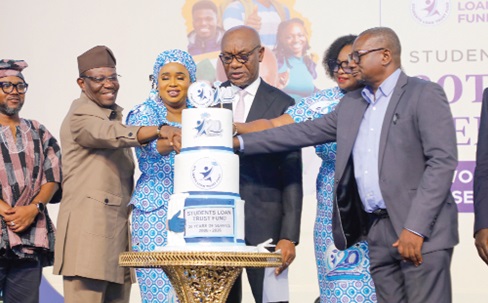
More than 4,000 beneficiaries of the Student Loan Trust Fund on government payroll are to begin repaying their loans through statutory salary deductions under a new recovery arrangement being finalised between the fund and the Controller and Accountant-General’s Department (CAGD).
The deductions will rank after Social Security and National Insurance Trust (SSNIT) contributions and Pay-As-You-Earn (PAYE) tax, making them the third statutory deduction on the salaries of affected public sector workers.
The Controller and Accountant-General, Kwasi Agyei, announced the measure at the 20th anniversary celebration of the trust fund in Accra yesterday.
He said the collaboration had already enabled the identification of more than 4,000 beneficiaries on the government payroll, with discussions underway to determine the modalities for implementation.
The initiative is expected to improve loan recovery, reduce defaults and strengthen the revolving nature of the fund to ensure that future generations of students continue to access financial support for tertiary education.
The anniversary celebration was dubbed: “Two Decades of Financing Futures: Resetting for Sustainability”.
Speaking at the celebration, Mr Agyei said sustainable student education financing required strong collaboration among government institutions, educational establishments, employers, financial institutions, development partners and students.
He said loan recovery was one area where such collaboration could yield a positive result.
“The sustainability of the revolving fund depends on the timely repayment of loans, ensuring (that) resources remain available for future students,” he said.
Mr Agyei said the partnership between the Student Loan Trust Fund and the Controller and Accountant-General’s Department presented an opportunity to strengthen loan recovery and improve the long-term sustainability of student financing in the country.
Principles
Mr Agyei said a sustainable student financing framework should be guided by four key principles, namely accessibility, affordability, recoverability and sustainability.
He said students who genuinely needed support must be able to access it without unnecessary barriers, while repayment arrangements should be fair and manageable.
Mr Agyei stressed that loans must be repaid to enable future students to benefit from the scheme.
A sustainable system, he added, must remain viable even as economic conditions changed and tertiary enrolment continued to rise.
The Controller and Accountant-General further urged beneficiaries to honour their repayment obligations, describing repayment as both a legal and moral responsibility.
“A student loan is not a grant. It is a strategic investment in the future of our young people with the expectation that, upon securing employment, beneficiaries will repay the support received so that others may also benefit,” he said.
Reforms
For her part, the Chief Executive Officer of the Student Loan Trust Fund, Dr Saajida Shiraz, said the institution had embarked on a series of reforms aimed at repositioning it to meet the changing demands of tertiary education financing.
She said the government’s No-Fee-Stress Policy had broadened the scope of educational financing and expanded access to tertiary education.
Dr Shiraz said the government had so far spent GH¢898.25 million to support 315,535 first-year students under the policy.
She said 1,583 students with disabilities had also benefited from full fee and residential support under the Free Tertiary Education for Persons with Disabilities initiative.
The CEO further disclosed that 16,403 students had benefited from the Student Loan Plus initiative, while enhanced loan packages had increased annual loan amounts from between GH¢1,500 and GH¢3,000 to between GH¢2,250 and GH¢4,500.
She said interest rates on student loans had also been reduced from 12 per cent compounded interest to a concessional rate of six per cent during the study and moratorium periods.
She added that allocations by the Ghana Education trust Fund (GETFund) to the institution had increased from GH¢60 million to GH¢200 million, with an additional GH¢50 million provided for the administration of the Free Tertiary Education for Persons with Disabilities initiative
Constraints
The Board Chairperson of the Student Loan Trust Fund, Cynthia Ameley Amarteifio, said the institution, established 20 years ago with the conviction that no Ghanaian student should be denied tertiary education because of financial constraints, had grown from modest beginnings into one of the country’s most important educational financing institutions, supporting students in universities, technical universities, colleges of education, colleges of agriculture and health training institutions.
The Director of Tertiary Education Division of the Ministry of Education, Dr Emmanuel Newman, representing the Deputy Minister of Education, Clement Apaak, said the Student Loan Trust Fund had become one of the country’s most important instruments for promoting equitable and inclusive access to tertiary education.
He said government remained committed to ensuring that access to tertiary education was determined not by socio-economic circumstances but by talent, effort and ambition.
