
Sunday school was a regular part of my childhood as a Presbyterian.
I grew up appreciating that Children's Service exists to provide holistic nurture and spiritual development for children under 12 years, guiding them into a personal saving relationship with Jesus Christ while supporting their physical, emotional, intellectual and spiritual well-being.
Those Sunday mornings were not just about neatly ironed clothes and struggling to stay awake during memory verse recitations.
We studied the Bible seriously. Questions were asked. Bible quizzes were organised to test our knowledge.
The teachings were carefully structured. We learned about Creation, the Flood, Joseph in Egypt, the Exodus and many other foundational stories. As I reflect on some of the challenges confronting us today, one story readily comes to mind: Noah's Ark.
The story is familiar. Humanity had become so corrupt that God decided to destroy the earth with a flood.
Yet Noah saw the signs, obeyed God's instructions and built an ark that preserved life when disaster struck.
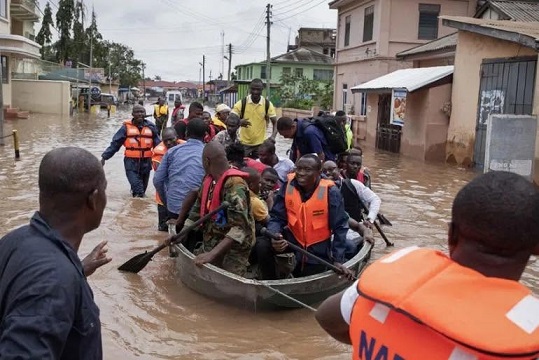
That story often returns to my mind whenever Accra experiences its annual ritual of flooding.
June 3, 2015, remains deeply etched in the memories of many Ghanaians.
The rains were stubbornly heavy. Many of us remained trapped at the office long after working hours.
Around 10 p.m., believing the rains had subsided, we left the Graphic head office.
The deputy editor at the time, Mr Inkoom, was our chauffeur.
Having been warned that floodwaters had engulfed parts of Kaneshie, we avoided that route and attempted to pass through Adabraka towards Kwame Nkrumah Circle.
But in front of the Adabraka Presbyterian Church, we encountered what looked like an inland sea. For a moment, I thought the Atlantic Ocean had changed course.
Mr Inkoom quickly reversed. We tried other routes through Kojo Thompson Road, the Cathedral area, Asylum Down and New Town.
Road after road was blocked. After hours of detours through Alajo, Tesano, Abeka and Darkuman, we eventually found our way home shortly after 3 a.m.
Somewhere around Kanda, we tuned in to a local Twi radio station. The broadcaster reported that people were burning alive at the GOIL filling station near Circle. We laughed in disbelief.
The following morning, I switched on the television.
What I saw left me speechless.
Burnt bodies. Charred remains.
Open trucks carrying the dead.
The unimaginable had happened!
That morning, a question lingered in my mind: Where was our ark?
In Noah's time, one man saw danger coming and built an ark.
Today, we have engineers of every discipline, development planners, environmental experts and access to technologies unimaginable in biblical times.
Yet more than a decade after June 3, and more than six decades after flooding was identified as a recurring problem in Accra, we still struggle to build our own version of the ark.
One wonders whether we are as stubborn as the generation that ignored Noah's warnings or whether we simply lack the resolve to implement lasting solutions.
The problem is certainly not new. A glance through the Daily Graphic of April 18, 1960, reveals a headline that remains painfully relevant today: "When the Rains Came to Accra." Floods.
Sixty-five years later, we are still discussing floods.
The challenge is not the absence of knowledge. We know the causes.
We know the flood-prone areas.
We know the consequences of poor planning, choked drains, unregulated construction and weak enforcement of regulations.
What appears to be lacking is sustained commitment.
Every rainy season brings the same promises.
Drains are to be desilted.
Waterways are to be protected.
Structures obstructing drainage channels are to be removed.
Yet year after year, the floods return, claiming lives, destroying property and disrupting livelihoods.
Perhaps our greatest challenge is not the absence of information.
We tend to forget.
We forget the images of June 3. We forget the grieving families.
We forget the warnings. We forget the lessons.
And because we forget, we repeat the same mistakes.
The lesson of Noah is not merely about divine judgement.
It is also about foresight, preparation and leadership.
Noah recognised a threat and acted before disaster struck.
He did not wait for the floodwaters to arrive before making plans.
That is precisely what modern governance is supposed to do.
Governments are elected not merely to respond to disasters but to anticipate them.
Development planning is not about reacting to crises after they occur; it is about preventing them where possible.
The recurring floods in Accra should therefore challenge all of us—politicians, planners, engineers, traditional authorities and citizens alike.
We cannot continue treating a decades-old problem as though it were a surprise.
One generation ignored Noah's warnings.
We should not make the same mistake.
The question remains as relevant today as it was on the morning of June 4, 2015: Where is our ark?
More importantly, when are we going to build it?
The writer is the Night Editor of Daily Graphic
