
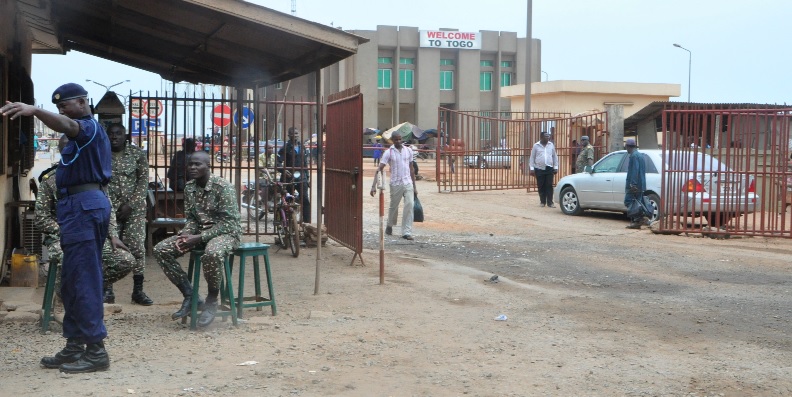
 Aflao, a densely populated community on the border with the Republic of Togo, is located in the Ketu South municipality in the Volta Region of Ghana. With a population of over 90,000 inhabitants of a cosmopolitan nature, Aflao serves as a major commercial town on the eastern gateway to Ghana.
The position of the town makes it an area of utmost strategic importance in terms of Ghana’s international trade, and, therefore, it experiences huge human and vehicular traffic daily to and from neighbouring Togo, Benin, Nigeria and beyond. Any first-time traveller to Aflao is expected to be welcomed to brisk human activity.
In effect, the town has converted traders and visitors into permanent residents.
The border was also in the limelight during the 1970s. A case in point was when the then president, Gnassingbe Eyadema, had to come to a compromise with Ghana’s Head of State, the late General Kutu Acheampong, not to construct skyscrapers in the area due to security concerns for the Togolese government.
Several other projects to transform Aflao as a hub of economic activity were stalled because of the relationship between Ghana and Togo. The border has sometimes been closed during electioneering years, but reopened to economic activities when elections are over.
Socio-economic agenda
Even though Aflao is an economically vibrant town, the Ketu South Municipal Assembly finds it difficult to meet its revenue target as a result of smuggling and other activities. There are numerous unapproved outlets used in entering the country, outwitting customs and immigration officials and consequently depriving the country of the needed revenue for development.
The border town, which is expected to have good motorable roads for goods and services to be carted to other parts of the country, has been in a deplorable state over the years, thus slowing the pace of productivity and general merchandise. The roads have what can be described as manholes, particularly when it rains, a situation which compels motorists to park their vehicles.
However, in the past few years, successive governments have made efforts to get Aflao town roads widened to ease vehicular traffic but to no avail, hence the need to construct another border crossing at Akanu, to ensure smooth vehicular traffic.
Currently the road network from Denu the municipal capital to Aflao, is under construction and expected to be completed in December, 2013.
Employment avenue
Another area of socio-economic development in the Ketu South District is the establishment of a cement factory, the Diamond Cement, at Aflao by a group of Indians, which has created a lot of employment opportunity for the youth in the area.
The company has created employment avenue for about 30 per cent of the youth and supported education and health institutions as its social responsibility within its catchment area.
For instance, the company is constructing a railway line from the Republic of Togo to Aflao for easy access of clinker from Togo for the production of cement.
Paramount chief’s assessment
Togbui Amenya Fiti V, the Paramount Chief of the Aflao Traditional Area, in an interview with the Daily Graphic said the district should be divided into two due to the vast nature of the area and for effective management and administration for rapid social and economic development. He asked the government, particularly the Local Government Ministry, to come clean on the status of Ketu South.
Torgbui Fiti said at the Local Government ministry, Ketu South was not recognised as a municipal assembly because it was not on their records. He explained that the vast nature of the district had prevented government appointees from properly managing it, hence the agitation by the youth.
He urged the government to upgrade Aflao into a municipality so as to provide the town with facilities befitting a municipal status. According to him, the road from Denu to Aflao, which is currently under construction, is very narrow, and, therefore, impeding human and vehicular traffic.
Torgbui Fiti said health and education facilities were being overstretched due to the influx of Togolese to access the facilities, adding that the whole Ketu South District had only one hospital, the Aflao Government Hospital, which also serves the distant communities of Somey and Klikor.
He appealed to the government to extend the railway line being constructed by Diamond Cement from Togo to Aflao to other areas such as Accra and the northern parts of the Volta Region.
Security at the border
On issues relating to security within Aflao and its environs, Mr Ben Beckley, the Chairman of the Border Security Committee (BORDSEC) and Sector Commander of the Ghana Revenue Authority (Customs Division), said the BORDSEC was in collaboration with its counterparts in Togo known as the Aflao-Kojoviakope Security Committee to ensure that traders transacted their business peacefully at the border without problems.
He said the environment in which his officers worked remained a major challenge, stating that the yard was so muddy that whenever it rained their operations became difficult. He also mentioned logistics and the lack of personnel as challenges being faced.
“Our core function is the collection of revenue and people do not understand why revenue is collected. They often attack our officers on duty but as professionals we exercise a lot of restraint,” he explained.
According to the sector commander, most of the people were not aware of their duties and needed to be educated on what the revenue collected was used for. He said his outfit normally organised stakeholders meetings to sensitise the public to their work.
According to him, between June and July, 2013, the preventive unit at the Dabala Checkpoint, the outstation of Kpoglo, Akanu and Havi, together with the Preventive Monitoring Unit (PMU) and the Rapid Deployment Team (RDT) had arrested 120 uncustomed vehicles.
Officials at the Dabala Checkpoint seized 7,395 full pieces imitation wax print which were uncustomed.
He stated that from January to July, 2013, the PMU and RTD seized 18,169 full pieces of imitation wax print and the total number of uncustomed goods without duty that was seized amounted to GH¢927,000, including penalties.
Mr Beckley appealed to the government to build a fence along the Ghana border to prevent smugglers from engaging in their illegal activities, adding that their counterparts in Togo had a wire mesh erected along their border line.
For Mr Julius Gborglah, who is the acting sector commander of the Ghana Immigration Service, the security situation along the border was under control but the 23 unapproved routes along the border made it difficult to monitor the activities of traders entering the country.
He said immigration personnel often had joint patrol with officials of Customs and also educated the public through the local FM stations on security issues and border management regulations. He appealed to the government to support the Immigration Directorate to expedite action to address their challenges.
Observation
A tour by the Daily Graphic of the Ghana-Togo border, which is mainly called the Beat and Pillars, revealed several entry points into Ghana. For instance from Beat 0 to 13, there were many artificial openings in the security wire mesh constructed by the Togolese government. These were used by smugglers and others in and out of the two countries.
According to some border residents in Ghana, those people were normally aided by the Togolese security, whom they alleged cut the wire for them to pass through.
Again, from Pillar 1 to 15, which are longer stretches of about 2km intervals with dotted entries, one can only see an immigration officer and a custom officer manning those posts. For example, pillars 4, 5, 6, 7, 8 and 9 have only two officers manning the whole stretch of about 12km. Moreover, the working conditions of the officers left much to be desired. According to one of the officers, he sometimes has to leave his post to look for food and water, which cost him GH¢7.00 by motorbike each day.
Suggestions
According to the officers manning the Beats and Pillars, for the country’s eastern borders to be properly secured to minimise smuggling and all other negative activities characteristic of border management, the government should team up with the Togolese to strengthen the existing wire mesh constructed by the Togolese government.
Another suggestion is for the government to construct a security fence along its border and also to demarcate a line between the Ghana-Togo border by constructing a motorable road along the border for effective and efficient patrolling.
By Gbriel Ahiabor/Daily Graphic/Ghana
