


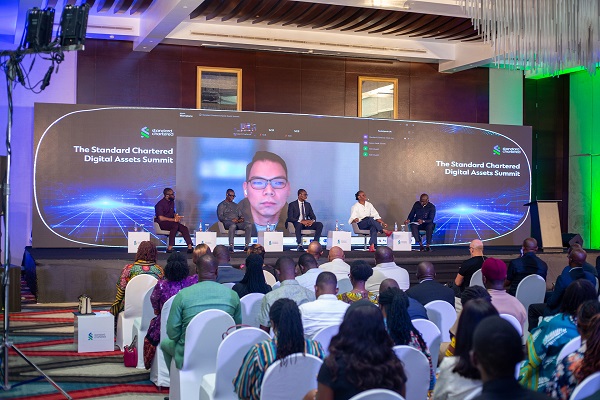
Standard Chartered has hosted its inaugural Digital Assets Summit in Accra highlighting what it sees as the growing role of stablecoins and other forms of digital money in reshaping cross-border payments across Africa.
The bank said accelerating adoption of digital assets is creating opportunities to improve the speed, cost and accessibility of cross-border transactions, while increasing the need for regulatory frameworks, risk management systems and trusted financial institutions to support the sector’s development.
Speaking at the Standard Chartered Digital Assets Summit in Accra, the bank’s Global Head of Digital Assets, Rene Michau, said stablecoins were increasingly moving payments and savings activity outside traditional financial rails, creating opportunities to improve efficiency while raising the need for stronger regulatory oversight and risk management.
He said Standard Chartered’s research estimates that the global stablecoin market, currently valued at roughly $300 billion, could expand to about $2 trillion by 2028.
The bank also expects significant migration of deposits into stablecoins across emerging markets as businesses and consumers seek more efficient mechanisms for payments and savings.
“The most transformative trend for cross-border payments will be stablecoins and other forms of digital money,” Mr. Michau said, noting that existing infrastructure continues to create friction in intra-African trade and payments.
According to him, digital assets were no longer a niche segment of financial markets but are increasingly becoming part of the broader evolution of money.
He argued that successful adoption will depend on balancing innovation with regulation, ensuring that new forms of money operate within trusted and well-supervised frameworks.
The comments come as regulators across Africa, including the Bank of Ghana (BoG) and the Securities and Exchange Commission (SEC), continue developing frameworks for virtual asset service providers and broader digital asset activities.
Benefits
Policymakers are seeking to harness the benefits of innovation while safeguarding financial stability, consumer protection and anti-money laundering standards.
Standard Chartered executives at the summit positioned digital assets as the latest stage in a long history of changes in payment systems, following transitions from physical cash and cheques to electronic banking, card payments and mobile money.
The Executive Director and Head of Markets at Standard Chartered Bank Ghana PLC, Jojo Bannerman, said digital assets should be viewed primarily as a tool for improving payment efficiency rather than as a replacement for existing monetary systems.
“The existing regulations around payments and currency sovereignty remain in place. Digital assets are an additional tool within the ecosystem,” Mr. Bannerman said.
He pointed to cross-border trade as one of the most immediate use cases, noting that a trader in Ghana, for example, could potentially make near real-time payments to suppliers in neighbouring countries without lengthy settlement periods, multiple currency conversions or the operational risks associated with carrying physical cash.
According to Mr Bannerman, faster settlement could improve working capital management for businesses by reducing the need to hold idle foreign currency balances while transactions are processed.
“The whole concept of using digital assets is to drive efficiency in payments, ensure trust within the payment ecosystem and lower costs for end users,” he said.
Beyond payments, Standard Chartered also sees growing opportunities in the tokenisation of financial assets.
Mr. Michau noted that tokenised money market funds and equities currently represent some of the largest segments of the tokenised asset market. However, he argued that broader growth will require digital representations of assets and money to develop simultaneously.
“The tokenisation of assets needs to happen alongside the tokenisation of money,” he said, citing stablecoins, central bank digital currencies and tokenised bank deposits as critical components of future market infrastructure.
Financial ecosystem
The First Deputy Governor of the Bank of Ghana, Dr Zakari Mumuni, said digital assets had evolved from a niche market into a significant component of the country’s financial ecosystem, with the potential to support capital formation, cross-border trade and financial inclusion.
“The question is no longer whether digital assets will shape African finance. They already are,” Dr Mumuni said, noting that more than three million Ghanaians are estimated to participate in the digital asset ecosystem, which accounts for activity worth billions of dollars.
Among the opportunities emerging from the sector, the deputy governor highlighted the tokenisation of real assets, which involves representing physical or financial assets in digital form on blockchain-based platforms.
According to him, such developments could enhance market efficiency, deepen capital markets and create alternative channels through which businesses access financing.
Opportunity
For his part, the Chief Executive Officer (CEO) of Standard Chartered Bank Ghana Plc, Xorse Godzi, said digital assets represent a strategic opportunity for Ghana to shape the future of finance while advancing financial inclusion, efficiency and innovation.
He emphasised that achieving those outcomes would require sustained collaboration among policymakers, regulators, businesses and financial institutions.