
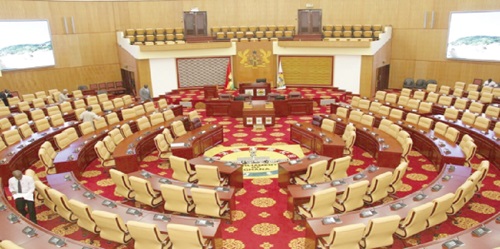
On June 11, 2026, Parliament partnered with Junior Graphic to launch an educational series - ‘Parliament and You’ – which aims to provide parliamentary education for young Ghanaians.
The initiative – led by the Parliamentary Services through the Public Engagements Department and Junior Graphic, the children-friendly publication of the Graphic Communications Group Ltd seeks to deepen young people’s understanding of parliamentary democracy, governance and civic responsibility.
Effective parliamentary democracy, good governance and maintenance of civic responsibility are dependent on parliamentarians’ adherence to probity, accountability, social justice and national service.
Evidence indicates that the Parliament of Ghana displays a mixed record in fulfilling the constitutional ideals of probity, accountability, social justice and national service. While the 1992 Constitution explicitly commands the legislature to build a social order anchored on these pillars under the Directive Principles of State Policy, many Ghanaians perceive a significant gap between Parliament’s institutional mechanisms and its practical performance. Supporters point to robust constitutional frameworks and active committee actions; critics identify partisan polarisation and weak oversight.
Probity: Integrity and Morality
Probity requires absolute honesty and integrity in public office, yet Parliament faces systemic hurdles in fully embodying this value.
Three issues stand out.
First, declaration deficiencies: While Members of Parliament (MPs) are legally required to declare assets under Article 286 of the Constitution, the system is criticised because these declarations are sealed and out of public view, preventing true citizen validation.
Second, there are regular ethics and conduct issues involving unparliamentary behaviour and sporadic physical altercations on the floor of the legislature, which undermine the moral standing expected of national leaders.
Third, there is the anti-corruption dilemma: while MPs routinely speak out against corruption, public perception trackers – such as Afrobarometer and Global InfoAnalytics – consistently capture deep public scepticism regarding politicians’ financial integrity.
Accountability: Checks and Balances
Although parliament has several dedicated tools for accountability, partisan politics often stalls their effectiveness.
The Public Accounts Committee, which holds regular, televised public hearings scrutinising the Auditor-General’s reports exposing financial irregularities across state entities, consistently exhibits partisanship and political polarisation, although it is structurally designed to function in a bipartisan manner.
Then there is the issue of executive dominance. Ghana’s hybrid constitutional system enables the president to select a majority of ministers from within Parliament, which weakens independent oversight, as many MPs balance their legislative duties with executive loyalty.
Finally, there is bipartisan gridlock: High-stakes accountability metrics, such as censures or impeachment motions, frequently collapse along strict party lines rather than serving national interests.
Social Justice: Equality and Rights
Parliament is tasked with the pursuit of progressive social justice.
Yet, it remains slow in passing crucial equity bills. For example, while Parliament has passed a key equity framework – the Affirmative Action (Gender Equality) Act – another, the Property Rights of Spouses Bill, remains pending.
First drafted in 2009 to fulfil Article 22 of the 1992 Constitution, the bill has faced decades of legislative stagnation and has yet to be fully passed into law.
The aim of the Property Rights of Spouses Bill is to address one of Ghana’s significant gender disparities.
Finally, there is the thorny issue of constituency funding.
MPs deploy the Common Fund to execute micro-development projects in health and education, and critics argue that distribution is often clientelist, not needs-based.
National Service: Country Over Self
National service implies sacrificing personal and partisan interests to advance popular interests.
Voting patterns show that MPs overwhelmingly place partisan agendas and electoral survival over overarching national goals, notably during contentious budget or tax debates.
Many Ghanaians believe that parliamentary privileges, ex gratia payments, and compensation packages shield lawmakers from the economic realities endured by the constituents they serve, discouraging the aim of national service.
Values
The ceremony honouring Flt. Lt. Rawlings at the NDC headquarters on June 22, 2026, was a celebration of the former president’s political impact on Ghana, nearly six years after his untimely passing.
President Mahama used the occasion to highlight the values which he stated Jerry John Rawlings brought to Ghana’s political life over several decades: probity, accountability, social justice and national service.
To what extent does Ghana’s political system – specifically the democratically elected parliament – embody the values which President Mahama highlighted? To what extent does parliament provide a good role model for children growing up in Ghana today, in relation to these values?
The Parliament of Ghana is widely regarded as a corrupt institution by the Ghanaian public, with major perception surveys consistently ranking MPs and the legislature among the most corrupt public bodies in the country.
Afrobarometer surveys consistently show that a majority of Ghanaians believe corruption is increasing.
MPs, along with the police and tax officials, are routinely identified by citizens as the most widely perceived corrupt officials. It will be a hard task to show young Ghanaians the virtues of parliamentary democracy while the values of probity, accountability, social justice, and national service remain underdeveloped.
The writer is Emeritus Professor of Politics, London Metropolitan University, UK.
