
Flt-Lt. Jerry John Rawlings came to power on December 31, 1981, with the aim of bringing about a people-centred democratisation.
His stated aim was to involve ordinary people directly in the country’s political and economic decision-making processes.
Yet, while his aim was to bring ordinary Ghanaians into the decision-making process, his regime was heavily dependent on the support of the military and attempts at direct democracy ultimately ended in failure.
What motivated Jerry John Rawlings to seize power via a military coup rather than seek democratic means?
After four decades of research into the politics of Jerry John Rawlings, I can confirm that he was primarily motivated by a deep moral outrage against widespread government corruption, severe economic mismanagement, and systemic social injustices that left ordinary Ghanaians unrepresented and, in many cases, impoverished.
Rawlings’ legacy
Flt-Lt. Rawlings died suddenly on November 12, 2020, and his political legacy continues to divide Ghanaians.
Some regard him as a reprehensible military dictator who presided over a lengthy period of significant political oppression involving disappearances and incarceration of opposition figures, substantial media repression, and a ‘culture of silence’.
Others regard Rawlings as a national hero.
He is widely referred to as ‘Junior Jesus’ and ‘Papa Jerry’, second only to Ghana’s first post-independence president, Kwame Nkrumah, in national estimation. Rawlings is widely credited with saving the country from economic ruin in the 1980s, and for facilitating the return to democracy.
Founding of NDC
Jerry John Rawlings founded the National Democratic Congress (NDC) in 1992, leading the party to victory in the country’s first elections under the Fourth Republic, and ushering in constitutional rule on January 7, 1993.
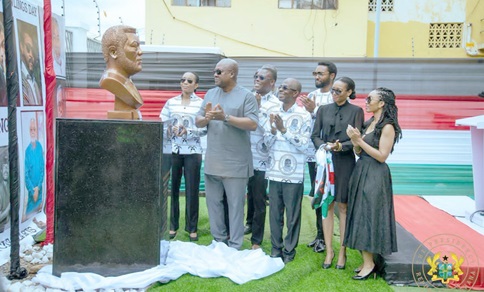
In a ceremony in his honour, held last Monday, June 12, the NDC renamed its national headquarters in Adabraka, Accra, as the JJ Rawlings House.
The date, coinciding with what would have been the late president’s 79th birthday, brought together senior party officials, members of the Agyeman-Rawlings family, and supporters of the party.
President John Dramani Mahama, accompanied by the National Chairman of the NDC, Johnson Asiedu Nketiah, General Secretary Fifi Fiavi Kwetey, and members of the Rawlings family, unveiled a commemorative bust and plaque in his honour. Addressing the gathering, President Mahama described the occasion as a moment of remembrance, gratitude, and recommitment to the ideals that have over the decades shaped the NDC.
He stated: ‘Today is a day of remembrance. It’s a day of gratitude and renewal. It’s a day that invites us to reflect on our journey as a political movement’.
President Mahama paid tribute to Flt Lt Rawlings’ contribution to Ghana’s democratic development, describing him as a transformative leader whose commitment to probity, accountability, social justice, and national service helped shape the political tradition from which the NDC emerged. President Mahama added that it is imperative that integrity, patriotism, sacrifice, courage, discipline and service to the people guide the actions of both the NDC and the government.
Probity, accountability, social justice and national service
The qualities that President Mahama highlighted – probity, accountability, social justice and national service – are foundational pillars that sustain Ghana’s parliamentary democracy.
They are essential to ensure ethical governance, civic duty, and equitable development.
These values are explicitly enshrined in the Preamble and Directive Principles of State Policy of the 1992 Constitution.
Why are probity and accountability necessary for parliamentary democracy to work well?
They are necessary to prevent the abuse of power and ensure public trust in state institutions, essential components in the struggle against corruption and to ensure that public officers perform their tasks with honesty and transparency.
In addition, there is a parliamentary oversight function, scrutinising government spending and executive actions, as well as the maintenance of public trust.
High standards of probity foster citizens’ confidence in democratic processes and the rule of law.
Finally, accountability ensures national revenues, including oil and tax resources, are utilised for public good rather than private gain.
Finally, social justice ensures that the benefits of democracy are distributed fairly across all segments of Ghanaian society while national service fosters patriotism, civic responsibility, and national cohesion in a multi-ethnic state.
In the second part of this article, I will assess the extent to which probity, accountability, social justice, and national service remain the guiding principles of Ghana’s democracy, more than three decades after the founding of the Fourth Republic.
The writer is Emeritus Professor of Professor of Politics, London Metropolitan University, UK
