
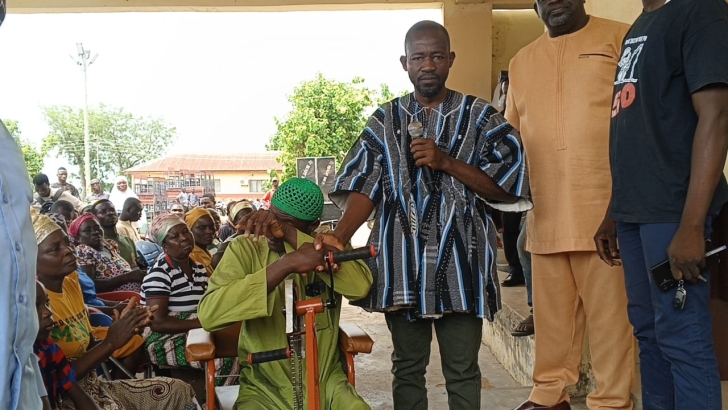
On a bright morning in Kpandai, Abdul Wahab sat quietly on his newly acquired three-wheeled tricycle, fighting back tears as he reflected on a journey marked by hardship, resilience, and hope.
For years, the father, Islamic teacher, and person living with a disability depended largely on the generosity of strangers to survive. Every Friday, he positioned himself along busy streets where passersby would offer him small amounts of money. While many saw a man begging for alms, Abdul Wahab saw an opportunity to build a future.
Instead of spending all the money he received on daily needs, he saved gradually toward a dream that many considered impossible.
"I want to thank the DCE for this life-changing support," he said. "Previously, I used to beg on the streets, especially on Fridays when people would give me money. Instead of spending the money on myself, I thought it wise to invest it in the construction of a container shop."
Today, that dream stands as a reality. A container shop has been mounted on a piece of land allocated to him through the intervention of the Kpandai District Chief Executive (DCE), Haruna Abdul-Karim. Yet, despite completing the structure, Abdul Wahab faces another challenge—raising enough capital to stock it with goods.
"Getting a fridge, drinks, biscuits, and other items has been a major challenge. I appealed to the DCE for land, and he gladly responded. As we speak, I have mounted the container," he recounted.
His story is one of many emerging from the Kpandai District Assembly's implementation of the District Assembly Common Fund (DACF) for Persons with Disabilities (PWDs), a programme that is steadily transforming lives and creating opportunities for some of the district's most vulnerable residents.
A Fund Changing Lives
For decades, many persons living with disabilities in the Kpandai District of the Northern Region have faced significant barriers to economic participation. Poverty, unemployment, social exclusion, limited mobility, and inadequate access to productive resources have often left many dependent on family members, friends, or public charity.
However, the DACF allocation for Persons with Disabilities is gradually changing that reality.
With an estimated 2,000 persons living with disabilities in the district, the Kpandai District Assembly has intensified efforts to ensure that the fund reaches beneficiaries who need support to improve their livelihoods.
The latest intervention, which marked the fourth consecutive disbursement under the current administration, saw the Assembly distribute GH¢163,000 in cash support and three-wheeled tricycles to 147 beneficiaries.
The support is intended to help recipients establish or expand small businesses, engage in farming, improve mobility, and pursue other income-generating activities capable of enhancing their economic independence.
For beneficiaries, the support represents more than financial assistance. It offers a chance to participate fully in society, earn a living with dignity, and reduce dependence on others.
The Mobility Challenge
For Abdul Wahab, mobility has always been one of the biggest obstacles standing between him and his aspirations.
Living without the use of his legs, he has had to rely on others for transportation and movement across town. A respected Mallam who teaches Arabic to members of his community, he regularly travels between his home in the Zongo community and his teaching centre near the Kpandai Polyclinic.
The journey, however, has never been easy.
"Without legs, you cannot move yourself to where you want to go," he explained. "I live in the Zongo, and travelling from there to the Polyclinic is quite far."
For years, he depended on borrowing a colleague's tricycle whenever it was available.
"Sometimes, I had to borrow a colleague's tricycle to aid my movement, but it was not convenient because he also had places to go," he said.
The lack of personal mobility affected not only his teaching activities but also his ability to supervise the development of his container shop and pursue other economic opportunities.
Recognising his situation, Abdul Wahab appealed directly to the District Chief Executive for assistance.
According to him, the DCE assured him that support would come.
Months later, that promise was fulfilled.
"Today, I can say that he has honoured his pledge, and I now have a new tricycle. I feel blessed and deeply grateful to the Assembly and the Social Welfare officers for considering me in this fourth batch," he said.
The tricycle has already transformed how he views the future.
For the first time in years, he can move independently, attend to his daily activities without depending on others, and focus on building a sustainable source of income.
Beyond Charity: Building Sustainable Livelihoods
Abdul Wahab's ambitions extend far beyond mobility.
A trained shoemaker and someone with knowledge in Information and Communication Technology (ICT), he believes his container shop can become a stable source of income for his family.
His immediate goal is to stock the shop with essential items and gradually expand its operations.
"My biggest priority now is to stock my shop so that my mother can help me manage it while I continue my Arabic teaching classes," he said.
"When that is done, I will no longer be a burden or have to come to the Assembly to seek support."
His determination reflects a broader trend among beneficiaries who increasingly see the DACF support as a stepping stone toward self-reliance rather than a form of charity.
Across the district, beneficiaries are using previous allocations to establish small businesses, invest in farming, acquire vocational tools, and improve their living conditions.
For many, the support has provided the initial capital needed to break cycles of poverty and dependence.
Assembly Reaffirms Commitment to Inclusion
Speaking at the fourth disbursement ceremony, District Chief Executive Haruna Abdul-Karim reaffirmed the Assembly's commitment to empowering persons with disabilities through targeted interventions.
According to him, the support forms part of broader efforts to create an enabling environment where persons with disabilities can become productive and self-reliant members of society.
He explained that the GH¢163,000 cash support and mobility aids were carefully allocated to help beneficiaries expand businesses, engage in farming activities, and improve their economic wellbeing.
The DCE emphasized that disability should never be viewed as an inability to contribute meaningfully to society.
"Disability is not inability," he told beneficiaries.
He encouraged recipients to invest the funds wisely and use the support to create sustainable sources of income rather than relying on street begging.
Mr. Abdul-Karim also stressed that the allocation of the fund is based strictly on need and not political affiliation.
According to him, the Assembly has adopted a transparent and inclusive approach to ensure fairness in the selection process.
"Unlike in the past, beneficiaries now receive support openly and fairly. We are committed to accountability, transparency, and ensuring that every deserving person benefits," he said.
The DCE described the fourth consecutive disbursement since assuming office in June 2025 as a significant achievement and evidence of the Assembly's commitment to improving the welfare of persons with disabilities.
Creating Lasting Impact
The impact of the programme is becoming increasingly visible across communities in the district.
Beneficiaries who previously struggled to meet basic needs are now investing in farming activities, operating small businesses, pursuing educational opportunities, and improving household incomes.
Others have received mobility aids that allow them to participate more actively in economic and social life.
The Assembly believes such interventions not only improve individual livelihoods but also contribute to local economic development by enabling more people to participate productively in community life.
Supporting this vision, the Business Advisory Center (BAC), Head Rashid Ibn-Imoro, urged beneficiaries to use the funds prudently and channel resources into viable ventures capable of generating long-term returns.
He assured them that his offi ce remains available to provide technical support, mentorship, and business development services to help ensure the sustainability of their enterprises.
Such support, he noted, is essential to helping beneficiaries convert financial assistance into successful and resilient businesses.
Restoring Dignity and Hope
For many persons with disabilities, one of the most significant benef,its of the programme cannot be measured in monetary terms.
It is the restoration of dignity.
The opportuni ty to live, support a family, move independently, or own a business can fundamentally alter how individuals see themselves and how they are perceived by society.
For Abdul Wahab, the tricycle symbolizes far more than transportation.
It represents freedom, opportunity and more importantly, hope.
His journey from street begging to entrepreneurship embodies the transformative potential of targeted social interventions when they are implemented effectively and reach those who need them most.
As he navigates the streets of Kpandai on his new tricycle and works toward stocking his container shop, Abdul Wahab is determined to write a new chapter in his life—one defined not by dependence but by self-reliance.
His story serves as a powerful reminder that behind every allocation of public funds is a human life waiting for an opportunity.
With four successive DACF disbursements already completed and growing evidence of positive outcomes, the Kpandai District Assembly's implementation of the District Assembly Common Fund for Persons with Disabilities is demonstrating how public resources can be usedsed to create meaningful change.
For Abdul Wahab and many others across the district, that change is already underway.
What was once a life shaped by hardship and uncertainty is gradually becoming a story of dignity, opportunity, and renewed hope for the future.
