
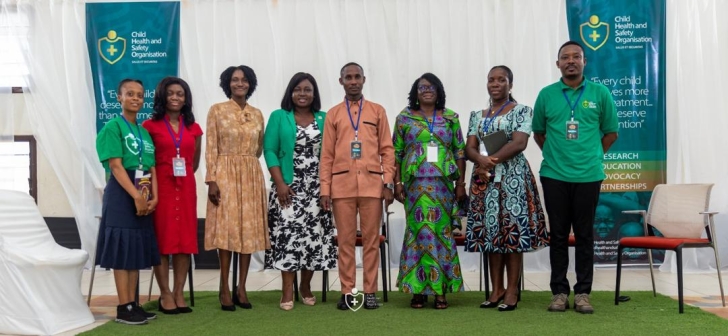
Participants at a stakeholder workshop have called for a coordinated national approach to preventing childhood injuries, urging government, schools, health institutions, parents, and communities to prioritise child safety through education, stronger policies, and increased public awareness.
The call was made at the Child Health and Safety Stakeholder Engagement Workshop, organised by the Child Health and Safety Organisation (CHSO) in collaboration with Ridge Hospital and SOS Children's Village in Tema to mark the Day of the African Child under the theme, "Protecting Children Through Awareness, Education and Prevention."
The workshop brought together representatives from hospitals, schools, non-governmental organisations, the media, faith-based organisations, and government agencies to address one of Ghana's most overlooked public health challenges—preventable childhood injuries.
Opening the workshop, the Founder of CHSO, Mr. Samuel Frimpong, shared the personal experience that inspired the organisation's mission after his young son survived a preventable injury. "This movement was born from one painful realisation—that many childhood injuries are not accidents; they are preventable events," he said.
He noted that while significant attention is paid to workplace safety, many children grow up without learning basic safety awareness. "Child safety is not simply a medical issue; it is an education issue," Mr. Frimpong stressed.
He explained that CHSO is working to shift Ghana from a reactive culture of treating injuries to a preventive culture through its "Safety Sense Framework"—STOP • LOOK • THINK • ASK—which is taught using The Safety Adventures of BB, a children's story series promoting safety awareness.
A Consultant Paediatrician at Ridge Hospital's Child Health Department, Dr. Abigail Amankwa-Boateng, urged participants to view childhood injuries as predictable and preventable rather than random occurrences. She identified burns, poisoning, drowning, falls, and road traffic crashes as some of the leading causes of childhood injuries in Ghana.
"The true measure of our success as a health system is not how many injuries we treat, but how many we prevent," she said.
Citing data from the World Health Organization and UNICEF, she called for stronger injury surveillance systems, the integration of safety education into school curricula, and the development of a National Child Injury Prevention Strategy.
The President of the Paediatric Society of Ghana, Dr. Hilda Mantebea Boye, said childhood injuries often result from gaps in awareness, supervision, and safety systems. "Preventing injuries requires coordinated action before, during and after risk exposure," she noted.
Sharing practical experiences from the education sector, the Vice Principal of Angels Specialist School International, Mrs. Stellastina Appiah, highlighted common safety challenges in schools, including unsafe play, inadequate supervision, unauthorised pick-ups, and bullying. "Child safety is not an event; it is a culture," she said, urging schools, parents, and health professionals to work together to create safer environments for children.
Delivering the keynote address, the Tema Metropolitan Chief Executive, Ms. Ebi Bright, described child safety as both a moral responsibility and a social investment. "Treatment is empathy. Prevention is justice. And prevention costs us so much less than the grief that it spares—not only in cedis, but in the one currency that no parent can ever be repaid in: the life of a child," she said.
She reaffirmed the commitment of institutions to promote early safety education, strengthen partnerships, support families, and champion safer environments for children.
Participants also engaged in breakout sessions, where they developed recommendations on improving children's physical environments, strengthening supervision, enhancing safety education, and addressing socio-economic factors that increase children's risk of injury.
CHSO said the recommendations from the workshop would inform future programmes and policy advocacy efforts leading up to the CHSO World Children's Day Summit scheduled for November 2026.
