
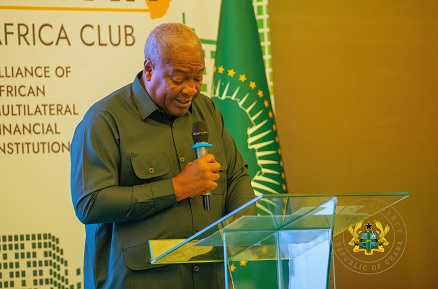
Ghana’s partnership with the European Union (EU) must move from one largely centered on aid and development assistance to one that is increasingly driven by trade, investment, innovation, industrialisation, and shared prosperity, President John Dramani Mahama has said.
President Mahama said the relationship has evolved beyond traditional development cooperation into a strategic partnership grounded in democratic values and shared interests.
He was speaking at the opening session of the Ghana-EU Partnership Dialogue in Accra on Thursday (June 11, 2026).
In attendance were the Minister of Foreign Affairs, Samuel Okudzeto Ablakwa and his Deputy James Gyakye-Quayson; Minister of Lands and Natural Resources, Emmanuel Kofi Armah-Buah; the Minister of Interior Mohammed Muntaka Mubarak; the EU Ambassadors to Ghana among others.
Interconnectedness
The President said, the EU and Ghana are meeting at a time when the international system is undergoing profound transformation; stressing that, in such a world, partnerships that are anchored in trust, mutual respect and shared interests become not merely desirable, but they become indispensable.
He described the Ghana-EU as “ultimately one of interconnected destinies”. Stressing that, “when Ghana prospers, opportunities expand for European businesses, and when Europe prospers, Ghana benefits from stronger trade, investment, innovation and technology transfer”.
He added that, as the world faces growing fragmentation, government believes that partnerships such with the EU must become stronger, more equitable and more strategic.
“Our objective should not be merely to maintain existing cooperation, but to elevate it to a whole new level,” he stated.
Economic recovery
President Mahama said the economy is showing encouraging signs of recovery and resilience after emerging last year from one of its most challenging periods.
He cited fiscal consolidation, macroeconomic stability and private sector-led growth, with inflation trending downward and investor confidence returning.
“Macroeconomic stability is not an end in itself. The true measure of success will be translating the improved economic conditions into better livelihoods for Ghanaian citizens,” he said.
He added that, central to that transformation is the government’s flagship “24-hour economy” initiative and accelerated export development programme, aimed at unlocking productivity across agriculture, manufacturing, logistics, transport, tourism and digital services.
“Our goal is simple, to ensure that Ghana produces more, exports more and creates more jobs for our young people. The future of Ghana’s economy lies not in exporting raw materials, but in producing higher value goods and services,” he said.
Support
For his part, the EU Ambassador to Ghana, Rune Skinnebach, said the European Union (EU) is ready to support Ghana’s shift toward trade, investment and industrialization.
Mr Skinnebach commended the government’s remarkable economic recovery and stabilisation, stressing that the country had outperformed targets under the IMF Extended Credit Facility.
“Through the Global Gateway strategy, the EU stands ready to accompany Ghana on its path by supporting and financing strategic infrastructure and industrial projects that contribute to sustainable growth and job creation,” he said.
Mr Skinnebach urged government to facilitate timely approvals for projects, but flagged hurdles for European businesses including difficulties with permits and land titles, port delays, and “new steep e-visa fees for non-Africans” which he said would not help mobilise investment or tourism.
Security partnership
He underscored the new Security and Defence Partnership Agreement signed earlier this year by Vice President Naana Jane Opoku-Agyeman and EU High Representative Kaja Kallas, the EU’s first with an African country.
The partnership, now worth over €100 million, focuses on equipment, training and preventing violent extremism spill-over from the Sahel.
He reaffirmed readiness of the EU to engage at next week’s high-level conference on the passed UN resolution on transatlantic slavery, although the EU abstained from its adoption.
Ghana-EU relations at ‘all-time high’ – Ablakwa
The Minister of Foreign Affairs, Samuel Okudzeto Ablakwa, on his part said Ghana-European Union relations are at an “all-time high”, as the two parties have deepened relations in recent time.
Mr Ablakwa said the year under review had been “exciting”, as Ghana became the first African country to formalise a Security and Defence Partnership Agreement with the EU, and also the first African country to secure sustainable timber certification under the Forest Law Enforcement, Governance and Trade (FLEGT) process.
“We were the second country, only after Indonesia, to secure what the experts say is a very, very complicated certification. We deserve a round of applause for achieving that,” he stated.
“From the foundations established in development cooperation, the partnership has evolved to embrace trade, investment, governance, climate action, peace and security, and human development. The partnership is today comprehensive and forward-looking,” he said.
Reparations, historical justice
The Minister said government was proud to have played a leading role under President Mahama’s leadership as AU champion on reparatory justice, which led to UN Resolution A/RES/80/250 declaring the trafficking of enslaved Africans as the gravest crime against humanity.
Contrary to predictions, he said, cooperation with the EU since the resolution had been constructive.
“Key EU partners like France have taken the lead in openly committing to work with Ghana to achieve the objectives of the UN Resolution. And President Macron will be addressing virtually the Next Steps Conference that President Mahama has convened from the 17th to the 19th of this month,” he said.
He said the Dutch government had presented a catalogue of artefacts identified for retention and return, while Germany was fully represented and would return some artefacts from the Volta Region.
He condemned the recruitment of Ghanaian youth by some European nations to fight wars not their own.
With President Mahama set to chair the African Union from February next year, Mr Ablakwa said Ghana wants synergies with the EU ahead of the next AU-EU Dialogue. He added that, an eminent panel is drafting the President’s AU chairmanship manifesto, and suggested the EU met the panel to align strategic agendas.
E-visa fees
Responding to the EU’s concern over Ghana’s new e-visa fees, Mr Ablakwa said the Interior Minister was already conferring with him and that Ghana was willing to have “a reciprocal discussion.”
He added that, visa fees are approved by Parliament under the Fees and Charges Act, but government would “convince our colleagues in Parliament” if EU member states reduce their own fees.
