
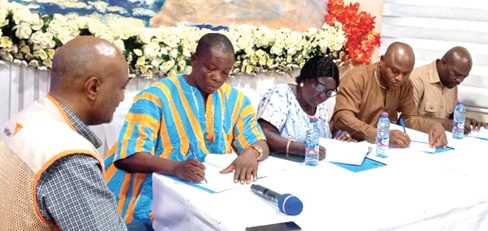
World Vision Ghana, a Christian relief, development and advocacy organisation, has signed a Memorandum of Understanding (MoU) with four district assemblies in the Upper East Region targeted at achieving universal access to Water, Sanitation and Hygiene (WASH) services by 2030.
Under the agreement, which falls under its Universal Service Coverage (USC) initiative, World Vision and the Assemblies would jointly work to improve WASH services in rural communities through resource commitment, hygiene promotion, sanitation, institutional strengthening, and safeguarding interventions to achieve universal access to WASH.
The beneficiary districts are Bawku West, Builsa South, Garu and Tempane, respectively.
World Vision Ghana is also piloting a revolving financing mechanism known as the “Drinking Water Sustainability Fund” to support repairs and expansion of water systems in beneficiary communities.
Speaking at the regional stakeholder engagement for the signing of the MoU in Bolgatanga last Thursday, the Programme Manager for Universal Service Coverage at World Vision Ghana, Cephas Wedam, said the MoU would ensure joint planning, implementation and monitoring of WASH interventions between World Vision Ghana and the Assemblies.
He further indicated that the MoU also committed the Assemblies to support community mobilisation, co-financing, and enforcement of sanitation by-laws and maintenance of WASH infrastructure.
Safe water
Mr Wedam explained that World Vision Ghana intended to provide safe water services to more than 700,000 people, sanitation services to over 300,000 people and hygiene interventions to more than 500,000 people across 23 operational districts nationwide.
Mr Wedam said the initiative would also support schools and healthcare facilities with WASH infrastructure to improve learning outcomes and reduce infections.
According to him, assessments conducted in the four beneficiary districts showed that sanitation and hygiene coverage remained far below the targeted threshold despite some gains in access to potable water, stating that each district would require investments exceeding one million dollars to achieve the 90 per cent coverage target by 2030.
Maintenance
To ensure sustainability of water systems, Mr Wedam said the organisation was introducing innovative models such as professionalised management systems, prepaid metering and water infrastructure insurance schemes.
He explained that the systems would help improve maintenance of rural water facilities and ensure continuous service delivery.
“We have tested these models, and they are workable. Communities are paying for water, and the systems are professionally managed,” he noted.
The Director of Strategy and Integrated Programme at World Vision Ghana, Joshua Baidoo, said access to safe water and sanitation was central to improving health, education and livelihoods, indicating that WASH was not merely about infrastructure but also about dignity, equity and opportunity for vulnerable populations.
Mr Baidoo explained that the USC initiative formed part of World Vision Ghana’s 2026–2030 strategy dubbed “Hope for Every Child”, which aims to improve the well-being of 2.8
million vulnerable children across the country.
The Associate Director of WASH, World Vision Ghana, Robel Wamisho, described the signing ceremony as a major milestone towards achieving Sustainable Development Goal Six, which seeks universal access to safe water and sanitation and urged stakeholders to prioritise sustainable management of WASH facilities to guarantee long-term benefits for communities.
All the district chief executives of the beneficiary assemblies reaffirmed their commitment to the implementation of the initiative and pledged support through co-financing and community mobilisation efforts.
The Bawku West DCE, James Ayamwego, said his outfit had committed about 55 per cent of its planned resources towards addressing water and sanitation challenges in the district.
