
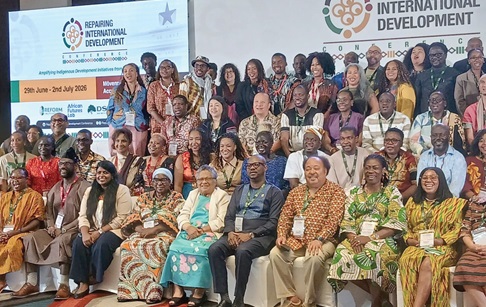
Speakers at an international development conference have underscored the role of reparatory justice in shaping the future of international development and fostering more equitable systems of global cooperation.
They said development systems and practices could move beyond extractive models towards approaches that recognised communities not only as beneficiaries but as authors of their own narratives and architects of their own futures.
They said the global development paradigm was in dire need of repair and recalibration, pointing out that they wanted development to be repaired holistically.
The speakers were the Founder and Director of Reform Initiatives, Makmid Kamara; the Co-founder and Executive Director of Africa Futures Lab, Dr Liliane Umubyeyi; the United Nations Rapporteur on Contemporary Forms of Racism, Racial Discrimination, Xenophobia and Related Intolerance, Dr Ashwini K.P.; the Chairperson of the Pawanka Fund, Dr Myrna Cunningham; the Head of Secretariat of the African Union Economic, Social and Cultural Council, William Carew and the Executive Chair of the Southern Africa Political Economy Series, Professor Ibbo Mandaza.
They were speaking at the Repairing International Development (RID) Conference organised by Reform Initiatives in partnership with Pawanka Fund, Deep South Solidarity Fund and Africa Futures Lab.
About 150 people from across the world attended the conference that sought to advance critical conversations on the future of international development in Africa by amplifying indigenous knowledge systems, community-led solutions and the voices and leadership of the global majority.
Mr Kamara said to reimagine development from a reparative justice lens meant centring inclusion and equality and added that it also meant rethinking and dismantling patriarchal systems of power and reversing extractive capital back to where it belonged.
Sustainable
He said for development to be truly sustainable and for the process to make meaning for communities, he proposed the adoption of what he called the Six Rs Framework, which were reconnection, re-education, repair, rebuild, resist and reimagine.
Explaining what each of the terms meant in the context of development, Mr Kamara said reconnection referred to development practices that reconnected people with their land, communities and identities. He added that it encompassed a set of actions and processes intentionally designed to reconnect local structures and communities that had been dismembered or disconnected by external interventions, enabling people to reclaim who they were and who they are.
For re-education, he explained that it referred to knowledge-building processes that liberated communities from the shackles of neoliberal thinking.
“Repair in this context means mending of wounds and harms that have been created by generations of foreign development interventions.
We're seeing a trend in which the demands and advocacy to develop or decolonise development are also now at risk of being hijacked by international development mercenaries.
The decolonising development agenda and campaign are also often disconnected from the processes of historical exploitation and extraction, which are often manifested through trade relations, public debt mechanisms, and illicit financial flows.
This, my comrades and colleagues, must change, which is why we need to reimagine.
We need to repair development,” he said.
Dr Ashwini said that although colonial rule had largely come to an end, many of the unequal structures associated with it continued to shape international economies, governance, trade and development financing.
She said that repairing development therefore required confronting not only contemporary inequalities but also the historical structures that continued to produce and perpetuate them.
Dr Umubyeyi said reclaiming begins by re-imagining the world beyond colonial structures and added that it required challenging the narratives that they inherited.
