
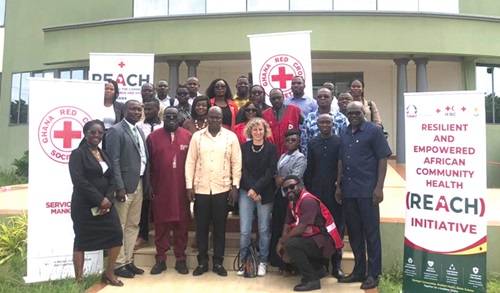
The Ghana Health Service (GHS), in partnership with the Ghana Red Cross Society and the International Federation of Red Cross and Red Crescent Societies (IFRC), has launched the Resilient and Empowered African Community Health (REACH) programme to strengthen primary healthcare delivery across four regions of the country.
The initiative will recruit, train and support more than 2,300 community health workers in the Volta, Western, Northern and Ashanti regions to improve access to essential healthcare services and strengthen community health systems.
Launching the programme in Accra, the Director-General of the GHS, Dr Samuel Kaba Akoriyea, said the programme came at a critical time when the country was implementing its free primary healthcare initiative, which sought to make healthcare accessible to all Ghanaians at the point of service.
"The REACH project is not a peripheral addition, but a key pillar in our efforts to transform primary healthcare delivery," he stated.
Dr Akoriyea explained that the project's objectives included deploying trained community health workers, increasing the uptake of life-saving health services through community empowerment and health literacy and building sustainable local delivery structures to support the Community-based Health Planning and Services (CHPS) programme.
He said the GHS would integrate the community health workers into national reporting and referral systems, while ensuring quality training and supervision to enhance disease surveillance and outbreak detection.
Dr Akoriyea commended the IFRC and the Ghana Red Cross Society for their commitment to improving health outcomes in Ghana.
He noted that the Ghana Red Cross Society's extensive volunteer network and longstanding presence in communities across the country had earned it a high level of public trust that would be instrumental to the programme's success.
Significant boost
The President of Ghana Red Cross Society, Dr Edward Donkor, said the programme aligned with the society's vision of achieving universal health coverage through strengthened primary healthcare services.
He described the recruitment and deployment of over 2,300 community health workers as a significant boost to Ghana's healthcare system, noting that the workers would support health promotion, disease prevention and early detection of disease outbreaks.
Dr Donkor further praised the programme's emphasis on integrating community health workers into national reporting and referral pathways, describing it as a key measure for ensuring sustainability and improving health data collection at the grassroots level.
Italian support
The Programme Officer of the Italian Agency for Development Cooperation (AICS), Carlotta Nanni, reaffirmed Italy's commitment to supporting Ghana's healthcare sector.
She said access to quality healthcare remained a fundamental human right and a key driver of sustainable development.
Ms Nanni explained that the REACH programme would help bridge healthcare access gaps in vulnerable communities by empowering local populations and strengthening frontline health services.
Two-year implementation
In an interview after the launch, the Director of Institutional Care Division of the GHS, Dr Lawrence Ofori-Boadu, said the programme would be implemented over a two-year period.
He explained that the initiative formed part of efforts to advance the President's primary healthcare agenda through partnerships that supported community-level healthcare delivery.
The REACH programme is expected to enhance community resilience, improve health literacy and expand access to essential health services while supporting Ghana's drive towards universal health coverage.
