
For years, some Persons with Disabilities (PWDs) and migrant returnees have struggled to find decent jobs and earn a stable income, not because they lacked ability or ambition, but because the opportunities they needed to build better lives remained out of reach.
While some spent years searching in vain for employment because of their disabilities, others returned home after unsuccessful migration journeys, unsure of how to rebuild their lives and livelihoods.
Setbacks, hope
Despite the setbacks, they refused to give up on the hope of a better future.
That hope has begun to bear fruit.
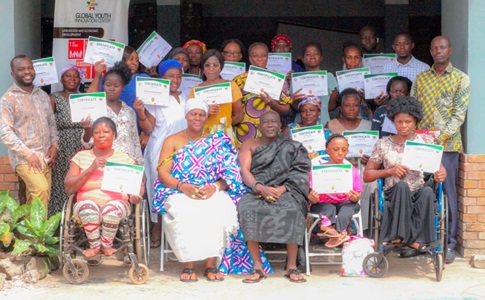
In the Sunyani Municipality 50 PWDs and migrant returnees from the Skills4Inclusion Project have graduated after completing four months of intensive, hands-on vocational and entrepreneurial training.
Of the 50 beneficiaries, 35 were PWDs, and 15 were migrant returnees, comprising 40 females and 10 males.
Implemented by the Global Youth Innovation Centre (GYIC), a non-profit organisation, the initiative is helping to rewrite the narrative for marginalised groups in Sunyani, the Bono Regional capital.
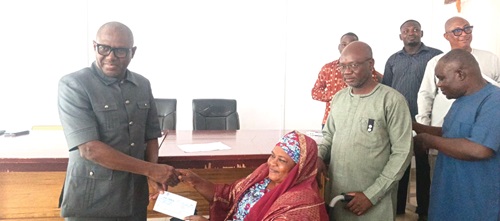
Alhaji Issah Nurah Dawaana, MCE for Wa, handing over a cheque to Kutum Abdullah, the Chairperson of the Wa Municipal Disability Association
The project is sponsored by German Sparkassenstiftung Western Africa under the Support for Local Training Providers in Ghana project on behalf of the Ghanaian-European Centre for Jobs, Migration and Development of the German Federal Ministry for Economic Cooperation and Development (BMZ), with co-funding from the European Union and implementation support from GIZ Ghana.
The four-month programme combined certified vocational training with entrepreneurship development, financial literacy, digital marketing, customer relations and business mentoring to prepare participants for self-employment and enterprise growth.
Already, some graduates have established businesses in confectionery, soap and detergent production, cosmetology and bead making, turning newly acquired skills into sustainable sources of income and renewed hope.
Increase local production
At the graduation ceremony, the Executive Director of GYIC, Eric Anorrey, said the initiative’s impact would extend far beyond its 50 beneficiaries through increased local production, job creation, stronger value chains and improved household incomes.
Mr Anorrey said the initiative would also help challenge long-standing stereotypes surrounding disability and migrant reintegration.
He stressed that success should not be measured only by the number of trainees, but by the lasting transformation in their lives.
The Bono Regional Director of the Labour Department, Charles Baah, described the project as a practical demonstration of the importance of inclusive skills development in strengthening Ghana’s labour market.
“The future of Ghana’s labour market depends on ensuring that every citizen, regardless of disability or migration history, has the opportunity to develop productive skills and participate meaningfully in the economy,” he said.
“Their achievements remind us that inclusion is not merely a social responsibility; it is an economic imperative for building resilient communities and a prosperous nation,” he said.
Selected graduates will also have the opportunity to access GYIC’s revolving interest-free microloan scheme to expand their businesses and enhance long-term sustainability.
Some of the beneficiaries told the Daily Graphic that the training had equipped them with practical skills, restored their confidence and renewed their hope for a better future.
PWDs in Wa Municipality receive support
In the Wa Municipality, 49 PWDs have received financial assistance and business equipment worth GH¢179,350 under the Persons with Disabilities (PWD) component of the District Assemblies Common Fund (DACF), aimed at improving livelihoods, promoting self-reliance, and reducing poverty.
The beneficiaries received support in the form of cash, educational assistance, healthcare funding, and equipment for income-generating activities.
The items distributed included welding machines, weaving looms, deep freezers, sewing and salon equipment, generators, and laptops to help beneficiaries establish or expand their businesses.
Speaking at the event, the Municipal Chief Executive (MCE) Alhaji Issah Nurah Dawanaa urged beneficiaries to use the support for its intended purpose, stressing that the intervention was designed to improve their economic well-being rather than provide short-term financial relief.
“This support is intended to alleviate poverty and help persons with disabilities establish sustainable livelihoods,” he said.
The Municipal Director of Social Welfare and Community Development, Gilbert Boi, who also serves as secretary to the Disability Fund Management Committee, explained that more than 500 applications were received, but only 49 applicants met the criteria after a rigorous vetting process.
He said 33 beneficiaries received support for income-generating activities such as petty trading, weaving, and small businesses.
Five beneficiaries were supported with educational assistance, including laptops and learning materials, while seven others received funding to cover medical expenses, including surgeries, medication, and hospital examinations.
In addition, he said GH¢10,000 was allocated to improve accessibility at Wa FM by constructing a disability-friendly entrance to enable persons with disabilities to access the radio station with ease.
The Representative of PWDs on the Common Fund Management Committee, Robert Dagurah commended the Municipal Assembly for ensuring that beneficiaries received both financial assistance and equipment.
The Chairperson of the Wa Municipal Disability Association, Kutum Abdullah, described the intervention as a significant milestone for persons with disabilities in the municipality.
One of the beneficiaries.
Zulfata Salifu, a professional weaver, said the support had revived her dream of establishing her own weaving business.
“I have the skills but lacked the materials to start working.
With the equipment I have received today, I can finally start my own weaving business. I am very grateful for this opportunity,” she said.
Writer’s email:
