
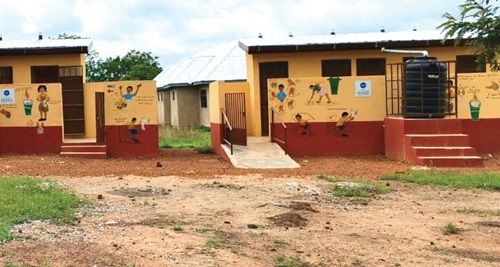
Pupils and teachers of the English-Arabic Basic School in Nandom in the Upper West Region can now heave a sigh of relief following the construction of a sanitary facility for them by SNV Ghana.
For years, the pupils and staff had to resort to open defecation or make do with the poorly maintained community toilets and were subjected to the constant threat of reptiles in nearby bushes as they responded to nature’s call.
The construction of an inclusive sanitation facility by the Healthy Future for All (HF4A) Project, implemented by SNV Ghana with support from the Helmsley Charitable Trust, therefore, came to them as a great relief and would transform sanitation, safety and impact learning at the school.
The facility
The facility, which includes separate sections for boys and girls, hand washing stations and a changing room for girls during menstruation, is already making a significant impact on attendance, academic performance and student confidence.
Speaking in an interview, the Headmistress of the school, Ayisha Ibrahim, described the situation before the intervention as critical.
According to her, the school had no toilet facility of its own and depended on a public toilet shared with the community.
“The children, especially the younger ones, could not use the facility comfortably because the openings were too large for them. Maintenance was also a challenge, so eventually we had to resort to using the bush,” she said.
“During the rainy season, the area gets flooded, and reptiles move around,” she recalled.
She said the lack of sanitary facilities affected teaching and learning as teachers always sought permission to go home whenever they had to attend to nature’s call.
“I personally had to do that several times. But now, that has become a thing of the past,” she said.
Menstrual hygiene
She also added that before the intervention, girls who experienced menstruation while in school often had no choice but to return home to change.
“Sometimes they would go home and not come back for the rest of the day. It affected their studies because lessons continued in their absence,” the headmistress explained.
With the provision of changing rooms for girls, she said they could now manage their menstruation hygienically and “we also keep sanitary pads and other necessities in the school to support them whenever the need arises,” she added.
According to Mrs Ibrahim, menstrual hygiene education provided through WASH Clubs had helped reduce stigma among students.
“The boys now understand what their female colleagues go through and offer support instead of teasing them.
The confidence level of the girls has improved tremendously,” she said.
A Form Two student, Khadijah Abdallah, recalled how pupils previously used nearby bushes or community toilets.
“The public toilets were not always clean, and some children had to go into the bushes.
That was dangerous because reptiles and other animals could harm them,” she said.
She noted that access to hand-washing facilities has also improved hygiene practices among students.
Khadijah said the girls’ changing room has been especially beneficial
“When girls experienced their menstrual periods, they often had to go home.
Sometimes they would not return because their homes were far away. Now we don’t need to go home anymore because we have the girls’ washroom here,” she said.
Another Form Two student, Abdul Samed Mohammed, said the facility had eliminated the dangers associated with open defecation and improved concentration in class.
“Before, some students would go home because they were uncomfortable or needed to change.
When they left, they missed lessons. Now they can use the facility and return to class immediately to continue learning,” he said.
Mrs Ibrahim expressed profound appreciation to SNV Ghana and its partners for the intervention and said measures had been put in place to ensure the facility remains functional for years to come.
Project manager
The Project Manager of the Healthy Future for All Project at SNV Ghana, Theresa Swanzy Baffoe, said the intervention was designed to improve hygiene, health and educational outcomes among children.
She explained that SNV had been operating in the Nandom area since 2015, with the Healthy Future for All project focusing on water, sanitation and hygiene interventions since 2022.
According to her, a total of 26 schools across the Nandom municipality were benefiting from the sanitation programme.
Each facility includes separate sections for boys and girls, with changing rooms provided to support menstrual hygiene management.
“The infrastructure is only the first step. We expect schools and communities to take ownership and ensure proper maintenance so that future generations can continue to benefit from them,” she said.
