
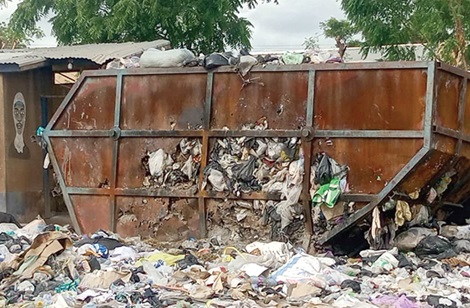
Worn-out refuse containers at designated waste collection points across parts of the Tamale Metropolis are contributing to poor sanitation, environmental pollution and heightened public health risks for residents living nearby.
Many of the containers, originally installed to promote proper waste disposal, have deteriorated over the years due to prolonged use and inadequate maintenance. Several have developed large holes in their sides, with rusted metal sheets allowing waste to spill onto the surrounding areas.
A visit by the Daily Graphic to refuse collection sites at Mohi Fong, Mohiyabihi, Nyohini and Kukuo revealed heaps of refuse scattered around the damaged containers, creating insanitary conditions and exposing residents to offensive odours and the risk of communicable diseases, including cholera.
In some communities, strong winds blow litter from the overflowing containers onto nearby roads and homes, while rainwater washes waste into drains, worsening environmental conditions and increasing the likelihood of flooding.
Contamination
A resident of Mohi Fong, Adam Osman, said the poor condition of the refuse containers had become a major source of concern for residents.
He explained that whenever strong winds swept through the area, waste from the dumping site was blown into nearby homes, contaminating food and water sources.
Mr Osman further said smoke from the frequent burning of refuse at the site affected nearby homes and polluted the air.
He warned that if the situation persisted, it could lead to an outbreak of diseases, particularly during the rainy season.
Delayed evacuation
Another resident, Jibrel Abdul Manan, blamed the situation on delays in evacuating refuse from the collection points.
According to him, waste had not been evacuated from some sites for about two months, forcing residents to dump refuse on the ground after the containers became full.
"When the containers are full, people have no option but to dump waste on the ground, which is later burnt.
The smoke pollutes the air and could cause respiratory diseases," he said.
Mr Abdul Manan appealed to the assembly to replace the damaged containers and ensure the timely evacuation of refuse to prevent further deterioration of sanitation conditions.
Assembly's response
The Public Relations Officer of the Tamale Metropolitan Assembly, Amadu Mustapha Zakari, acknowledged the problem and said steps were being taken to improve waste management in the metropolis.
He explained that the assembly was evaluating proposals from sanitation service providers through a competitive procurement process to award contracts for waste management.
Mr Zakari said the metropolis had been divided into eight sanitation zones, with each zone to be managed by a private contractor under the proposed arrangement.
Sanitation performance
The sanitation challenges in the Tamale Metropolis are reflected in national data.
According to the 2023 District League Table Report on Metropolitan, Municipal and District Assemblies, jointly produced by the National Development Planning Commission and UNICEF, only the Sagnarigu Municipal, Savelugu Municipal and Tolon District assemblies in the Northern Region were ranked for access to sanitation services.
The report also ranked the Northern Region 14th out of the then 16 regions, with a sanitation score of 38.4 per cent, highlighting the need for greater investment and improved waste management systems across the region.
Efforts to improve sanitation could start with the provision of sanitary bins to improve the conditions.
