
I first encountered Cameron Duodu not as the 89-year-old journalist and writer I would meet many years later, but as the author of a book I read as a secondary school student.
The Gab Boys, published by FONTANA LONDON (PAPERBACK) and ANDRE DEUTSCH LONDON (PAPERBACK), was one of those books that introduced me to the world of African literature.
I read it without imagining that, years later, I would find myself working at the Daily Graphic, the newspaper Duodu himself had once edited.
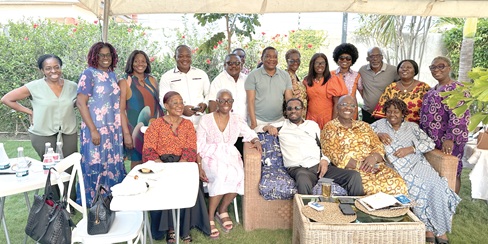
So when I found myself among about 20 carefully selected guests at his 89th birthday celebration on Saturday, September 5, it felt rather like meeting an old literary acquaintance whose work I had encountered long before I met the man.
Duodu hails from Asiakwa in the Eastern Region and began his education in a Presbyterian mission school. In those days, there was an interesting test of readiness for school: a child had to be able to stretch one hand over the head and touch the opposite ear.
Looking at Duodu's stature and height today, I can confidently guess that he had no difficulty whatsoever meeting that requirement when he reached school-going age.
Some people I know, however, were lucky they did not have to go through such a test.
Given their vertically challenged stature, they might have had to wait until about age 20 before the hand would finally find its way to the opposite ear.
But beneath the laughter was a man whose memory has become an extraordinary repository of Ghana's history.
Listening to Cameron Duodu narrate the past reminds you that history is rarely as neat as the textbooks make it appear.
Duodu's recollections add the human dimensions often missing from that chronology: wounded pride, broken relationships, rumours, unemployment, insults, injustice and the little tensions that can eventually ignite a nation.
He took us back to the Ghanaian soldiers who returned home after fighting in the Burma Campaign during the Second World War.
They expected recognition and fair treatment. Instead, some encountered a rather hostile social environment.
There were even derogatory remarks about insects they were alleged to have brought home — supposedly neither lice nor bedbugs, but mysterious creatures somewhere in between.
One can almost imagine the jokes and taunts that circulated.
Lost Loves
But there was a more serious source of resentment.
While the soldiers were away, some young men had entered relationships with their wives and girlfriends.
Communication with soldiers on the war front was difficult, and some young men apparently assumed the soldiers might never return.
When they did return, the ex-servicemen were understandably angry.
They referred to the young men as “kwasankobi” — useless fellows — and, in some cases, reportedly brutalised them.
Then came another grievance: the treatment of British and Ghanaian ex-servicemen.
While British ex-servicemen had received what was regarded as their due ex gratia payments, their Ghanaian counterparts felt cheated.
The anger simmered.
On February 28, 1948, the ex-servicemen marched peacefully towards Christiansborg Castle to present their grievances to the Governor.
Before they could secure the audience they sought, an armed policeman opened fire. Not one shot.
Not two shots.
But three! Sergeant Adjetey, Corporal Attipoe and Private Odartey Lamptey were killed. And Ghana exploded.
The February 28 killings had an extraordinary effect because the policeman who pulled the trigger was a white man, a Superintendent Imray.
Just imagine what an explosive effect the murderous action of a white man (who probably didn't fight to save Britain from the Germans!) had on Ghanaian ex-soldiers many of whose comrades-in-arms had lost their lives fighting against the Germans and the Japanese in East Africa and Burma!
The end of British rule in the Gold Coast was thus inevitably underwritten by those shots at Osu, which the Governor in the Christiansborg Castle may not even have heard!
The deaths triggered riots and widespread destruction.
The ex-servicemen put on their uniforms, and looting began. British-owned businesses, particularly those associated with the United Africa Company (UAC), became targets.
In some cases, even employees of businesses being looted reportedly joined the looters.
Every ex-serviceman became an ardent ‘propagandist’ for Kwame Nkrumah and his Convention People's Party (CPP) when they split from the United Gold Coast Convention and campaigned all over Ghana under the catchy slogan, "SELF-GOVERNMENT NOW!"
Newspaper reports of the disturbances further inflamed the situation.
Duodu suggested that while some of the journalism could be described as irresponsible, it was politically useful to those seeking to mobilise the population against colonial rule.
He was also fortunate to have had unusual access to information.
As a young man, he stayed with an uncle who was a local postmaster giving him a window into the information circulating at the time.
Beyond the facts
That is what makes listening to Duodu so fascinating. He does not merely tell you what happened. He tells you how people felt when it happened.
He also recalled the night Ghana became independent. As a young journalist with the New Nation, he was close enough to Kwame Nkrumah to observe events around the podium.
The crowd was unusually large.
At one point, Nkrumah reportedly turned to Krobo Edusei and said: “Krobo, come and psyche up the people for me.” Krobo Edusei needed no second invitation.
“Tsooboi! T-s-o-o-o-o-b-o-o-o-i-i-i-!!” The crowd responded with an explosive “Yeee!”
Then Nkrumah began: “At long last, the battle is ended . . .”
History had found its voice. Yet Duodu also reflected on the promise of independence and the question that continues to haunt us: Have we created the African personality Nkrumah spoke about?
He acknowledged Nkrumah's achievements — Akosombo Dam, the Tema Motorway, the Black Star Line, the Atomic Energy Commission, among many others — but pointed to the “painful contradiction” of a leader who had experienced imprisonment without trial later presiding over a system in which people could also be detained for years without trial.
And then came another observation that struck me: Ghana is too polarised. Interestingly, that polarisation did not begin today.
Its roots can be traced to the years leading up to independence, when competing political and social interests were already creating deep divisions.
Cameron Duodu’s gracious daughters, Yvonne, Maureen and Sophie, together with members of a year group of ex-students of Wesley Girls High School, Cape Coast, hosted a gathering that was as warm and intimate as one could imagine.
It was a small gathering, perhaps deliberately so.
But sometimes 20 people in a room with an extraordinary storyteller can be more valuable than a stadium full of people.
The event was a special visit by the past students who felt honoured to have his daughter, Yvonne Badoo (nee Duodu) as their mate.
They came to see in person, the man they had only met through his articles in the media, and was editor of the Daily Graphic for nearly one year, in 1970.
Basically, they came to inform him that they were proud of having been the mates of his daughter and to offer him gifts in appreciation of his contribution to the growth of a virile media establishment in their beloved country, Ghana
Duodu remains remarkably youthful — the kind of 89-year-old who makes you wonder whether somebody has tampered with the calendar.
More importantly, he remains intellectually alert and wonderfully capable of connecting the past to the present.
His final message was as powerful as it was simple: Ghana is one of the best countries.
We have no reason to have poor people.
But manna is not going to fall from heaven.
We have to create it ourselves.
We do not have to be greedy, cheat or amass wealth at the expense of the ordinary person.
Perhaps that is the real lesson from the gathering.
Our politicians, journalists and other professionals need to listen to people who lived through our history. History is not only in textbooks and archives.
It lives in the memories of people such as Cameron Duodu.
At 89, he is not simply celebrating longevity.
He is carrying memories.
We should find him, listen to him and record his stories.
Because when history speaks in a living voice, we should not wait for it to become an archive before we start listening.
— The writer is the Night Editor of Daily Graphic
