

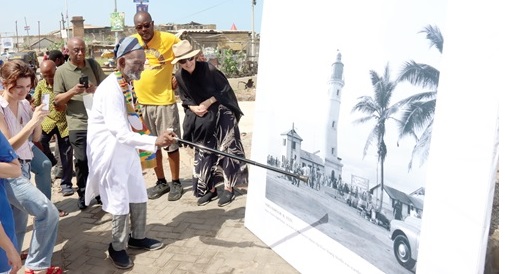
The first time I encountered the Willis E. Bell Archive was somewhere in September 2025 at Mmofra Place in Accra.
I remember leaving the exhibition with the feeling that I had stumbled upon something much larger than a collection of old photographs.
The images were windows into a Ghana that many of us knew only through stories: the confident young nation emerging from colonial rule, the political theatre of independence, the changing face of Accra, village life, children at play, workers at construction sites and the personalities who occupied the centre of the national stage.
I wrote about the launch of the archive for my Going Places column, describing it as a public inheritance - a reminder that without memory, there is no future.
Now, barely a year later, that inheritance has travelled from Accra to Arles in France. And what a journey!
The Willis Bell Archive is currently part of Ghana! Dreaming Independence 1957–1976, a major exhibition at the 57th edition of Les Rencontres d'Arles, widely regarded as one of the world's great photography festivals. The exhibition opened in July and runs until October 4, 2026.
For Ghana, this is more than an exhibition abroad. It is a remarkable cultural achievement. For the first time in its 57-year history, Rencontres d'Arles is giving Ghana such prominent attention.
That alone should make us pause and consider what it means for a country's visual heritage to move from an archive in Accra into the international spotlight.
The exhibition, curated by Ghanaian-French curator Damarice Amao, looks at the period surrounding Ghana's independence and the decades that followed. But it does not merely invite visitors to look backwards. It asks how photography helped a newly independent country imagine itself.
When Ghana became independent on March 6, 1957, it was not simply changing political status. It was also attempting to construct a new national identity. Photography became one of the instruments through which that identity could be recorded, projected and remembered.
Willis E. Bell understood this perhaps better than most. Born in Burma to American missionary parents in 1924, Bell had an unusual route to Ghana.
He was educated in India, travelled as a Merchant Navy sailor and worked for Drum magazine in apartheid South Africa before arriving in Ghana around the country's independence period.
From the late 1950s into the 1970s, his camera followed a nation in transition. He photographed Kwame Nkrumah and other political figures. He photographed ceremonies and ordinary people.
He recorded architecture, work, fashion and the everyday business of living. His pictures appeared in official publications and even on currency.
But perhaps his greatest contribution was that he photographed Ghana not simply as a foreign visitor might photograph an African country, but as a society undergoing a profound transformation.
At the Arles, Bell's photographs now appear alongside the work of pioneering Ghanaian photographers such as Felicia Abban and James Barnor, while also entering into conversation with contemporary artists including Carlos Idun Tawiah, Rita Mawuena Benissan, Denyse Gawu-Mensah and Postbox Ghana.
The result is a conversation between generations. Damarice Amao puts it succinctly.
‘‘The exhibition explores how photographic cultures helped create national unity, while bringing historical images into dialogue with contemporary artists examining the meaning and resonance of that visual memory today.’’
This is where the idea of tourism becomes interesting.
We often think of tourism as people travelling to see monuments, beaches, castles and landscapes. But cultural tourism is also about travelling into stories.
Arles itself understands this very well. Every summer, the historic French city becomes a global meeting place for photography.
More than 50 official exhibitions occupy heritage locations, including chapels and 12th-century cloisters. For several months, the city effectively becomes a world capital of photography.
To have Ghanaian history occupying space in that environment is a form of cultural visibility that cannot easily be measured in visitor numbers.
At the 2025 launch of the Willis Bell Archive at Mmofra Place, Professor Samuel Ntewusu, Director of the Institute of African Studies, warned about the chronic neglect of record-keeping in Ghanaian institutions.
His concern was simple but profound: if we do not preserve our records, future generations may inherit gaps where their history should be.
The journey of the Bell photographs to Arles gives that warning a new urgency. An archive that might once have been seen as a collection of old negatives has now become part of a global conversation about photography, independence and nationhood.
Kwame Crentsil, Project Manager of the Willis Bell Archive, represented the archive in Arles during the opening week. His participation was supported by the Institut français du Ghana, under the direction of Jérémie Desjardins.
Crentsil also joined a panel on archives at Cour Fanton, alongside contemporary Ghanaian contributors Carlos Idun Tawiah and Rita Mawuena Benissan, moderated by scholar Margaux Lavernhe.
His observation deserves attention: ‘‘Photography in post-independence Ghana was not a luxury but an act of nation-building.’’
That may be the most important lesson of the Bell Archive.
