
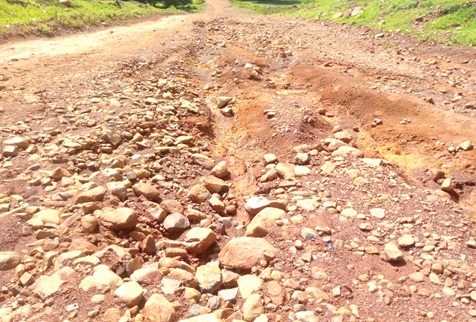
For decades, the people of Nabdam in the Upper East Region have endured deplorable road networks, with the Asonge-Pelungu-Sakoti road becoming a painful reminder of years of neglect and a major barrier to the development of the district.
Pregnant women, the sick and the elderly have had to endure painful and risky journeys on the rocky, pothole-ridden road to access health care, while farmers struggle to transport their produce to markets, losing income due to delays and the poor state of the road.
The situation, residents say, has affected almost every aspect of life in the district, from healthcare delivery and education to trade and agriculture.
The Nabdam District, which is home to thousands of residents, largely farmers and traders, has no tarred road within its communities, except the Bolgatanga-Bawku Highway, which passes through the district.
Demonstration
It is against this background that residents of Nabdam last Tuesday embarked on a peaceful demonstration to present a petition to President John Dramani Mahama through the Nabdam District Chief Executive (DCE), Francis Yenwona Tobig, demanding urgent action to fix the roads.
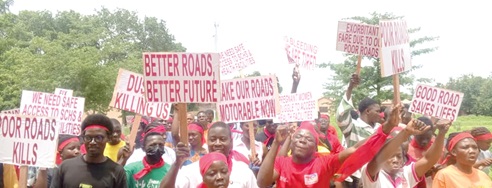
The residents held a peaceful demonstration calling for attention to the state of the roads.
The demonstration brought together residents from different communities across the district, who marched to express their frustration over what they described as years of neglect of the district's road infrastructure.
The petition was read by Albert Dok Dong, one of the convenors of the demonstration, and presented to the DCE on behalf of the residents.
Poor roads affecting development
In the petition, the residents said the deplorable condition of the Asonge-Pelungu-Sakoti road and other community roads had become a major setback to the development of Nabdam.
They said the road had deteriorated considerably, making transportation difficult, particularly during the rainy season.
The residents also complained about inadequate culverts, which they said allowed floodwaters to wash away sections of the road.
They further noted that the poor road conditions had increased vehicle maintenance costs for transport operators, resulting in higher transport fares for residents.
Farmers, patients bear the burden
The residents said the bad road network had had a devastating effect on agriculture, which remains the backbone of the district's economy.
They explained that farmers often struggled to transport their produce, particularly tomatoes, to market centres on time, resulting in post-harvest losses and reduced incomes.
They also raised concerns about challenges faced by sick persons, particularly pregnant women, the elderly and critically ill patients in accessing healthcare facilities because of delays caused by the poor road.
The petitioners added that schoolchildren and teachers also faced constraints travelling to and from school, especially during the rainy season, affecting attendance and academic performance.
Demand
The residents appealed to the government to immediately begin the construction of the Asonge-Pelungu-Sakoti road, describing it as a key commercial route in the district.

Albert Dok Dong (right), one of the convenors of the demonstration, presenting the petition to Francis Yenwona Tobig (left), the Nabdam District Chief Executive (DCE), while others look on.
The petitioners also called on the Ghana Highway Authority and the Department of Feeder Roads to undertake an urgent technical assessment of the road to pave the way for its construction.
They further appealed to the authorities to include Nabdam in future road development projects in the Upper East Region and undertake temporary maintenance works to ease the hardship of commuters while awaiting full-scale construction.
DCE assures
Receiving the petition on behalf of the government, the Nabdam District Chief Executive (DCE), Francis Yenwona Tobig, acknowledged the concerns raised by the residents, describing their demonstration as a legitimate way of drawing attention to the challenges confronting the district.
He said the Asonge-Pelungu-Sakoti road was a concern shared by the Assembly and the Member of Parliament for the area, adding that efforts had already been made to get the road fixed.
According to him, consultancy work had been completed on the road, and the project had been submitted for consideration, with the next major step being its inclusion in the national budget for funding.
The DCE explained that the ongoing grading and maintenance works on some sections of the road were temporary measures by the Assembly to reduce the difficulties faced by residents while awaiting the commencement of the main construction works.
He assured the residents that the Assembly would continue to engage the relevant authorities to ensure that the road was constructed, stressing that the government was committed to addressing the concerns raised in the petition.
Mr Tobig added that efforts were also being made to improve other road networks in the district, including the Kongo-Pitanga road and other strategic routes, to enhance connectivity and promote development.
He urged residents not to see the temporary maintenance works as a substitute for the main project but rather as an interim measure to ease travel while the Assembly pursued a permanent solution.
