
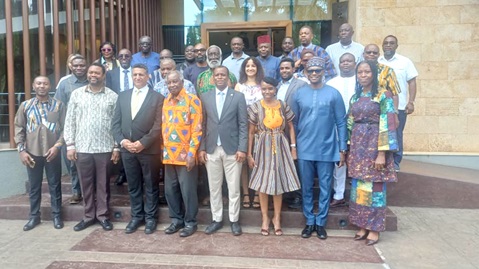
The Secretary-General of the Ghana Commission for the United Nations Educational, Scientific and Cultural Organisation (UNESCO), Prof. Osman Tahidu Damba, has urged Africans to own their history and ensure their achievements and contributions are documented from an African perspective.
He said such efforts were crucial to addressing historical misrepresentations, safeguarding Africa’s intellectual heritage and providing future generations with an accurate account of the continent’s role in shaping global civilisation.
Professor Damba, who was addressing the opening of a three-day Workshop on Encyclopaedia Africana Volume IV at Peduase in the Eastern Region last Wednesday, explained that the Encyclopaedia Africana was conceived as a continental intellectual project to ensure that Africa's history, achievements and contributions were no longer interpreted primarily through external lenses, but through the experiences, voices and perspectives of Africans themselves.
He said the initiative would help document and showcase Africa’s contributions to science, technology and innovation, while strengthening the continent’s intellectual sovereignty and historical consciousness.
“Africa's history, achievements and contributions would no longer be interpreted primarily through external lenses, but through the experiences, voices and perspectives of Africans themselves,” he emphasised.
African contribution
The event, which marked a significant milestone in the implementation of the Encyclopaedia Africana Project (EAP), following its continental operationalisation and the development of Volume IV, brought together scholars, scientists and researchers from across Africa and the diaspora.
They are to develop the conceptual framework, thematic structure, editorial standards and contributor database that would guide the production of the volume.
Professor Damba, who represented the Minister of Education, Haruna Iddrisu, observed that the Encyclopaedia Africana, conceived by Dr W.E.B. Du Bois and championed by Ghana's first President, Dr Kwame Nkrumah, remained one of the continent's most significant Pan-African intellectual initiatives.
He stressed that the encyclopaedia had become even more relevant at a time when nations across the world increasingly recognised knowledge, innovation, science and technology as critical drivers of development and competitiveness.
Historical responsibility
The Director of the EAP Secretariat, Christian Dovi, said the workshop was being held with a deep sense of historical responsibility and represented a return to the intellectual vision of Pan-African pioneers.
He said that the Encyclopaedia Africana was more than a collection of articles, describing it as an enduring intellectual monument that would preserve African knowledge, celebrate the continent’s ingenuity and inspire future generations.
A former Vice-Chancellor of the University of Ghana, Emeritus Professor Ivan Addae-Mensah, for his part, traced the history of the Encyclopaedia Africana project and said it originated in 1960 when Dr Nkrumah invited Dr Du Bois to help document African history from an African perspective, and correct colonial distortions.
He said that despite the challenges that followed its launch in 1962, including the death of Du Bois and the overthrow of Nkrumah, the project had produced three volumes that continue to serve as authoritative records of African history.
