
Ghana’s budget openness and accessibility score has declined sharply to 25 per cent in the 2025 Open Budget Survey (OBS), down from 30 per cent in 2023, raising concerns about access to key budget information.
The OBS is a comparative, fact-based research instrument that assesses public access to central government budget information, conducted by the International Budget Partnership (IBP) and independently peer-reviewed. It assesses three dimensions — transparency, public participation, and oversight.
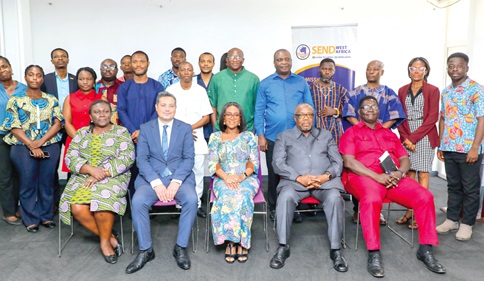
The report presented in Accra by SEND Ghana revealed that the country’s transparency score rose marginally from 17 per cent in 2023 to 22 per cent in 2025.
The score is, however, far below the 61-point benchmark considered “sufficient” for publishing adequate budget information.
Among the four sub-regional countries that participated — Ghana, Nigeria, Gambia, and Sierra Leone — Ghana’s transparency performance was the lowest.
Transparency is measured by the publication of eight key budget documents.
As of December 31, 2024, only five were available online. They were the pre-budget statement, enacted budget, mid-year review, year-end report, and audit report.
The report indicated that the Executive Budget Proposal and Citizens’ Budget were not published on time, while the in-year report was produced but not made public.
Comprehensiveness
Explaining the comprehensiveness of the budget, the Programme Officer of SEND Ghana, Mohammed Tajudeen Abdulai, said comprehensiveness was also weak.
He indicated that only the audit report and mid-year review met the 61-point pass mark.
The year-end report and enacted budget scored 50 per cent, while the pre-budget statement scored 28 per cent.
He recommended publishing the Executive Budget Proposal, Citizens’ Budget and year-end report online and on time, disclosing debt levels and multi-year expenditure projections in the pre-budget statement, and enriching the enacted budget with detailed revenue categories.
Public participation
For public participation, the score improved from 22 per cent in 2023 to 33 per cent in 2025, beating Nigeria among the four countries.
“Participation was highest at the budget formulation stage at 33 per cent, and at the audit stage at 33 per cent.
Approval-stage participation rose from zero in 2023 to 11 per cent in 2025, while implementation-stage participation stayed at zero per cent,” Mr Abdulai said.
Gaps identified included the absence of formal mechanisms for public engagement during implementation.
Oversight
On oversight, Mr Abdulai stated that the composite oversight score for Parliament and the Audit Service stood at 33, with Parliament scoring 28 per cent and the Audit Service 44 per cent. both of which fell short of the OBS pass mark of 61.
To strengthen oversight, the report recommended that Parliament must debate budget policies before the proposal is laid, publish committee analyses online and on time, and be consulted before funds are shifted by the Executive.
For the Audit Service, it suggested stronger parliamentary or judicial approval for the appointment or removal of the Auditor-General and review of audit processes by an independent fiscal institution, which Ghana currently lacks.
Focus
The Chairperson of Parliament’s Public Accounts Committee (PAC), Abena Osei Asare, said the value of the OBS lay in the questions it raised about budget transparency and oversight, not just the scores.
She urged analysts to also highlight what drove the score from 51 per cent in 2015 to 56 per cent in 2021, so lessons could be applied to current gaps.
“If there was an improvement from 51 to 56, something happened.
That should also be highlighted so that we can do the needful,” she said.
Ms Osei Asare stressed that abiding by the Public Financial Management Act was key, arguing that much of the required budget information, including revenue categories and debt data published monthly by the Bank of Ghana, already existed in budget appendices, but needed to be made more citizen-friendly.
She admitted Parliament’s oversight score of 28/100 showed “a lot of gaps”, especially in publishing committees’ work online.
However, she stressed improvements such as Parliament TV and live coverage of PAC sittings.
The PAC Chairperson called for joint timelines between the Ministry of Finance and Parliament for budget publications, and for Parliament to approve any reallocations by the Executive to reduce fiscal risks.
She also proposed a scorecard to track the implementation of the Auditor-General’s recommendations by ministries, departments and agencies.
