
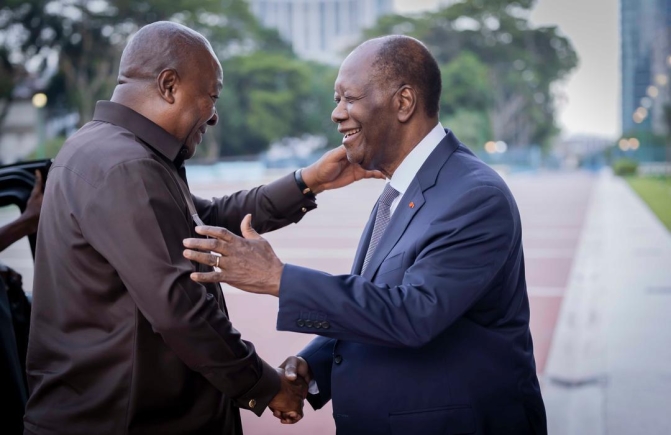
Ghana and Côte d'Ivoire have agreed to harmonise their cocoa farm-gate pricing policies, a landmark move designed to improve the income of farmers, stabilise the market and end unhealthy competition across their shared borders.
The commitment was contained in a Joint Declaration signed by President John Dramani Mahama and Côte d'Ivoire’s President, Alassane Ouattara, at the Côte d'Ivoire-Ghana High-Level Summit on the Future of the Cocoa Economy in Abidjan yesterday.
The two countries together account for about 60 per cent of global cocoa production.
Under the agreement, the two governments will adopt a common framework with shared principles and methodology for determining producer prices.
They will also reinforce alignment between their Trading Rooms and strengthen market intelligence to ensure transparency and better returns for farmers.
“Fair remuneration for farmers is a pillar of the sector’s sustainability and a requirement for economic justice and social stability,” the two leaders declared.
They stressed that placing farmers at the centre of the cocoa value chain was critical for the long term survival of the sector.
2018 Declaration
The declaration builds on the 2018 Abidjan Declaration and the achievements of the Côte d'Ivoire-Ghana Cocoa Initiative (CGCI), including the introduction of the Living Income Differential, harmonised price announcements, traceability systems and the African Regional Standards for Sustainable Cocoa.
The two countries also pledged to deepen scientific cooperation to fight Cocoa Swollen Shoot Virus Disease (CSSVD), which continues to threaten farms.
Beyond pricing, Presidents Mahama and Ouattara agreed to expand local processing and value addition, while promoting the consumption of cocoa products made in Africa.
They further announced plans to open the CGCI alliance to other African producing nations to strengthen cooperation in research, advocacy industrialisation and intra-African trade.
The leaders observed that while Africa produced about 80 per cent of the world’s cocoa, the continent still captured only a marginal share of the multi-billion-dollar chocolate value chain.
They warned that price volatility, illegal mining, climate change, the growing use of cocoa substitutes and increasingly strict international sustainability requirements remained major threats to the sector.
The farm-gate price harmonisation is expected to strengthen the bargaining position of the two countries in global markets and ensure cocoa farmers receive fair and decent rewards for their labour.
