
The rainy seasons remain nature’s oldest kindness to humankind.
Long before we built cities or wrote laws, we learned to lift our faces to the sky with joy and wait as the clouds gather and finally break to give us rain to cool the earth and water our crops for a bountiful harvest.
But today, the same rain brings us pain due to greed and uncontrolled human activities.
To satisfy our selfish interests, we forget to ask why Illegal mining has desecrated our lands and turned the rain into a monster taunting us instead of the peace that comes with the beautiful torrent of nature.
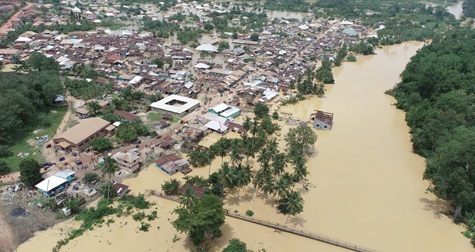
In the Western and Central regions, from Sekondi to Samreboi, from Cape Coast to Moree, Yamoransa and other parts of the country, we face a cruel irony; the same rivers that once sustained life are now swallowing homes, farmlands and roads, disrupting socio-economic activities and even claiming lives.
Consequences How did we get here?
Over the years, the Western and Central regions have recorded floods, but not to this magnitude.
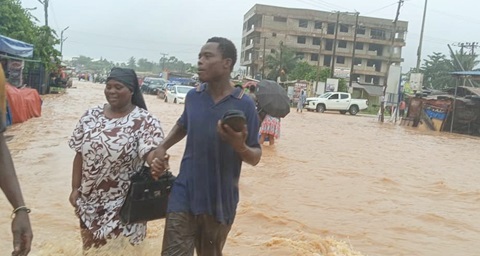
Parts of Cape Coast were also submerged after the rains
We have seen illegal mining of gold and industrial minerals, but not with this impunity and enormity.
What we are seeing today could best be described as reaping what we excavated and now we the consequences of these negative environmental activities are catching up with us in the cities.
In most of the communities, land owners and elders take nice gifts and fail to act; the municipal and district assemblies fail to enforce the laws and watch unconcerned as the illegal financiers and the diggers, who are mostly migrants, invade the communities and destroy the environment.
Migrants
In 2024, a study by the University of Mines and Technology revealed that in major galamsey hotspots such as Wassa Amenfi, Amansie West, and Atiwa, about 60 to 70 per cent of illegal miners were not indigenes.
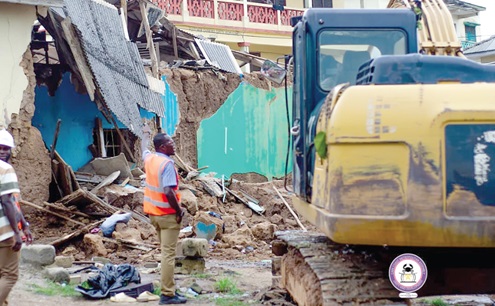
Some structures considered to contribute to the flooding being demolished
Aside from a few who are Ghanaians from other regions in Ghana, the rest crossed borders from Burkina-Faso, Togo, Nigeria, Côte d’Ivoire, and as far as China to mine, and therefore do not care what happens to the environment after the illegalities.
But the communities have their share of the blame, as many connive to give out lands to these destroyers.
In the end, the local cost to the people is enormous and painful, as farmlands, rubber and cocoa plantations are destroyed.
The sad truth is that the effects impact everyone, the farms, schools, hospitals and businesses are in an environment damaged and polluted with heavy metals and arsenic activated into water bodies.
Again, in all the affected communities, there are elders, politicians, chiefs, religious and other leaders, who watched and allowed illegal miners to strangle rivers and clear forests for a few grams of gold to satisfy the selfish interests of people.
In Samreboi, excavators were driven through the forest in search of gold, disrupting the Samrae and Tano rivers.
As a result, when rainwater from adjoining districts and regions on its normal course at a high current to the ocean reached the town, it could not continue its journey to the Ankobra, Shama or Jomoro estuaries; therefore, with force, the flood swells and found its level in the communities.
As we grieve and sympathise with the victims, it is important to see this year’s flooding not only as natural disasters; these are consequences for tampering with the earth.
Environmental crime
Until we treat galamsey, illegal sourcing of industrial materials such as sand and stone, building on waterways, filling of wetlands and winning at the beaches, mining in forest reserves and rivers as an environmental crime, we will continue to see floods, keep mopping and scooping as the floodwaters find their level.
Hydrologists at Kwame Nkrumah University of Science and Technology (KNUST) are said to have found that the cross-sectional flow area of the Pra River at Twifo Praso had shrunk by 62 per cent since 2018 due to siltation.
Lost forest cover
In the mining regions, districts and communities, galamsey operators have cleared over 34,000 hectares of forest reserves since 2020, per data from the Forestry Commission.

Daniel Darlington Atitso — Western Regional NADMO Director
The Western Region alone is said to have lost more than 19,000 hectares as a result.
The rain that should have soaked into the roots now slips straight into towns, destroying farms, uprooting national installations, claiming lives and properties.
Today, we are witnessing floods in Accra, Takoradi, Sekondi, Samreboi, Apremdo, Ellembelle, Cape Coast and many other cities across the country.
Threat to food security
Already, the activities of illegal miners of gold and other industrial materials pose a serious threat to agriculture, as topsoil is completely eroded, affecting produce.
In the case of Samreboi, the Tano and Samrae rivers burst their banks after some hours of rain; in addition, the river receives water from upstream.
The surrounding buffers, which were once forest, but now a moonscape of pits that hold heavily polluted water, could not hold the waters, causing the flooding.
Economic loss
Floodwaters in the Western and Central regions turned areas that hitherto did not flood into massive ponds, claiming more than 20 lives, halting transportation and other economic activities.
The situation was compounded by buildings on waterways.
The most convenient route to and from Accra-Cape Coast-Takoradi-Elubo, and to other countries, such as Cote d’Ivoire, Liberia, Sierra Leone and then to the Ashanti Region is through Yamoransa Junction, but due to such actions and inactions, the stretch now floods, resulting in long vehicular traffic.
A journey from Takoradi to Accra that took drivers three to four hours extended to between seven and 10 hours, with some commuters spending the night on the road.
The situation disrupted economic activities and impacted incomes.
The dangers of not speaking out about these environmental crimes will soon become a dangerous price to pay.
Natural and biblical laws
An African proverb says, the present generation did not inherit the earth from our ancestors; we borrow it from our children yet unborn, hence the need to treat the earth well. It was not given to us by our parents; it was loaned to us by our children.
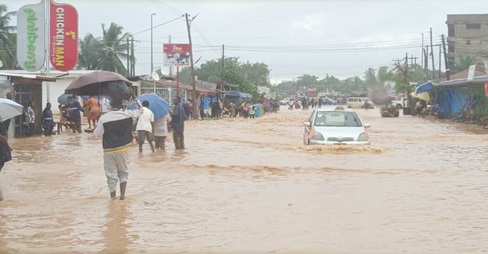
The floods disrupted socio-economic activities
Even the Bible in Numbers 35:33-35 reflect on ecological responsibility, noting that degrading the earth has moral and divine consequences.
"You shall not pollute the land in which you live... You shall not defile the land in which you live, in the midst of which I dwell."
Unprecedented
The Western Regional Minister, Joe Nelson, acknowledged that human activities largely caused the situation at Samreboi and other parts of the region.
“It rains every year, but this year’s havoc caused by the rain is unprecedented.”
Historically, he said, the Tano River and other water bodies swell, but not to the extent of flooding the communities.
“In the past, there were no mining activities in the Tano River; it was alive and flowed freely into the ocean.
Nobody diverted the river, but today, people with impunity enter the river, mount machines and mine while others divert this same river to their illegal mining sites, tempering its flow,” he stated, warning that the regional security council would work with related agencies to curb the menace.
Mr Nelson said that, as the security clampdown on the illegal activities, it was time for all to speak out and check the illegalities at the community level, adding, “From what we have seen, it seems if someone is misbehaving and acting in a way that will affect the community, we don’t care.”
“That is wrong, and today, we can all see the results of our refusals to speak. It is time for us to rise and defend the communities and the environment,’ he stressed.
NADMO
The Regional Director of NADMO, Daniel Darlington Atitso, described the situation as terrible and avoidable, and urged the people to stand against activities that erode progress and cause havoc.
Mr Atitso said the focus is immediate evacuation, “We at NADMO are doing our best to contain the situation, our prime focus is to ensure the safety of the victims as we support them.”
“We, as a primary state agency responsible for managing disasters, emergencies, and similar crises, are committed to bringing immediate relief to disaster victims, coordinating the resources of the state institutions, and collaborating with those who are supporting us to manage the situation,” he said.
A member of the Samreboi community, Emmanuel Donkor, said the recent floods were the first in the community and that “the situation is such that many residents have been displaced, all their belongings have submerged, many small businesses have lost their wares.
“What we need now is support from the affected region coordinating councils and government to enable us to have a decent place to sleep for now and food to eat because we have lost everything,” he said.
