
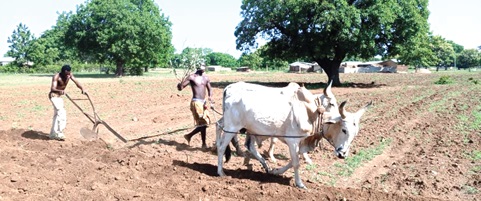
For almost a month now, 42-year-old Ziyaba Yen and many of his fellow farmers in the Dagliga community in the Nabdam District of the Upper East Region have watched their hopes for a good farming season gradually fade.
Although a few farmers in low-lying areas have benefited from the early rains, Mr Yen and other farmers in rocky and upland communities, particularly in the Nabdam, Talensi, Bolgatanga East and parts of the Bawku West districts, are struggling to continue with their farming activities due to the prolonged dry spell.
Each morning, Mr Yen, like his colleagues, walks to his farm hoping for rain to chase him back home, but he is disappointed every day and returns with his clothes dry, watching his young millet plants struggle to survive under the scorching sun.
Unlike last farming season, when Mr Yen and other farmers across much of the Upper East Region had completed sowing by this time of the year and were already looking forward to harvesting their early millet, this season is different, and farmers say they are becoming more worried by the day.
"We thought the rains had settled, so everyone rushed to prepare their land and sow, but for almost three weeks after planting, there has been little or no rain.
Some of our seeds failed to germinate and those that did are struggling. Many farmers have not even been able to plough their lands," Mr Yen said.
Farmers worried
A maize and millet farmer from Logre in the Nabdam District, Thomas Kolog, said the prolonged dry spell that followed sowing had dashed their hopes.
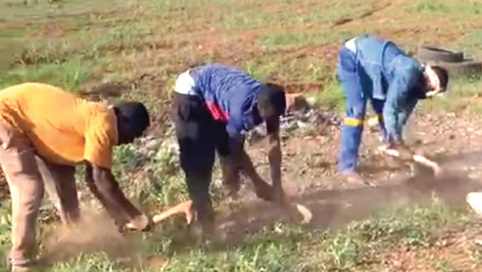
Some farmers in the Dagliga weeding their farm amid dust due to the prolonged dry spell
"For more than three weeks after sowing, there has been little or no rain.
The soil has become too hard and many of us cannot continue planting," he said.
He explained that many farmers who planted maize immediately after the first rains were now watching helplessly as their crops wilted under the scorching sun.
Another farmer from Zuarung-Morshe in the Bolga East, James Ayamga, said the lack of rainfall had also made it difficult to carry out weeding on farms where crops had germinated.
"Weeds are competing with the crops, but the ground is too dry to weed effectively.
If the rains continue to delay, many farmers may lose a greater portion of their harvest.
In fact, we should have been preparing to harvest the early millet by the middle of this month, but as it stands, that is not possible," he lamented.
Rocky terrain worsens situation
A farmer from Tong-Zug in the Talensi District, Patrick Nyabil, said communities located on rocky terrain were experiencing more severe conditions because the shallow soils dried up quickly after every rainfall.
"In the valleys, some farmers are managing because the soil retains moisture, but here on the rocky lands, everything dries up within a few days.
Several farmers have not even started ploughing because there has not been enough rain to soften the land," he said.
According to him, many households depend entirely on rain-fed agriculture, and any prolonged interruption in rainfall directly threatens their livelihoods.
He warned that if the current weather pattern persisted, farmers would either reduce the acreage under cultivation or abandon some fields altogether.
Fear of poor harvest
The farmers said inconsistent rainfall had become a recurring challenge in recent years, making it increasingly difficult to determine the right time to plant.
They feared that lower crop yields would not only affect household food supplies but also reduce incomes, making it difficult for many families to cater for education, healthcare and other basic needs.
Potential losses
The Upper East Regional Focal Person and National Secretary of the Peasant Farmers Association of Ghana (PFAG), Ibrahim Jambeidu, described the current rainfall pattern as worrying, saying it had left many farmers, particularly in the Nabdam and Talensi districts, badly affected.
He said if the rains failed to stabilise in the coming weeks, thousands of farmers could lose substantial investments made in seeds, fertilisers, tractor services and labour.
"Many farmers are yet to sow at this stage of the farming season and even those who have sown are unable to apply fertiliser," he said, calling for increased government investment in small-scale irrigation and other climate-resilient agricultural interventions to reduce farmers' dependence on rainfall.
Agriculture directorate concerned
The Upper East Regional Director of the Department of Agriculture, Alhaji Zakaria Fuseini, acknowledged that the erratic rainfall pattern had become a major concern to the department because agriculture in the region remained largely rain-fed, with over 900,000 people, representing between 80 and 90 per cent of the population, engaged in farming.
He explained that while the total amount of rainfall recorded over a season might not necessarily decline significantly, its distribution had become increasingly unpredictable.
Alhaji Fuseini therefore advised farmers to continue following weather forecasts issued by the Ghana Meteorological Agency and maintain close contact with agricultural extension officers.
He also encouraged the adoption of drought-tolerant crop varieties and climate-smart farming practices to minimise the effects of changing weather patterns.
A visit by the Daily Graphic to some farms in the Nabdam District last Wednesday found some farmers ploughing their fields in anticipation of rainfall before sowing, while others were weeding their farms amid clouds of dust rising from the dry soil due to the prolonged dry spell.
