
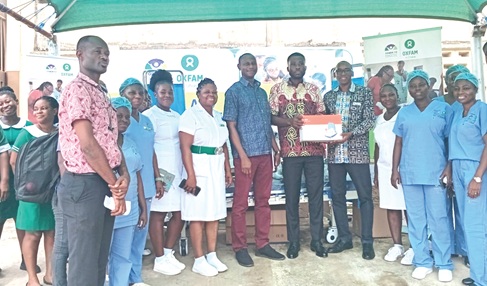
The Ewim Polyclinic in Cape Coast has appealed for support to establish a theatre to address growing surgical demands.
Ewim's challenge
The acting Medical Superintendent of the Ewim Polyclinic, Dr Amos Kofi Pepprah, who made the call, said the facility continued to grapple with major infrastructure deficits, particularly the absence of a functioning theatre.
Dr Pepprah made the call when Oxfam donated items, including delivery beds, maternity beds, autoclaves, neonatal resuscitation equipment, oxygen systems, blood pressure monitors, newborn weighing scales, suction machines, delivery kits and other essential supplies to the polyclinic last Thursday. Similar items were presented to the Winneba Polyclinic also in the Central Region.
According to him, the facility, which was 50 years old, handled between 80 and 100 patients daily and records approximately 3,000 patient visits every month.
"The Ewim Polyclinic is an old facility. Looking at our infrastructure and equipment, we think we are lagging. Our biggest challenge currently is that we do not have a theatre," he said.
Theatre
Dr Pepprah explained that although the facility had surgeons, medical officers, and trained personnel capable of performing surgical procedures, patients requiring operations had to be referred elsewhere due to the lack of a theatre.
"The only thing we are waiting for is a theatre. Equipment such as theatre beds, anaesthesia machines and other theatre-related items would help us start surgical operations here," he said.
He further indicated that the facility's emergency ward, which has only eight beds, was inadequate for the volume of patients seeking healthcare services.
The medical superintendent appealed to Oxfam, the Government of Canada and other development partners to support the facility with equipment and infrastructure to establish a theatre and expand critical wards.
He assured the donors that the items received would be properly maintained and utilised for the benefit of patients.
Speaking at the presentation ceremony at the Ewim Polyclinic, the Country Director of Oxfam in Ghana, Mohammed-Anwar Sadat Adam, said Oxfam Ghana had invested nearly GH¢1.5 million in medical equipment, medicines and essential health commodities to strengthen maternal, newborn and reproductive healthcare services in eight health facilities across the country.
He said the intervention, undertaken under Oxfam's Power to Choose (P2C) Project, saw the Ewim and Kasoa Polyclinics receive a range of medical equipment to improve healthcare delivery, particularly for women, adolescent girls and young people.
"No young woman or girl should be excluded from services or information because of who she is or where she comes from. Care must be accessible, respectful and responsive," he stressed.
The Power to Choose Project, funded by Global Affairs Canada, is being implemented in Ghana in partnership with the Women in Law and Development in Africa (WiLDAF), the Planned Parenthood Association of Ghana (PPAG), SEND Ghana, NORSAAC and the Participatory Action for Rural Development Alternatives (PARDA), alongside the Ghana Health Service and other stakeholders.
Mr Adam said the support formed part of efforts to ensure that women, adolescent girls and young people had access to quality, respectful and inclusive sexual and reproductive health services.
According to him, the project, valued at CAD7.2 million, was operating in 37 communities across eight metropolitan, municipal and district assemblies in the Greater Accra, Central, Bono East, Northern and North-East regions, stating that the project had gone beyond the provision of equipment by investing in the capacity development of healthcare workers.
He disclosed that 102 healthcare workers have so far received training and mentorship in youth-friendly services, emergency obstetric and neonatal care, family planning, gender-based violence response, respectful maternity care and inclusive service delivery.
Training impact
A Midwifery Officer at the Ewim Polyclinic, Gloria Acquah-Baidoo, who benefited from one of the project's training programmes on emergency obstetric and newborn care, said the training had significantly improved her confidence and ability to manage emergency cases.
