
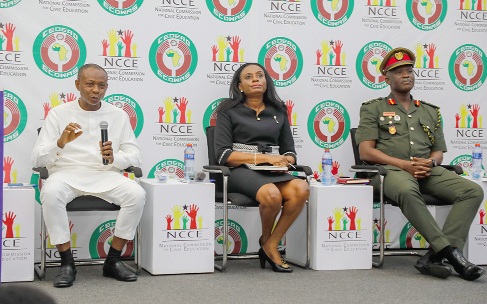
Security analysts have called for stronger public trust, community vigilance and collaboration between citizens and security institutions to safeguard the country against emerging threats, including violent extremism, transnational organised crime and the proliferation of small arms and light weapons.
They said the country’s relative peace and stability should not breed complacency, particularly as developments in neighbouring countries could have security implications for communities across the country.
The analysts were the Director of the National Counterterrorism Fusion Centre and Chairman of the Joint Operations Committee of the National Security Council Secretariat, Major General Dr Timothy Ba-Taa-Banah; Peace and Conflict Analyst at the National Centre for the Coordination of Early Warning and Response Mechanism, Victoria Amah Asiedua and the Senior Researcher and Deputy Programme Head for Peace Operations, Stabilisation and Peacebuilding at the Kofi Annan International Peacekeeping Training Centre, Dr Mustapha Abdallah.
They made the call in Accra last Wednesday at a national dialogue organised by the National Commission on Civic Education (NCCE) and the Economic Community of West African States (ECOWAS) on sustaining post-election peace and strengthening community resilience against emerging security threats in the southern border communities.
The dialogue was organised to promote citizen participation in conflict prevention and strengthen cooperation among security agencies, traditional authorities, civil society organisations and community groups.
Threats
Major General Ba-Taa-Banah said threats originating from the northern part could affect communities in the south because of the country’s relatively small geographical size and porous borders.
He also said that although the country remained secure, there was the need for citizens to remain vigilant and report suspicious activities and unusual developments through appropriate channels.
Major General Ba-Taa-Banah expressed concern about the involvement of some citizens in criminal activities, saying some people knowingly provided accommodation, transport and other forms of support to criminals, while expecting security agencies to deal with the consequences.
“Every citizen has a responsibility and members of the public must report concerns to traditional leaders or directly to the appropriate security institutions,” he said.
On small arms and light weapons, Major General Ba-Taa-Banah said their misuse remained a security concern, although there were legal processes for acquiring and possessing firearms.
He called for sustained public education, simpler procedures for renewing firearm licences and periodic amnesty programmes to encourage people to surrender unlicensed weapons.
Early warning
Ms Asiedua said effective early warning depended on communities understanding the risks and vulnerabilities within their areas.
She identified unemployment, corruption, illegal mining, resource conflicts, cross-border trafficking, narcotics and the proliferation of small arms as some of the issues requiring close attention.
Ms Asiedua urged communities to establish peace structures involving chiefs, youth leaders, women’s groups and other stakeholders to identify emerging tensions and communicate early warning signals to national institutions.
Internal vulnerabilities
Dr Abdallah, for his part, said the country’s security strategy should go beyond preventing threats from crossing the country’s borders.
He said unemployment, inequality, marginalisation and governance challenges could create conditions which violent extremist groups could exploit.
Dr Abdallah said experiences from the Sahel showed that extremist groups could exploit local grievances and the absence of basic services to gain influence within communities.
He, therefore, urged the country to address internal vulnerabilities alongside measures to secure its borders, particularly in communities where young people faced limited economic opportunities.
