
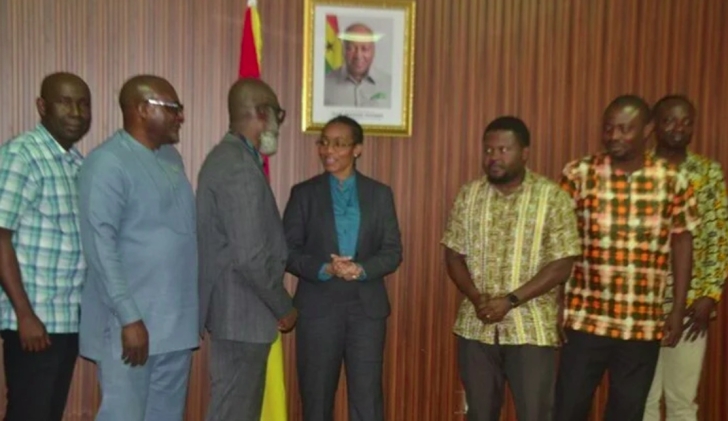
The government is advancing plans to transform the Ghana Space Science and Technology Institute (GSSTI) into a fully fledged Ghana Space Agency, in a move aimed at strengthening the country's coordination of space activities and expanding its participation in the global space economy.
The Minister of Environment, Science and Technology, Dr Zanetor Agyemang-Rawlings, disclosed at a press conference in Accra on Monday, October 5, 2026, that the initiative formed part of her First 100 Days Public Engagement Agenda, which is intended to move Ghana's space science and technology agenda from aspiration to implementation.
She said processes were already underway to draft a Bill for the establishment of the agency, following Cabinet's approval. She explained that the transformation would provide the country with the appropriate legal, institutional, technical and operational framework to coordinate its space activities.
The proposed agency is expected to provide a stronger institutional framework for coordinating Ghana's space activities, developing national space programmes, promoting research and innovation, facilitating public-private partnerships and strengthening international cooperation. It will also support the development of space infrastructure and related technologies.
The move is aligned with Ghana's national Space Policy, which identifies the creation of a statutory space agency as a key element of the country's space strategy.
A major focus of the new agency will be the practical use of satellite and geospatial technologies across sectors including agriculture, environmental monitoring, disaster management, telecommunications, mining, logistics, insurance and national security. The government also plans to expand investment in skills covering aerospace and satellite engineering, remote sensing, geospatial science, artificial intelligence, robotics and data science, while positioning Ghana as a regional hub for Earth observation.
The Director of the institute, Dr Joseph Bremang Tandoh, said a central agency was expected to address the fragmentation of space-related activities across government institutions. He explained that different ministries currently undertake activities requiring satellite data independently, making coordination and resource use more difficult. A national agency, he said, could coordinate the acquisition and processing of satellite imagery and make the resulting information available to government institutions.
Dr Tandoh also said Ghana currently has no satellite in orbit and relies on third parties for satellite imagery when required. He noted that stronger domestic capabilities could provide more timely information for areas such as border surveillance, agriculture, flood forecasting and environmental monitoring.
The government's space ambitions are built on an existing policy framework. Ghana's Space Policy calls for a coordinated national space programme, development of space infrastructure and human resources, research and development, commercialisation of space applications, international cooperation and an appropriate legal and regulatory framework for industry participation.
The government is also seeking to expand international partnerships as it develops its space capabilities. In September 2026, Ghana and Japan explored deeper cooperation in space science, technology and innovation, while Ghanaian and Japanese organisations have been working on opportunities for joint space technology projects and capacity development.
Environmental applications are another priority. Ghana plans to combine satellite imagery, drones, ground observations, geospatial systems and artificial intelligence to monitor deforestation, illegal mining, land degradation, water bodies, coastal erosion, drought and other environmental challenges.
The first phase of the agency's development will focus on stakeholder engagement, advancing the legislative process, identifying infrastructure and capacity requirements and strengthening international partnerships. The government has submitted drafting instructions to the Attorney-General's Department as it moves toward legislation for the new agency.
The proposed transformation marks the next stage in Ghana's efforts to build a coordinated national space programme, with the government positioning space science and Earth observation as tools for economic development, environmental management, national security and technological innovation.
