
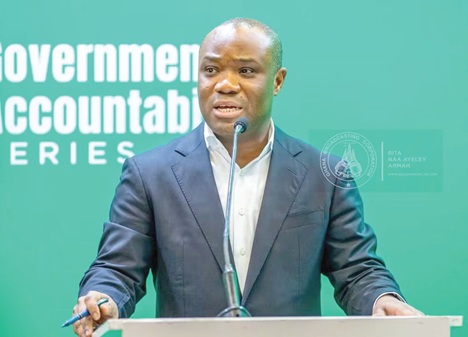
The Minister in Charge of Government Communications, Felix Kwakye Ofosu, has reaffirmed the government’s commitment to guaranteeing the safety and security of journalists and deepening the frontiers of free speech.
Speaking at the launch of the Ghana Journalists Association’s 30th Media Awards launch and inauguration of the Awards Committee in Accra last Wednesday, Mr Kwakye Ofosu said President John Dramani Mahama would be the last person to take away the space within which the media operated since he was one of the main architects of its enhancement.
Assault of journalists
Mr Kwakye Ofosu condemned the unfortunate incident involving a blogger and a journalist who were recently assaulted during the demolition of structures at the Laboma Beach and the La Pleasure Beach by personnel of the Ghana Armed Forces (GAF).
He said GAF remained a well-respected institution known for discipline, and therefore urged the public to separate the actions of a few individuals from the institution.
The minister added that the President had directed that any such incident be investigated, adding that the government would pursue the matter to its logical conclusion.
He stressed that the country remained a safe place for the practice of journalism, and that the country's improved standing in the global media index from 72 to 59, a 13-point improvement, reflected that.
Mr Kwakye Ofosu asserted that criticism of the government, however harsh, was not a crime, but threats of death or violence, especially against the President, were not tolerable in any jurisdiction.
"A clear distinction must be struck between free speech and criminal conduct," he stressed.
Investigative reporting
For his part, the Minority Leader in Parliament, Osahen Alexander Afenyo-Markin, challenged the media to reclaim the frontline of investigative reporting.
Mr Afenyo-Markin cited Article 162(5) of the 1992 Constitution, which mandates the media to uphold the responsibility and accountability of the government to the people, stressing that the media must be concerned about recent developments in the country, including the “drug trade”.
He cited a JoyNews research team report which showed that 28 drug busts involving Ghana had occurred in the past year, 11 of which were major cocaine cases.
The remaining 17 involved cannabis, methamphetamine, heroin and pharmaceutical opioids.
He said according to the report, the street value of the cocaine seized was between $1.3 billion and $1.7 billion; with the Belgian customs data at the port of Antwerp ranking Ghana fifth among countries of origin for cocaine entering Belgium, making it the only country outside South America in the top five.
Mr Afenyo-Markin said the country's image suffered as a result, adding that law-abiding exporters of timber, cocoa, cashew and other produce faced intense vetting, prolonged cargo holds and high inspection fees at foreign ports.
He accused the government of using red herrings to divert public attention whenever the minority demanded accountability, as well as using state security agencies against political opponents.
The legislator urged the media not to settle for sanitised government press statements, while also calling on political leaders to deepen back-channel engagements and reduce partisanship, saying temporary power did not mean using state security to intimidate.
Mr Afenyo-Markin reaffirmed the minority caucus' commitment to defending press freedom and protecting journalists from state overreach.
