
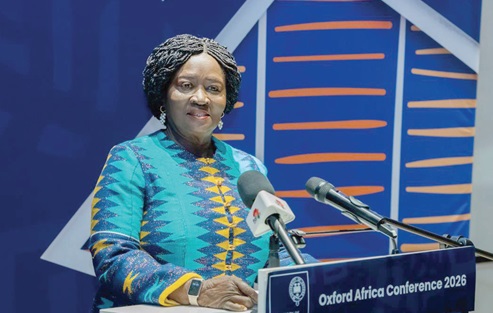
The Vice-President, Professor Naana Jane Opoku-Agyemang, has called for greater African representation in global governance systems.
She said often described as having a frontier and rising economy, the continent must now organise herself to compete, integrate, innovate and build at scale.
Delivering a keynote address at the Oxford Africa Conference 2026 at the University of Oxford in the United Kingdom, Prof. Opoku-Agyemang said the continued exclusion of Africa from major global decision-making structures, particularly the United Nations Security Council, had created an imbalance between global powers and the institutions through which that power was exercised.
“If institutions and indeed democracies are to remain legitimate, they must remain responsive to contemporary realities,” the Vice-President said.
“For many African states, the continued absence of meaningful African representation within key global decision structures, particularly the United Nations Security Council, remains a source of growing imbalance,” she pointed out.
Addressing participants during the conference on the theme, “Anchoring Africa: Grounded Leadership in the Age of Disruption,” the Vice-President stressed that legitimacy in governance was determined not only by representation, but also by the ability of institutions to deliver tangible outcomes for citizens.
She said that governments across much of the developing world continued to operate within difficult structural conditions, including high borrowing costs, debt burdens and unequal access to international finance, factors she said limited the ability of states to deliver growth, stability and opportunities at the scale citizens increasingly expected.
Prof. Opoku-Agyemang pointed out that one of the defining governance challenges of the current era was whether both national and international institutions could adapt quickly enough to remain credible amid accelerating global change.
“This is one of the defining governance questions of our time: whether institutions, national and international alike, can adapt quickly enough to remain credible amid accelerating change while serving their people,” she said.
Event
The Vice-President’s remarks formed part of wider discussions at the conference, which focused on governance, economic transformation, leadership and Africa’s evolving role in global affairs.
The Oxford Africa Conference, organised by the Oxford University Africa Society, brings together policymakers, academics, business leaders, innovators, and students from across Africa and the diaspora to examine key issues shaping the continent’s future.
Accountability
The Vice-President further urged African countries to make deliberate efforts to strengthen governance systems that promoted accountability, continuity, innovation and inclusion, especially in the face of global uncertainty and rapid technological change.
She said building resilient institutions was essential to ensuring that development was sustained and that economic progress benefitted all citizens rather than a few.
Prof. Opoku-Agyemang said while data and projections highlighted Africa’s vast opportunities, long-term progress would depend on the quality of leadership and the strength of institutions.
“Data may illustrate the breadth of the opportunity and project the possibilities ahead.
“But our future will ultimately be shaped by leadership, by institutions that are capable of functioning credibly and consistently, and by systems capable of recognising the full productive potential of her people.
AfCFTA, 24H+
Prof. Opoku-Agyemang described the African Continental Free Trade Area (AfCFTA) as a strategic opportunity for Africa to strengthen regional manufacturing, deepen intra-African trade and reduce vulnerability to global shocks.
She, however, cautioned that integration alone would not guarantee transformation without financing, infrastructure, reliable power supply and policy consistency.
To Ghana’s domestic agenda, the Vice-President said flagship initiatives, including the government’s 24-Hour Economy policy, supported mechanisms for micro, small and medium enterprises (MSMEs), and the planned Women’s Development Bank as tools intended to unlock productivity across formal and informal sectors.
She described the Women’s Development Bank, currently under development, as far more than another financial institution.
“The Women’s Development Bank is a structural response to a long-standing gap within our financial system,” she said, citing the persistent exclusion of women, and the broader informal sector operators, from sustainable access to capital.
