
Outdoor air pollution caused 12,870 deaths in 2024, with nearly two-thirds (64 per cent) occurring before the age of 70, according to a new UNDP Ghana Investment Case for Improved Ambient Air Quality and Health.
The findings identified stroke as the leading cause of air pollution-related deaths, accounting for 47 per cent of fatalities, followed by ischemic heart disease (21 per cent) and acute lower respiratory infections (17.4 per cent).
Acute lower respiratory infections accounted for the largest share of disease cases linked to air pollution.
The study, undertaken with support from Breathe Cities, an environmental health service in London, also attributed more than 316,000 cases of illness to outdoor air pollution, underscoring its growing impact on public health.
Economic burden
Beyond its health impact, the report estimates that outdoor air pollution cost Ghana US$1.9 billion (GH¢28 billion) in 2024 — equivalent to 2.3 per cent of the country's Gross Domestic Product (GDP).
Stroke alone represented 42 per cent of the total economic burden, followed by acute lower respiratory infections (29 per cent) and ischemic heart disease (17 per cent).
The objective of the study was to quantify the health and economic costs of air pollution to support evidence-based policymaking, strengthen advocacy and guide targeted interventions.
Launch
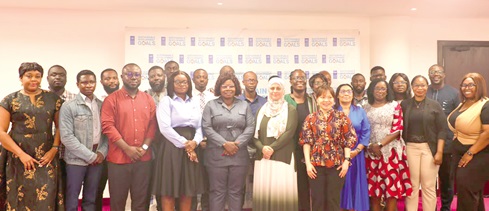
Presenting the facts at the official launch of the report in Accra last Tuesday, Programme Specialist for HIV, Health and Development, Belinda Amankwa, said the investment case focused exclusively on outdoor air pollution, excluding indoor pollution, and it was developed using globally recognised UNDP methodologies adapted to Ghana's context.
She said the study involved extensive consultations with government ministries, the Environmental Protection Agency (EPA), Ghana Health Service, academia, civil society and development partners, alongside rigorous data validation and economic modelling.
Ms Amankwa stated that the report recommends five national priorities: adopting a unified national air quality policy, expanding air quality monitoring and data sharing, strengthening multi-sectoral coordination, mobilising innovative financing for clean air initiatives, and investing in research, particularly on vulnerable groups such as children and pregnant women.
"At the city level, it calls for accelerating clean transport, improving waste management, enforcing industrial emission standards, encouraging cleaner industrial practices through incentives, and intensifying public education on the dangers of air pollution," she said.
Urgent action
The UNDP Deputy Resident Representative, Shaima Hussein, called for coordinated national action to tackle air pollution and described it as one of the world's most preventable yet deadliest environmental health threats.
Citing the 2025 State of Global Air Report, Ms Hussein mentioned that air pollution contributed to 7.9 million deaths worldwide in 2023, with 86 per cent of those deaths linked to non-communicable diseases (NCDs).
She also referenced the World Bank's findings that outdoor air pollution costs the global economy about five per cent of GDP annually.
"The economic consequences were equally severe, with losses estimated at US$1.9 billion—equivalent to 2.3 per cent of our national GDP.
Sadly, these are not just numbers or statistics; they represent lives impacted, communities strained, and futures at risk.
Air pollution is indeed relentless and borderless, permeating communities and economies, with impacts that reach across all society and even into future generations," she said.
Environmental agenda
Speaking on behalf of the Ministry of Environment, Science and Technology, Solomon Laryea of the Policy Planning, Monitoring and Evaluation Directorate said air pollution remains one of the leading environmental determinants of health, contributing to respiratory diseases, cardiovascular diseases, cancers, and other preventable illnesses.
He stressed that developing a robust investment case is not only an environmental priority but also a strategic public health intervention that would strengthen decision-making, attract sustainable financing, and promote multi-sectoral collaboration.
