
Libraries must be equipped with emerging technologies and repositioned as centres of innovation, digital inclusion and lifelong learning to remain relevant in the modern information age, Professor Monica Mensah Danquah, has said.
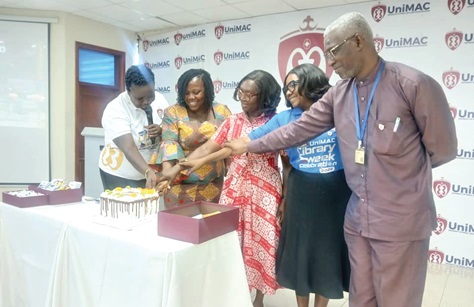
She made the call as keynote speaker at the Maiden Library Week celebration of the University of Media, Arts and Communication (UNIMAC), held on the theme “Libraries for the Future: Enhancing New Technologies Today.” The event brought together faculties, students, sister university librarians and the Ghana Library Association.
Prof. Danquah said libraries could no longer rely on their traditional roles of storing and lending books but must evolve in response to rapid digital transformation and the rise of artificial intelligence (AI).
She said libraries remained important in the knowledge ecosystem but warned that their relevance would increasingly depend on how well they adapted to changing user needs, technological advancement and information behaviour in the digital era.
She said the question was no longer whether libraries faced challenges or not, but how they responded to them.
Challenges
Prof. Danquah highlighted challenges confronting modern libraries to include inadequate funding, poor digital infrastructure, skills gaps among information professionals and the widening digital divide between well-resourced and under-resourced institutions.
She said those challenges could weaken the ability of libraries to effectively serve their communities if urgent reforms were not undertaken.
Priorities
To address the challenges, Prof. Danquah outlined five priorities for building future-ready libraries.
She called for increased investment in digital infrastructure, continuous training and reskilling of library staff, greater integration of artificial intelligence into information management, expanded access to digital resources and stronger collaboration among libraries, universities and technology partners.
Prof. Danquah said libraries must shift from being passive repositories of information to active centres of learning, innovation and research.
In the future, she said libraries should not only provide access to information but also equip users with the skills to critically evaluate and apply knowledge in an increasingly digital world.
Support
Prof. Danquah urged university management, policymakers and development partners to prioritise investment in libraries, saying such investment was essential to improving educational quality and knowledge development.
She concluded that the success of libraries should no longer be measured by the size of their physical collections but by their impact on learning, innovation and community development.
The Rector of UNIMAC-IJ, Prof. Christiana Hammond of the Institute of Journalism, who chaired the occasion, said libraries had evolved from book repositories into key centres for teaching, learning and research in the digital era.
She noted that earlier library use was limited to printed books and classroom activities, but that had changed significantly with technological advancement.
She said students were now expected to function as “prosumers”, producing and consuming knowledge in the digital space.
That, shift, she said required universities to equip students with innovative and technology-driven skills for problem-solving.
Prof. Hammond added that UNIMAC remained committed to producing graduates who can apply technology in practical and innovative ways.
She stressed that the library remained central to academic transformation, providing access to information resources and research support.
She urged students and staff to embrace the changing nature of knowledge production. She later declared the 2026 Library Week officially launched.
Library digital expansion
The university’s librarian, Lydia Nyantakyi-Baah said the library was implementing major digital improvements to modernise services and enhance access to information for students and staff.
She said digital resources had been expanded and enhanced off-campus access systems had been introduced to support remote learning and research.
