

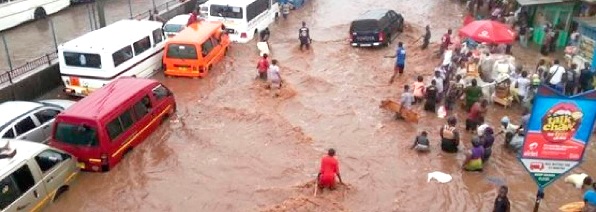
Isn’t it interesting that when it rains in Accra in recent times, folks switch to survival mode? Elsewhere, earthquakes, typhoons and hurricanes are the curse.
Here, one could say we only deal with floods. Evidently, it is the way we have been handling our built environment.
The question is: how should the tourism industry respond to such calamities? Of course, the interest of not only tourists but also residents is important here.
Especially for tourism destinations, the dependence is mutual. If tourists stay away from such destinations, the resident population will lose their livelihood.
Tourism has proven to be a resilient industry, although it can be susceptible to shocks from risk-increasing events.
Natural disasters tend to lead to considerable infrastructural damage, which impedes the recovery of tourism, in particular if the damages are tourist-related infrastructure. The concept of leisure tourism might be seen as frivolous when many people are suffering.
Although tourism security discussions often focus on human actions such as terrorism and crime, natural hazards frequently cause more deaths than acts perpetrated by humans.
Whether described as “acts of God” or “natural disasters,” many of these events are, in reality, exacerbated by poor planning, inadequate preparedness, and ineffective risk management.
Too often, humanity has built hotels too close to drainage channels or the shoreline. In the tourism industry, greater emphasis is frequently placed on the marketing appeal of a location than on understanding its inherent risks and implementing the necessary measures to mitigate them.
Too many tourism professionals do not know what questions to ask or whom to ask. Also, what are the human, legal, and economic consequences of a risk?
How do we react in case of a disaster such as a flood? Let’s see if the following titbits help:
• Each location has its own set of risks; know yours! Although there is no location without some risk, risks are often dependent on a locale’s geography.
That means it is not enough to understand that a hotel is located near a big gutter or a beach resort is located next to a large body of water.
Other factors must also be taken into account. Tourism officials need to understand drainage, rainstorms, local topography, river locations, locations of power plants, in many locations and the number of potential roads that can be used for evacuation purposes.
• Know not only your own location’s risk but also your neighbours’ risks. An often overlooked risk is that your location may become an evacuation centre for a natural disaster in a neighbouring town or district.
How will you cope with a large-scale evacuation? Do you have a plan to intermingle with visitors and evacuees, and what unforeseen problems might such an evacuation entail?
• Never overlook the potential for a health crisis. During a crisis, we are often so concerned about basic needs that we overlook having proper (or at least minimal) health standards and medicines in place.
Evacuation centres can contain hundreds of people, some of whom may carry simple colds or other illnesses.
In such close quarters, these illnesses can quickly turn into epidemics that cause additional pain and suffering.
• Be prepared before the crisis occurs. As soon as it is known that a potential natural disaster may occur, bring in as many supplies as possible.
Make sure you have places that are safe for storage and have thought through both a distribution system and some form of triage or rationing system.
• Get back to basics and develop delivery systems. This means that electricity may be lost, and simple solutions are often preferable. Is there a way to communicate if cell towers go down or are destroyed?
• Get control of the narrative and smile. The last thing a tourism location wants to do is turn itself into a victim. Be prepared to tell your story, and body language speaks as poignantly as words.
Encourage smiles; the more positive the body language, the higher the levels of cooperation.
• Emphasise a sense of community. The more people have a sense of helping their neighbour, along with a sense of self-reliance, the faster the healing.
Natural disasters bring suffering. However, the suffering can be lowered if people have a sense of community combined with a can-do attitude.
• Meet with business leaders regularly. Recovery from a natural disaster is dependent not only on government aid but also on local businesses.
Have a plan in place that will enable businesses, especially pharmacies and food outlets, to resume operations as soon as possible.
Once the supply of basics is reestablished, other areas can be attended to.
• Tell the truth. A tourism industry that lies about its condition will not only lose credibility but will also take extra time to recover its reputation and the public’s trust.
Be truthful about the problems, then explain in simple, understandable terms what you are doing to address them and what your recovery timeline will be.
