
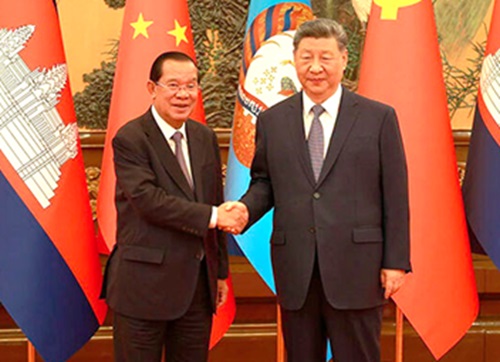
As China marks the 105th anniversary of the Communist Party of China (CPC) which was founded in 1921, the occasion provides an opportunity to reflect on one of the most significant modernisation journeys of the modern era.
While perspectives on China's political system may differ, there is broad recognition that the country's transformation has reshaped global trade, manufacturing, technology and development.
Over the past several decades, China has achieved remarkable progress in poverty reduction, infrastructure, industrialisation and innovation.
For Africa, the significance of this milestone lies not in replicating China's development path, but in examining which aspects of its experience—particularly long-term planning, industrial upgrading and policy implementation—may offer useful insights for countries pursuing their own modernisation.
Modernisation beyond economic growth
China's modernisation journey demonstrates that development extends well beyond achieving rapid economic growth. While sustained increases in GDP have attracted global attention, the country's transformation has been underpinned by a broader and more integrated approach to development.
Modernisation has involved building a strong industrial base, investing heavily in transport and digital infrastructure, upgrading technology and manufacturing capabilities, reducing poverty on an unprecedented scale, expanding access to education and managing one of the world's largest urbanisation processes.
Increasingly, it has also focused on strengthening innovation, improving institutional capacity, and advancing green development as part of a transition towards higher-quality growth.
China's experience illustrates how these different dimensions can reinforce one another over time to support long-term development.
For African countries, this perspective is particularly relevant. As governments pursue industrialisation, economic diversification and sustainable growth, modernisation should be understood not simply as expanding economic output, but as building resilient economies, competitive industries and stronger institutions capable of supporting inclusive and lasting development.
Four practical features
While China's modernisation has been shaped by its unique historical, political and socioeconomic context, several practical features of its development experience have attracted global attention.
These features do not constitute a universal blueprint, but they offer useful points for reflection for countries pursuing their own development ambitions.
i. Long-term planning and policy continuity.
One of the defining characteristics of China's modernisation has been its emphasis on long-term strategic planning.
Successive Five-Year Plans have provided broad policy direction while allowing room for adaptation as domestic and global conditions evolved.
These plans have supported industrial upgrading, infrastructure expansion, technological advancement and economic restructuring over several decades.
Combined with relatively consistent implementation, they have helped provide predictability for public investment and private sector growth.
ii. Investing in productive infrastructure. Infrastructure has served as a foundation for China's economic transformation. Investments in modern ports, expressways, airports, high-speed rail, logistics networks and digital infrastructure have reduced transaction costs, connected markets and supported industrial expansion.
Importantly, infrastructure development has largely been integrated with broader economic objectives, including manufacturing, exports and regional development.
For Africa, this highlights the importance of viewing infrastructure not simply as a means of connecting places, but as a catalyst for production, trade and industrialisation.
As the African Continental Free Trade Area (AfCFTA) continues to evolve, strategic infrastructure investments can play an increasingly important role in strengthening regional value chains and improving the competitiveness of African economies.
iii. Moving up the value chain. China's economic transformation has also been characterised by its gradual progression from labour-intensive, low-cost manufacturing towards higher-value industries.
Over time, the country has expanded into advanced manufacturing, robotics, electric vehicles, artificial intelligence and renewable energy technologies. This transition reflects sustained investment in industrial capabilities, technology and skills.
Africa's development priorities differ, but the underlying principle of value addition remains highly relevant. Rather than relying predominantly on the export of raw commodities, many African countries are increasingly seeking to promote agro-processing, mineral beneficiation, manufacturing and regional production networks.
iv.Innovation and human capital. A fourth feature of China's modernisation has been the growing emphasis on knowledge, innovation and talent development. Significant investment in research and development, higher education, science and technology, entrepreneurship and the digital economy has supported China's transition towards higher-quality growth.
Expanding access to quality education, supporting research institutions, encouraging entrepreneurship and investing in digital skills can help position African economies to compete in an increasingly knowledge-driven global economy.
In this context, innovation should be viewed not as a luxury for advanced economies, but as an essential component of sustainable and inclusive development.
Why context matters
While China's modernisation offers valuable insights, it is equally important to recognise that development pathways are shaped by national contexts.
China's experience emerged from a unique combination of historical circumstances, institutional evolution, demographic dynamics, policy choices and economic conditions that cannot simply be transplanted elsewhere.
Likewise, Africa is not a single entity but a diverse continent comprising countries with different political systems, governance structures, resource endowments, population profiles and development priorities.
As Africa and China continue to deepen their partnership, the focus of cooperation is gradually expanding beyond traditional infrastructure and trade towards broader drivers of long-term development.
These areas have the potential to strengthen productive capacity, support value addition and enhance Africa's competitiveness in an increasingly knowledge-based global economy.
Such exchanges help move Africa–China relations beyond government-to-government engagement by creating opportunities for learning, innovation and long-term collaboration across societies.
Conclusion
As China marks the 105th anniversary of the Communist Party of China, the occasion presents an opportunity to reflect on one of the world's most consequential modernisation journeys.
For Africa, the value lies not in replicating China's path, but in critically examining the experiences, policies and institutions that have contributed to its transformation. Modernisation has no single blueprint.
The writer is the Founder & Executive Director, Africa-China Centre for Policy and Advisory
Email:
