
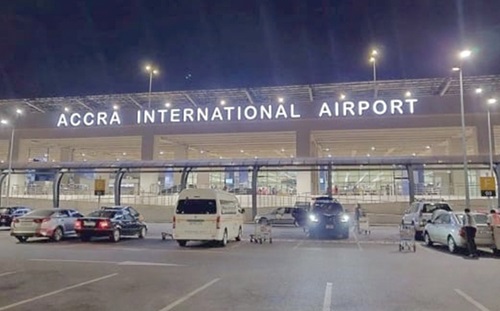
There are moments in travel when progress is not announced with fanfare or marked by the opening of a massive new terminal.
Sometimes, it is something much simpler.
Sometimes, progress means keeping your shoes on.
This week, I experienced one of those moments at the Accra International Airport.
As I passed through the security screening area, I noticed a group of airport officials, the Ghana Airports Company Limited (GACL) personnel and immigration officers gathered around newly installed security scanners.
They were testing the equipment and ensuring everything was ready.
The machines looked remarkably similar to the advanced systems I have encountered at some of the world's leading airports, including Dubai International.
Curious, I asked what was happening
"It starts from midnight," one officer told me. That simple statement made me happy.
President John Dramani Mahama had announced during the launch of Ghana's e-Visa platform on May 25 that travellers would no longer need to remove their shoes, belts and laptops during security screening from August. This week, that commitment moved from announcement to reality.
The Ghana Airports Company Limited is now rolling out state-of-the-art security screening equipment at passenger checkpoints in both terminals two and three, marking a major improvement in the passenger experience at the Accra International Airport.
Ending one of travel's most frustrating rituals
Anyone who travels regularly knows the routine.
You arrive at security, remove your laptop, take off your shoes, remove your belt, empty your pockets and place everything into trays before walking through the scanner.
Then comes the scramble afterwards to put yourself back together while hundreds of other passengers wait behind you.
It is one of those airport rituals many travellers have simply accepted.
But it does not have to be that way.
Having travelled through several airports across Africa and beyond, I have seen the difference technology makes.
At airports in South Africa, including Johannesburg and Cape Town, passengers move through security with greater ease.
The same applies in Seychelles and many airports in Europe, the Middle East and Asia.
Yet, across parts of Africa, including Accra until now, Lagos, Freetown, Lomé and other airports, travellers continue to experience slower and less convenient security processes.
The difference may appear small, but for frequent travellers, it is significant.
A new security experience for travellers
The upgrade at the Accra International Airport goes beyond simply keeping your shoes on.
With the new screening system, passengers will no longer need to remove laptops and large electronic devices from their cabin baggage.
Electronics can remain safely packed inside the luggage, while the scanners conduct more advanced security checks.
Travellers will also be able to keep their shoes and belts on unless they are specifically selected for additional screening.
Liquids, aerosols and gels will also receive improved handling. While the international requirement that individual containers must not exceed 100ml remains, passengers will no longer need to remove these items separately.
Another welcome addition is the Automatic Tray Return System, which will help speed up the screening process by returning trays quickly to passengers and reducing congestion after security checks.
These may appear like small operational improvements, but anyone who has spent time in airport queues understands their importance.
The tourism experience starts at the airport
For many visitors, the airport is their first physical interaction with a destination.
Before they experience Ghana's beaches, heritage sites, festivals, cuisine or famous hospitality, they experience immigration, security, baggage claim and customer service.
That first impression matters.
A visitor arriving in Ghana is not only judging the efficiency of an airport.
They are forming an opinion about the destination itself.
This is why improvements such as the new security scanners go beyond convenience.
They contribute to Ghana's wider tourism ambitions.
As the country seeks to attract more leisure travellers, business visitors, investors and conference delegates, every part of the visitor journey must reflect efficiency and hospitality.
Tourism is not only about attractions. It is also about accessibility and experience.
Preparing Accra for a bigger role
The security upgrade is part of a broader transformation taking place at the Accra International Airport.
The airport is undergoing several improvements, including a new connecting concourse between Terminals two and three, additional passenger boarding bridges, travelators, expanded retail spaces, improved lounges and better passenger circulation.
Terminal two is also being remodelled, while runway upgrades and additional aircraft parking stands are designed to support future growth.
These investments are important because Ghana's aviation ambitions go beyond simply handling passengers.
Accra has the potential to strengthen its position as a West African gateway for tourism, trade and MICE - meetings, incentives, conferences and exhibitions.
A world-class destination requires a world-class arrival experience.
Technology must work every day
Of course, introducing technology is only one part of the journey. Maintaining it is equally important. Last week, when I returned from Abuja, I expected to use the automated e-Gates that have made my arrival experience much easier over the past year.
Instead, I found them unavailable due to maintenance. I had become so accustomed to the convenience of the biometric system that going back to the manual process felt like a step backwards.
My passport has not received an arrival stamp for months because the e-Gates have handled my return seamlessly.
Hopefully, the maintenance will be completed soon.
The journey into the future
Ghana deserves recognition for this latest improvement.
Too often, conversations about African aviation focus only on challenges. It is equally important to acknowledge progress when it happens.
The future of tourism depends not only on beautiful destinations but also on seamless journeys. Visitors remember how they were welcomed, how easily they moved and how efficiently systems worked.
Keeping your shoes on may appear like a small victory. Keeping your laptop safely inside your bag may seem even smaller.
But these are the details that shape traveller confidence.
And sometimes, the journey into the future begins with something as simple as no longer having to take off your shoes at airport security.
