
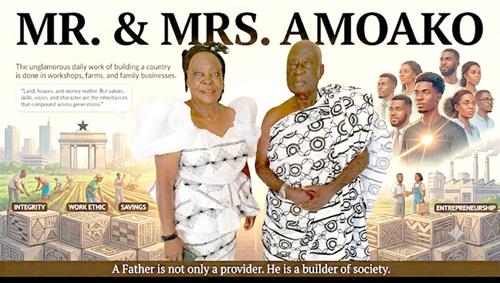
He is James Kwakye Amoako, a close friend of my late mother at Asante Mampong.
When she died while I was still a boy, he could have offered his condolences and stepped back into the ordinary space most people dwell but he did not.
He rather stepped forward and quietly, steadily, and for years without my even understanding the full weight of what he was doing, taught me the rudiments of life, without ever sitting me down to say so.
He instilled in me that fatherhood is not always a matter of blood. I did not then understand the true depth of his role in my life until I was past 21.
By then, the foundation had already been laid: my education, my sense of discipline, my sense of direction all other values all carried the fingerprints of his tutelage, even though I had not known to look out for them.
I think of Mr Amoako’s guidance on every Father’s Day and this year, his example has pushed me toward a larger question.
If one man’s sense of duty could re-direct the entire course of a single life, what would happen if more men understood fatherhood in this context and he lived it out, not as a private transaction between a man and his household but as a form of building a nation of responsible adults?
A father is not only a provider.
He is the builder of society. It is possible to feed a family well, walk children to school and nurse a comfortable home but still hand that family a broken country.
Provision of domestic needs without adequate parental guidance is incomplete.
Mr Amoako did not just provide for me; he built something durable in me that I now carry into the world.
That is the standard.
A man’s responsibility does not end at his doorstep of his nuclear family.
Politicians come and go but fathers remain
Governments in Ghana change every four or eight years.
Administrations rise on promises and fall on disappointment.
But the values a father instills in the younger generation such as work ethic, integrity, patience and ambition outlive every election cycle.
Mr Amoako never held political office and he never needed to.
But his influence has outlasted every government that has come and gone since my mother passed away.
That is the kind of power fathers carry and this is the role I uphold as we celebrate and honour our fathers.
Fathers control the real economy
Long before any government policy reached a village or a market stall, it was our fathers, farmers, traders, artisans, drivers, teachers, engineers, entrepreneurs who were creating the wealth that held the nation together.
They are Ghana’s true engine of development, the people doing the unglamorous daily work of building something out of nothing.
A nation’s strength then is measured less by what happens in its stock of material capital and more by what happens in its homes, workshops, farms and family businesses.
National transformation begins at home
Honesty. Discipline. A culture of savings.
Entrepreneurial acumen.
Patriotism.
These are not abstract virtues.
They are instilled into children and taught in individual households by visionary fathers.
A country cannot be corrupt at the top if its homes can consistently produce honest and responsible citizens.
Mr Amoako never lectured me on these values but he simply lived them out in a way that made cutting corners look petty and beneath my sense of esteem.
That is how character is actually transferred to the next generation.
It is not transferred through political speeches.
Stop waiting for politicians to solve everything
Development does not arrive by appointment from government offices.
It happens when citizens, especially fathers, take ownership of their families and communities, their local economies, their schools, and their roads.
Mr Amoako took ownership of one boy’s future without being asked to.
Multiply that instinct across a nation and you can appreciate the beginning of real transformation.
A father’s legacy is not what he owns, but what he leaves behind
Land, houses and money matter.
But values, skills, vision and character are the traits that compound over generations and build the nation.
Mr Amoako left me a template for how to live with integrity and purpose and this inheritance has never depreciated.
Fathers must become producers, not merely consumers
Nations grow wealthy when their people produce more than they consume.
Fathers who nurture seeds of manufacturing, agriculture, innovation and entrepreneurship in their children, rather than mere employment and consumption, are doing the unseen work of developing the nation, one household at a time.
The future belongs to such fathers who prepare the next generation.
Every father should ,therefore, ask himself these questions: Am I raising a job seeker or a job creator?
A follower or a leader? Mr Amoako never asked himself these questions aloud, but his actions answered them all.
He prepared me to build, not merely to wait.
Fatherhood is leadership
Fatherhood requires no title nor political office.
It requires the willingness to serve, mentor, protect and build.
To leave things better than you found them.
By that definition, James Kwakye Amoako was one of the great leaders I have ever known, even though he never sought to lead anyone beyond his own front door.
On this Father’s Day, let us honour not only the men who feed their families, but the fathers who by choice, build communities, mentor the overlooked, uphold integrity when no one is watching and contribute, quietly or boldly, to developing nation.
Ghana will not be transformed by politicians alone.
It will be transformed when fathers rise beyond their homes and accept their responsibility as builders of the nation the way one man once rose, without fanfare, to build something lasting in me.
Happy Father’s Day, Mr Amoako!!!
