
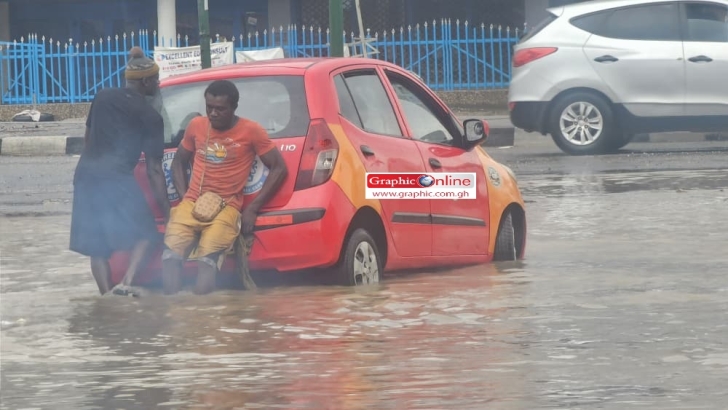
President John Dramani Mahama is right to condemn the indiscipline that worsens flooding in Accra.
No serious observer can deny the damage caused by plastic waste, blocked drains, illegal structures, weak planning enforcement, and construction on waterways.
These are real problems. They are visible whenever heavy rain turns parts of the capital into streams, ponds, and dangerous corridors of moving water.
But the claim that Accra’s flooding is “not an engineering problem” is wrong, incomplete, and potentially dangerous.
It is wrong because flooding is, by its nature, an engineering problem, even when it is also a social problem.
It is incomplete because Accra’s flood crisis cannot be reduced to citizen indiscipline alone.
It is dangerous because political language shapes public policy. When leaders frame flooding mainly as a matter of discipline, the state may escape responsibility for decades of poor infrastructure planning, weak drainage investment, inadequate maintenance, poor land-use control, and fragmented water governance.
As a water resources engineer who has worked in Ghana, I agree that behaviour matters. But behaviour does not replace hydrology.
Discipline does not replace drainage capacity. Public education does not replace stormwater modelling. Demolishing structures on waterways does not remove the need for detention basins, culverts, channels, floodplain zoning, early-warning systems, solid-waste systems, and proper basin-wide planning.
The real issue is not whether Accra’s flooding is an engineering problem or a social problem. That is the wrong question. The better question is why Ghana has failed to treat urban flooding as an integrated water resources management problem.
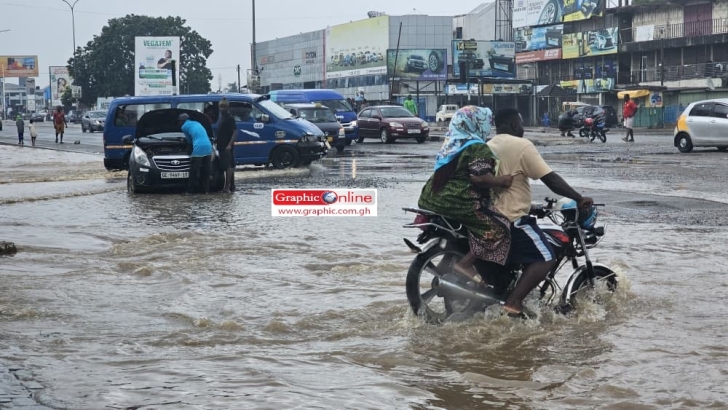
The Problem With the President’s Statement
The problem with the President’s statement is not that he mentioned indiscipline. He is right to do so. Accra’s drains are often choked with refuse. Buildings have been erected in places where water should naturally pass. Some residents dump waste into gutters and later blame government when the same gutters overflow. These behaviours must be condemned.
But leadership must be careful not to turn a partial truth into a national explanation.
To say Accra’s flooding is “not an engineering problem” gives the impression that engineers have no central role in the solution. That is misleading. It suggests that the problem lies almost entirely with ordinary citizens and their behaviour. That is also unfair.
The citizen who dumps plastic into a drain contributes to flooding, but the citizen did not design the city’s drainage network. The trader at the roadside did not approve buildings in floodplains. The schoolchildren walking through floodwater did not destroy wetlands through formal permits. The ordinary household did not decide that Accra should expand rapidly without matching drainage infrastructure.
Citizens must be disciplined, yes. But government must also govern.
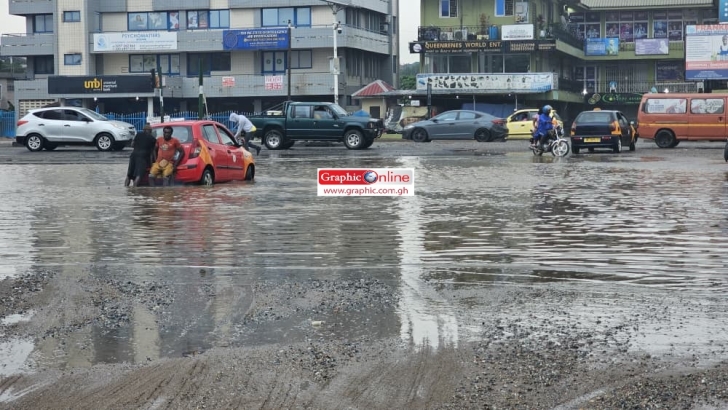 Flooding Is Never Just One Problem
Accra floods because rainfall meets a city that has not made enough room for water.
Natural wetlands have been filled. Floodplains have been occupied. Open lands that once absorbed rainfall have been replaced by concrete, asphalt, roofing sheets, paved compounds, roads, malls, houses, churches, offices and fuel stations. Streams have been narrowed. Some drains are undersized. Some channels are incomplete. Some outlets cannot discharge efficiently under certain conditions. Some settlements sit directly in the path of water.
These are not only social failures. They are also planning failures, engineering failures, enforcement failures, institutional failures, environmental failures and governance failures.
Flooding is never just one problem. It is the final result of many failures meeting at the same time. Poor waste disposal blocks drains. Poor planning places people in danger. Poor engineering underestimates runoff. Poor maintenance reduces drainage capacity. Poor enforcement rewards illegality. Poor coordination allows one institution to blame another while citizens suffer.
The floodwater we see on the streets is only the visible part of a deeper systems failure.
Engineering Is More Than Concrete Drains
One reason the public debate is weak is that many people think engineering simply means constructing big concrete drains. That is a narrow view.
Modern water engineering is not only about gutters and culverts. It includes hydrological analysis, hydraulic design, stormwater modelling, flood-risk mapping, climate adaptation, land-use assessment, catchment management, environmental protection, water storage, risk communication and the design of both structural and non-structural solutions.
A water resources engineer does not only ask: where should we build the drain? The better questions are: how much rain is falling? How much of it becomes runoff? Where does the runoff come from? How fast does it move? What land uses are increasing runoff? Where can water be stored? Which communities are exposed? What level of flood risk is acceptable? How will climate change affect future rainfall? How should infrastructure, planning, enforcement and community behaviour work together?
That is engineering.
Therefore, to say Accra’s flooding is not an engineering problem is to reduce engineering to masonry. It ignores the broader role of water resources engineering in diagnosing, modelling, designing, managing and reducing flood risk.
Accra does not need concrete alone. But Accra certainly needs engineering.
Why Accra Must Think in Catchments, Not Gutters
A serious flood-management strategy for Accra must begin from the catchment, not the gutter.
When it rains, water does not respect electoral boundaries, municipal lines, ministerial mandates or political slogans. Water follows gravity, topography, land cover, soil condition, drainage capacity, obstruction and storage. What happens upstream affects what happens downstream.
If upstream areas are paved, runoff increases. If natural channels are blocked, water finds another route. If wetlands are destroyed, the city loses natural storage. If drains are choked downstream, water backs up upstream. If drainage outlets are restricted, water accumulates. If rainfall intensity increases but old drainage assumptions remain unchanged, flooding becomes predictable.
The Odaw-Korle system, for example, should not be treated as a collection of isolated drains. It must be managed as a basin system. Local desilting may help, but it cannot solve a basin-wide problem if upstream development continues to increase runoff and downstream capacity remains inadequate.
This is why Accra must stop thinking in gutters and start thinking in catchments.
A gutter mindset waits for water to arrive in the neighbourhood and then tries to push it away. A catchment mindset asks where the water begins, what increases its speed and volume, where it can be slowed, where it can be stored, where it can safely pass and which communities must be protected.
That is the kind of thinking Accra needs.
What Integrated Water Resources Management Teaches Us
Integrated Water Resources Management, commonly called IWRM, teaches that water, land, ecosystems, people, infrastructure and institutions must be managed together. It rejects the narrow idea that water problems can be solved by one agency, one drain, one contractor, one demolition exercise or one public education campaign.
Applied to Accra, IWRM means flooding should be managed as a connected water and land-use problem.
If a person throws plastic into a drain, that is indiscipline. If the assembly fails to provide reliable waste collection, that is governance failure. If a developer builds on a waterway, that is lawlessness. If officials approve that development, that is institutional failure. If a drainage channel is too small for current runoff, that is engineering failure. If wetlands are destroyed without replacement storage, that is environmental failure. If upstream development increases downstream flooding, that is land-use failure. If no one models future rainfall intensity under climate change, that is planning failure.
All these failures meet in the floodwater.
This is why an integrated approach is not an academic luxury. It is the only realistic way to manage urban flooding in a fast-growing coastal city like Accra.
Lessons From Other Cities
Accra is not the only city facing intense rainfall, rapid urban growth, paved surfaces and climate-related flood risk. Other cities have learned that flood management cannot rely on concrete drains alone, and it cannot rely on public discipline alone.
Rotterdam in the Netherlands has treated water as part of urban design. The city uses water squares, green roofs, water storage facilities and public spaces that can temporarily hold stormwater during heavy rainfall. This is not the rejection of engineering. It is better engineering, designed to work with water rather than simply fight it.
Singapore also offers a useful lesson. Through its Active, Beautiful, Clean Waters approach, the country has transformed some drains, canals and reservoirs into multifunctional water spaces. Drainage, water storage, public recreation, ecological improvement and community responsibility are brought together.
Copenhagen provides another example. After damaging cloudburst events, the city developed a plan that combines streets, parks, pipes, detention areas, green spaces and emergency flow routes. Some streets are designed to carry excess water safely during extreme rainfall, while parks and open spaces temporarily store water.
China’s Sponge City approach also carries lessons for Accra. The idea is to make urban areas absorb, store, clean and slowly release rainwater through permeable pavements, wetlands, rain gardens, green spaces and ponds. The aim is not to abandon conventional drainage, but to reduce pressure on drains by managing stormwater closer to where it falls.
These examples are not perfect models for Accra to copy blindly. Ghana has its own geography, economy, settlement patterns and political realities. But they teach one important lesson: serious cities do not reduce flooding to indiscipline alone. They combine engineering, land-use control, ecosystems, public behaviour, enforcement, maintenance and long-term planning.
Indiscipline Matters, But It Does Not Excuse the State
Indiscipline matters. Let that be clear.
People who dump refuse into drains endanger lives. Developers who build on waterways must be held accountable. Officials who approve illegal structures must face consequences. Communities that treat drains as rubbish bins cannot expect those same drains to protect them during storms.
But indiscipline must not become a convenient excuse for state failure.
The state has a duty to plan. The state has a duty to enforce. The state has a duty to invest. The state has a duty to maintain infrastructure. The state has a duty to protect wetlands and floodplains. The state has a duty to coordinate institutions. The state has a duty to update drainage design standards. The state has a duty to ensure that cities grow with infrastructure, not ahead of it.
It is too easy to blame citizens after every flood while ignoring the systems that made the disaster possible.
Where were the planning authorities before buildings appeared on waterways? Where were the assemblies when drains became dumping sites? Where were the regulators when wetlands were being filled? Where were the engineers when drainage designs became outdated? Where were the politicians when flood-control projects were delayed, underfunded, abandoned or poorly maintained?
Citizens must not be careless. But governments must not be negligent.
What an Integrated Flood Strategy Should Include
An integrated flood strategy for Accra must be practical, coordinated and sustained beyond political cycles.
First, Ghana must update the hydrological and hydraulic design basis for Accra’s drainage infrastructure. Many drains were designed for a smaller city with less paved land and different rainfall assumptions. Accra has changed. Rainfall risk is changing. Runoff has changed. Engineering standards must respond.
Second, Accra needs distributed water storage, not only bigger drains. A city cannot simply push all stormwater rapidly downstream and expect safety. Detention ponds, retention parks, restored wetlands, green corridors, permeable pavements, school-field storage areas and open floodable spaces can slow runoff and reduce peak flows.
Third, land-use planning must become hydrological planning. No district assembly should approve development without asking a basic question: where will the water go? Building permits must be tied to flood-risk maps, drainage impact assessments and enforceable stormwater requirements.
Fourth, waste management must be treated as flood infrastructure. Plastic waste in drains is not only a sanitation issue. It is a hydraulic obstruction. If Ghana wants flood control, it must invest in regular waste collection, recycling systems, enforcement against dumping, drain inlet protection and routine maintenance before the rains begin.
Fifth, wetlands and natural waterways must be protected as part of the city’s drainage system. Wetlands are not empty lands waiting for development. They store water, slow runoff, filter pollution and reduce flood peaks. Destroying them is equivalent to removing part of the city’s flood-control infrastructure.
Finally, enforcement must be fair and politically courageous. It is not enough to demolish the structures of the poor while powerful developers, politically connected actors and well-known institutions escape scrutiny. If waterways must be protected, they must be protected everywhere, not only where enforcement is politically convenient.
Accra Needs Discipline, Design, and Governance
President Mahama could have said: “Accra’s flooding is not merely an engineering problem. It is also a problem of indiscipline, planning, enforcement, waste management, climate adaptation and governance.”
That would have been accurate. That would have educated the public. That would have challenged citizens without absolving the state.
But to say it is not an engineering problem risks creating false comfort. It suggests that if people stop dumping rubbish and stop building on waterways, Accra’s flooding will be solved. That is not true. Those actions are necessary, but they are not sufficient.
A clean undersized drain is still undersized. A cleared channel without adequate downstream capacity will still overflow. A city without storage will still flood. A floodplain filled with concrete will still send water somewhere else. A drainage system designed for yesterday’s city cannot safely serve tomorrow’s climate.
Accra needs discipline, but Accra also needs design.
It needs enforcement, but it also needs engineering.
It needs public education, but it also needs public investment.
The tragedy of Accra’s flooding is not that Ghana does not know what to do. The tragedy is that Ghana often knows what to do but fails to sustain the discipline, financing, coordination and political courage required to do it.
Floodwater does not respect political convenience. It exposes every weak point in the city’s planning system. It reveals where engineers were ignored, where planners were overruled, where assemblies failed, where citizens were careless, where politicians delayed and where institutions looked away.
So yes, Accra’s flooding is a social problem. But it is also an engineering problem. More importantly, it is an integrated governance problem.
The way forward is not to choose between engineering and discipline. The way forward is to bring engineering, discipline, planning, ecology, enforcement and community responsibility into one coherent flood-resilience agenda.
That is the honest conversation Ghana needs.
The writer, Dr. Enoch Ofosu is a water resources engineer and environmental scientist. He has worked in water resources management in Ghana and currently works in environmental research in Canada.
