
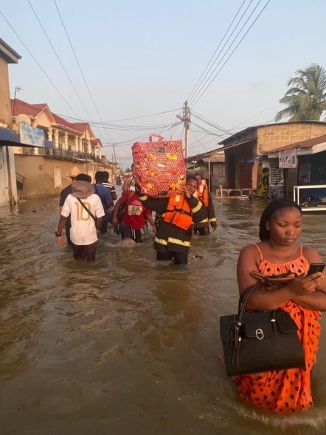
Every rainy season, Accra performs the same grim ritual. The skies open, the streets fill, the cameras roll, and officials arrive at flooded communities to promise action. Then the waters recede, the cameras leave, and nothing structurally changes.
In May 2025, a single rainfall event measuring 132.20 mm in parts of Greater Accra killed five people, displaced more than 3,000, and submerged communities from Weija and Kaneshie to Adabraka, Adentan-Dodowa, and Oyarifa.
In early June 2026, Accra flooded again. Kwame Nkrumah Circle, Odawna, Adabraka, and the roads leading to the Tema motorway were underwater within hours. This is not a natural disaster. It is a manufactured one.
The evidence is unambiguous. Research published in 2025 analysing flood incidence and rainfall data in Accra found no statistical correlation between increased rainfall intensity and the rise in flooding frequency. The primary driver is land use failure.
Over 52 percent of households surveyed in flood-prone areas identified weak enforcement of land use regulations as the principal cause of flooding.
Wetlands and buffer zones that once absorbed stormwater, including the Densu Delta, Sakumo Lagoon, and Songor Lagoon in Greater Accra, have been systematically encroached upon by residential and commercial development, much of it permitted through political interference in planning enforcement.
Impervious surfaces now dominate areas that once retained water. Drainage channels are blocked by solid waste. Waterways are built over. The result is that even moderate rainfall of 25 millimetres, as NADMO confirmed following the May 2025 event, overwhelms the city completely.
The human and economic toll is no longer tolerable. Ghana commemorates June 3 annually as National Flood Disaster Day in memory of the over 150 lives lost in the 2015 Circle inferno, when floodwaters ignited spilled fuel from a filling station and killed men and women who had simply sought shelter from rain. A decade later, the structural conditions that produced that disaster remain substantially intact.
For low-income households in flood-prone settlements, a single event erases years of accumulated assets. Markets in Makola and Kaneshie lose inventory in hours. Transport networks collapse, disrupting employment and commerce across the metropolitan area.
As Accra positions itself as a regional economic hub, these recurring losses are not a peripheral concern. They are a direct threat to national development.
A serious response requires action on four simultaneous fronts.
First, land governance must be treated as the foundation of flood management, not an afterthought. The Accra Metropolitan Assembly and the Greater Accra Regional Coordinating Council must enforce a zero-tolerance policy on development within mapped flood zones and wetland buffer areas.
This requires digital land use mapping using satellite imagery and GIS technology to identify and gazette all flood-risk zones, making data publicly accessible. President John Mahama’s flood resilience task force, established in 2025, provides a political mandate for this. That mandate must be converted into binding spatial plans with enforcement capacity, not advisory recommendations.
Second, infrastructure investment must be reoriented toward nature-based solutions alongside engineered drainage. The GARID Project mobilised over US$350 million for flood management in Accra. Yet communities continue to flood because concrete drainage systems cannot compensate for the loss of natural water retention functions.
Constructed wetlands, permeable paving in high-runoff zones, urban green corridors along waterways, and restored riparian buffer zones must be integrated into every infrastructure intervention. These are not supplementary features. They are load-bearing components of a flood-resilient city.
Third, technology must be deployed systematically. Ghana Meteorological Agency already issues weather warnings, but the translation of those warnings into community-level early action remains weak.
A real-time flood early warning system, integrating GMet rainfall forecasts with sensor networks in high-risk drainage catchments and automated SMS and radio alerts to affected communities, would save lives at a fraction of the cost of post-disaster relief.
UNDP and the Ministry of Finance are already exploring parametric flood insurance for Greater Accra, which triggers automatic payouts when predefined rainfall or flood severity thresholds are reached. This financial protection layer must be scaled and embedded in national disaster preparedness financing.
Fourth, public education and community ownership are irreplaceable. No infrastructure solution holds if residents continue to dispose of solid waste in drains and waterways, and if communities accept floodplain settlement as normal. District assemblies, traditional authorities, schools, religious institutions, and civil society organisations must carry sustained, practical flood risk education into communities, not seasonal campaigns during the height of the rains, but year-round programming that builds a culture of environmental responsibility.
None of these fronts can succeed in isolation. Urban flooding is a cross-sectoral problem that defeats single-agency solutions. The Ministries of Works and Housing, Local Government, Lands and Natural Resources, Finance, and Environment must operate from a shared, binding flood resilience framework. The Environmental Protection Authority, NADMO, the Accra Metropolitan Assembly, the Ghana Institution of Engineers, universities, and community-based organisations must all hold defined roles within that framework, with clear mandates, timelines, and public accountability for delivery.
Accra’s floods are predictable, not inevitable. The engineering knowledge, the planning tools, the technology, and the legal frameworks required to address them exist. What has been absent is the institutional discipline to apply them consistently, without political interference, across administrations. The question Ghana must now answer is whether it will treat flood resilience as a permanent governance commitment or continue to treat each flood season as a fresh emergency. The people who died in May 2025 and June 2026 deserve a definitive answer.
The writer, Dr. Michael Addaney is a Senior Lecturer in Environmental Policy and Planning, Department of Land Management, University of Energy and Natural Resources (UENR), Sunyani, Ghana
