


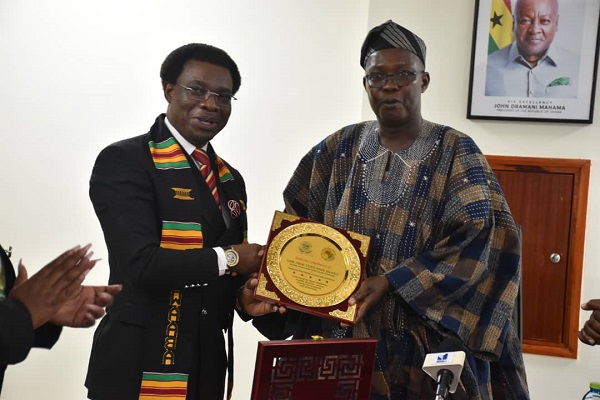
The First Deputy Speaker of Parliament, Bernard Ahiafor, has said Ghana’s development depends largely on the efforts of its own people, as the country seeks to deepen international partnerships and attract investment opportunities through diplomatic engagements.
He made the remarks while welcoming the Secretary-General of the United World Congress of Diplomats (UN-WCD), who was in Ghana on a working visit facilitated by the David Douglas Leadership Forum (DDLF).
The visit was aimed at strengthening international cooperation, promoting foreign direct investment and trade, and enhancing leadership and cultural exchanges.
Mr Ahiafor said national development could not be achieved solely through external support, stressing the need for citizens both at home and abroad to contribute meaningfully to the country’s progress. He urged Africans living abroad not to lose sight of their responsibilities towards their countries of origin.
Development
“We had believed that no country could develop without the pragmatic efforts of its own people, and we encouraged citizens wherever they found themselves to remember their responsibility to contribute to national development,” he said.
Mr Ahiafor also expressed appreciation for community development initiatives, particularly access to potable water in parts of his constituency. He noted that water remained one of the most essential needs of every community and said investments in water infrastructure had a direct impact on people’s lives.
“Water had remained essential to human existence, and communities that benefited from such interventions would continue to appreciate and support those who invested in improving their lives,” he said.
He further assured the visiting delegation of his support and pledged to assist in areas within his capacity to help strengthen partnerships and developmental initiatives.
Speaking during the visit, the founder of the David Douglas Leadership Forum and Deputy Chairman of the United World Congress of Diplomats, David Douglas Tenge, said Ghana’s selection for the visit reflected growing international interest in the country’s investment and trade opportunities.
Investment
Mr Tenge said the Secretary-General’s decision to visit Ghana, despite preparations for a larger international event in the United States next month, demonstrated the importance attached to Ghana’s participation in global diplomatic and economic engagements.
“We had considered the Secretary-General’s visit to Ghana as a strong indication that the country remained an important destination for investment, trade, diplomacy and leadership development,” he said.
He explained that the Secretary-General had travelled with investors and international partners, creating opportunities for business engagements and discussions on future collaborations.
Mr Tenge disclosed that Ghana had been allocated 25 slots to participate in an upcoming international event in the United States, adding that the visit was intended partly to facilitate preparations and ensure Ghanaian delegates completed the necessary processes to participate.
He said the growing interest among members of the African diaspora in engaging with Ghana further reinforced the country’s position as a destination for investment and cultural exchange.
“Ghana had positioned itself as a country open to business, partnerships and international cooperation, and the visit offered an opportunity to showcase those prospects to the global community,” he said.
According to Mr Tenge, the government’s proposed 24-hour economy policy aligned with several initiatives being pursued by the David Douglas Leadership Forum, particularly in agriculture, youth empowerment and export promotion.
He explained that the organisation was promoting agricultural production, processing and exports on the global stage, while also creating opportunities for young people through leadership and empowerment programmes.
The Secretary-General’s visit included meetings with government officials and diplomats to discuss investment opportunities, trade partnerships and bilateral cooperation.
Activities during the visit also included the signing of a Memorandum of Understanding between the David Douglas Leadership Forum and the United World Congress of Diplomats, a youth empowerment programme at the University of Ghana, Legon, and discussions with the Ghana Union of Traders’ Associations on trade facilitation and partnerships.
The visit was also expected to pave the way for the establishment of national chapters of the United World Congress of Diplomats and the Pan African Centre for Conflict Transformation and International Affairs in Ghana.