
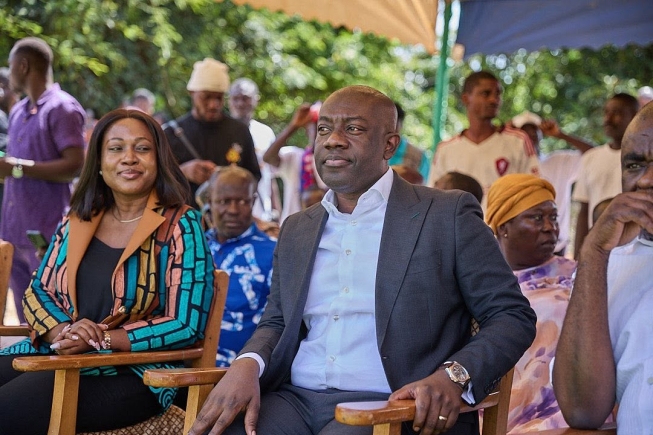
The Member of Parliament for Ofoase/Ayirebi, Kojo Oppong Nkrumah, has proposed five ideas the government must adopt to solve the worsening youth unemployment problem in the country.
He suggested the need for the government to anchor every job programme to a published delivery scorecard with clear metrics on beneficiaries, cost per job created, time-to-placement, and employment retention.
He also advocated the separation of skills creation from job creation and funding both differently, saying that training people without creating demand for their skills only manufactured disappointment.
“Shift the funding model from sovereign financing to private mobilisation. Government should focus on de-risking, co-investing, and creating regulatory clarity while private capital drives large-scale job creation,” he proposed.
Apprenticeship economy
Presenting a statement on rising youth unemployment in Ghana, Mr Oppong Nkrumah said urged the government to make the
apprenticeship economy the spine of the youth employment strategy through national certification, employer co-funding, and clear pathways into employment or self-employment.
“Build a credible Labour Market Information System that publishes timely district-level data on vacancies, sectoral demand, skills gaps, and graduate absorption to guide policy and budget decisions,” he suggested.
Disturbing unemployment statistics
Mr Oppong Nkrumah, who is the Ranking Member on the Economy and Development Committee, said the data from the Quarterly Labour Force Statistics of the Ghana Statistical Service showed that in December 2024, the unemployment rate for young Ghanaians aged 15 to 24 stood at 32 per cent.
By the third quarter of 2025, that figure had risen to 32.5 per cent, he said.
“In Greater Accra, youth unemployment in Q3 2025 reached 49.3 per cent and nearly one in every two young people in our capital region is unemployed,” he said.
The MP indicated that the GSS also show that seven out of every 10 unemployed Ghanaians were under the age of 35.
“The GSS classifies 1.34 million young people aged 15 to 24 as not in education, employment, or training.
“When Ghana’s National Youth Policy definition extending to age 35 is applied, that figure rises to 1.95 million as nearly two million young Ghanaians are neither earning nor learning,” he said.
Let’s all take responsibility
Mr Oppong Nkrumah, who is the Ranking Member on the Economy and Development Committee, said the unemployment problem in the country was not a general problem with a youth dimension but it was a youth problem and the burden was getting worse.
He was blunt that no government had fully solved that problem, including the previous New Patriotic Party government, saying that “we must all take responsibility.
Asking what was being done now to tackle unemployment and whether it was working, Mr Oppong Nkrumah made reference to various employment-related programmes the current government had proposed as a remedy.
He cited the 24-Hour Economy, the One Million Coders Programme, the Adwumawura Programme and the promise of 250,000 jobs annually.
He said the 24-Hour Economy was launched in July 2025 but the Authority Bill only came before the House in February, with concerns already being raised that it did not provide for the promised shift system or employment expansion.
“The One Million Coders Programme received over 90,000 applications in 48 hours, showing the hunger among young people.
“Yet by November 2025, the programme's website was effectively offline before being relaunched with plans to onboard 30,000 people in the first cohort,” he said.
Things getting worse
On Adwumawura, he said a target of 10,000 businesses a year was announced but by March 2026, 11 months after launch, grants had been awarded to only 475 entrepreneurs.
He recalled how on November 12, last year, 21,000 young people converged at the El-Wak Stadium for a single Ghana Armed Forces recruitment exercise.
He said six died in the stampede and five more went into intensive care while they were competing for only 2,000 slots.
“The question confronting us is whether these programmes will work, or whether we urgently need a new job creation strategy,” he said.
“Ghanaian youth do not want slogans. They want feasible programmes that create dignified, productive, and well-paid jobs,” he said.
