
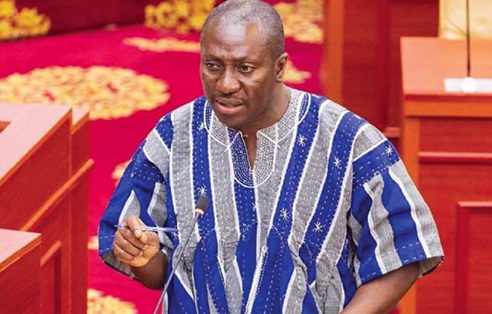
The Minority Caucus in Parliament has called on President John Dramani Mahama to direct the Attorney-General and the Minister of Justice to urgently repeal Sections 207 and 208 of the Criminal and Other Offences Act, since they are being used to criminalise free speech.
Addressing the press in Parliament last Friday, the Minority Leader, Alexander Afenyo-Markin, demanded the immediate withdrawal of all pending prosecutions under sections 207 and 208 of the Criminal and Other Offences Act, including the second prosecution threatened against Camila Alhassan, a TikToker.
He also demanded the discharge of any person currently serving a sentence under either section and the passage, without delay, of legislation repealing both sections along the lines of a Bill already before Parliament.
“We demand a public commitment from government that no citizen will face criminal charges for speech that is merely critical, embarrassing or unwelcome to those in power.
“This is because a law that can jail a government critic today can jail a government supporter tomorrow -- the day the political fortunes of this country turn -- as they always eventually do,” he cautioned.
Repeal
The Caucus said though the Criminal Libel law was repealed 25 years ago, sections 207 and 208 were left standing and had been used as a state machinery against innocent citizens.
“Nobody needs to repeal the reforms of 2001 to bring Criminal Libel back.
All that is required is a prosecutor willing to reach for section 207 or section 208 whenever words used are unflattering and a charge sheet that speaks of ‘public order’ and ‘breach of the peace’ rather than of libel or defamation,” he said.
Arrest pattern
Mr Afenyo-Markin said Ms Alhassan, a young Ghanaian, was sentenced on Thursday, July 16, this year, to one year with hard labour for a TikTok video.
He said Ms Alhassan was convicted under section 207 of the Criminal and Other Offences Act, 1960, under "offensive conduct conducive to a breach of the peace."
He said the Police Service had since indicated she would face a second prosecution under section 76 of the Electronic Communications Act for the same underlying conduct.
“We condemn both the prosecution and the conviction. A one-year custodial sentence, with hard labour, for a social media post is not proportionate.
“It is not justice, but a warning shot fired at every Ghanaian who owns a smartphone,” Mr Afenyo-Markin said, saying that Ms Alhassan was not alone.
He also cited how Kwame Baffoe, popularly known as Abronye DC, was remanded on identical charges of offensive conduct and publication of false news before being granted bail of GH¢100,000 as well as other personalities who were also arrested and seized from their homes in a pre-dawn raid including Alhassan Abdul Rahaman and Alfred Ababio Kumi, describing those as a threat to free speech.
“This is not a series of unconnected incidents; it is a pattern,” the Minority Leader said.
Finish the job
Mr Afenyo-Markin, who is the MP for Effutu, indicated that in 2001, the Kufuor administration, with Nana Addo Dankwa Akufo-Addo serving as Attorney-General, repealed Ghana's Criminal and Seditious Libel laws.
That decision made Ghana the first country in Africa to fully free itself of insult laws, and it earned the country the admiration of press freedom organisations across the continent and beyond.
It was, and remained, one of the proudest achievements of that administration and of the New Patriotic Party, he said.
However, he said sections 207 and 208 were left standing and were being used by the state to silence critics of the government.
“Twenty-five years after 2001, it is time to finish the job. We are not asking government to invent something new.
“We are asking government to take the next step on a road this country has already chosen to walk,” he said.
Abuse of free speech
The Minority Leader said while the caucus was not asking anyone to tolerate falsehood, insult or recklessness, it condemned irresponsible speech and irresponsible publication in all its forms, regardless of who was responsible for it and which party that person supported.
