
There are moments when a nation must say no, not out of ingratitude or arrogance, but self-respect.
Ghana said such a no in April this year.
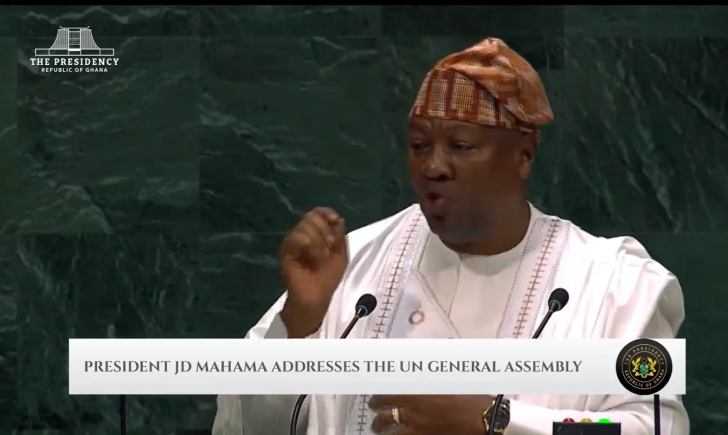
President John Dramani Mahama last Friday justified the government’s decision to reject a new health compact presented by the United States to replace funding previously provided under the United States Agency for International Development (USAID).
He described the conditions in the document as humiliating and an affront to sovereignty. (Read our front page lead story).
First, the compact demanded that Ghana hand over its pathogen profile.
Second, the country must hand over its medical records.
Third, it required Ghana to commit a set amount of counterpart funding, dictated from outside.
Fourth, and perhaps most alarming, it stipulated that any medications or medical products brought into the country under the programme would not be subject to inspection by the Food and Drugs Authority (FDA).
The Daily Graphic fully supports the decision to reject it.
To understand why, we must put it in context.
The genesis of this compact is the abrupt withdrawal of USAID support.
An amount of $174 million, which had been programmed into the national budget, was withdrawn, creating a significant gap in education and health.
The health sector alone suffered a $ 74 million annual shortfall, affecting critical areas, including medical research, HIV and AIDS testing laboratories and the administration of the President's Emergency Plan for AIDS Relief, including antiretroviral drugs.
That gap triggered the Accra Reset Initiative — Ghana’s attempt to reimagine health sovereignty in a world where aid can no longer be taken for granted.
We must be honest: $74 million a year is a lot of money.
For the people living with HIV who depend on antiretroviral drugs, for laboratories that test and track diseases, for research institutions that protect us from the next pandemic, that cut hurts and disrupts.
No government would readily turn away funding to fill such a hole.
But there is a line between partnership and paternalism, between support and surrender.
What was presented crossed that line to the extreme.
Consider what was being asked.
A nation’s pathogen profile is not just data.
It is national security information.
It is the genetic map of the diseases circulating among our people, our vulnerabilities, our biological landscape.
To demand it as a condition for health aid is to turn a health partnership into an intelligence extraction exercise.
No sovereign country surrenders that.
Consider medical records.
The medical records of Ghanaians are private, protected, intimate.
They belong to the Ghanaian people and are held in trust by the Ghana Health Service.
To demand bulk access to them as a condition for aid is to treat citizens not as patients to be helped, but as data points to be harvested.
And consider the demand that medicines imported under the programme should bypass inspection by the FDA.
The FDA is not a bureaucratic nuisance. It is the last line of defence between a fake drug and a dying child.
Ghana has fought hard, over decades, to build a respected regulatory authority that checks for substandard, falsified, and expired medicines.
To ask that we exempt an entire supply chain from that scrutiny is to ask us to gamble with Ghanaian lives.
Finally, to dictate a fixed counterpart funding amount is to undermine Parliament’s power of the purse.
Ghana’s budget is approved by Parliament, not by a donor compact. Partnership respects that.
The Daily Graphic is not putting this out in an anti-American spirit.
The United States, through USAID and the United States (US) President’s Emergency Plan for AIDS Relief (PEPFAR), has saved millions of lives in Ghana and across Africa.
For that, we remain grateful.
That history is precisely why the new conditions are so jarring.
They replace a model of solidarity with a model of transactional control.
There will be short-term pain. The $74 million health budget shortfall must be filled.
The government must show, with transparent budgeting, how it intends to fill it without compromising services.
The Daily Graphic urges the state to accelerate domestic health financing, plug leakages in the National Health Insurance Scheme, and partner other nations and institutions that respect mutual accountability.
But some principles cannot be priced.
Cabinet was right to throw that compact out in record time.
And in that fine, dignified “no” lies a lesson for all of Africa: sovereignty is not a slogan we chant at Independence Day.
It is a line we must be willing to defend, even when the cost is high, even when the offer comes with a cheque attached.
We do not want aid that humiliates us.
We want partnerships that respect us.
