
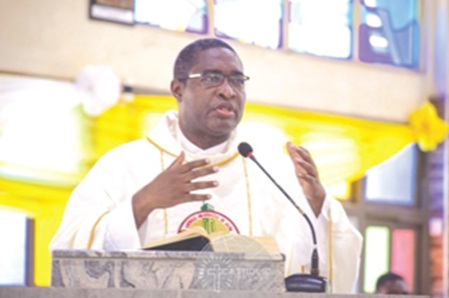
An Auxiliary Bishop of the Accra Catholic Archdiocese, the Most Rev. John Kobina Louis, has urged Ghanaian leaders to resist corruption, waste and nepotism in the discharge of their responsibility to the citizenry.
“The government has a particularly serious responsibility because public resources belong to the people and are entrusted to leaders for the common good,” he stated.
He has, therefore, urged the government to strengthen institutions; “create an environment where businesses can flourish and create decent jobs; improve education and healthcare; support agriculture and local industries and ensure that national resources benefit ordinary citizens, especially the poor.”
Most Rev. Louis said this in his homily during a pastoral visit to the St Michael Catholic Church, 37 Military Hospital, last Sunday.
It was on the theme, “poverty in the midst of plenty: our failures and responsibilities.”
His visit coincided with the climax of the parish feast, where 60 candidates also received the Sacrament of Confirmation.
Promises
Most Rev. Louis said the country did not need leaders who merely promise another banquet.
“We need leaders who ensure that the food actually reaches the table of the hungry,” he said.
Most Rev. Louis said that also meant responsible economic management, stressing that “when public funds are misused, when contracts are inflated, when projects are abandoned or when political interests take precedence over national interest, the consequences are not abstract. The poor pay the price.”
He said the country was the citizenry’s shared table, but if “some are eating excessively, while others have nothing, something is wrong.”
“If some have opportunities while others are systematically excluded, something is wrong,” he stressed.
He said the country was endowed with gold, cocoa, oil, fertile land, forests, water, human resources, among other things.
“Yet, we still have families struggling to put food on the table, young people searching desperately for employment, children lacking adequate nutrition, communities without reliable access to basic services,” he said.
He said the issue raises a fundamental question as to where poverty come from in a world of plenty.
Most Rev. Louis said poverty was sometimes made worse by greed, corruption, selfishness, exploitation, waste, indifference and laziness.
He said the problem was not always the absence of resources but often the unjust distribution and irresponsible use of resources.
