
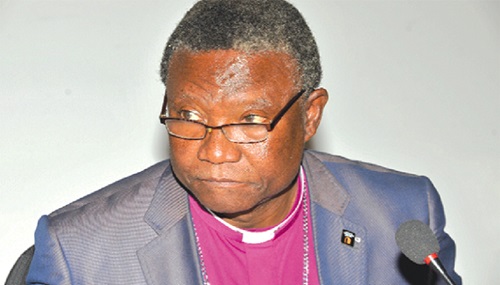
A former National Chairman of the National Peace Council (NPC), Most Reverend Professor Emmanuel Asante, has stated that certain fundamental national interests ought to transcend partisan politics.
He said political parties might legitimately disagree about the means by which national objectives should be achieved but some national priorities should be tackled irrespective of the party in power, and devoid of extreme partisanship.
“Education, health, peace, economic development, institutional integrity, environmental protection and the welfare of future generations should not become casualties of electoral cycles”, he stressed.
Most Rev. Prof. Asante, who is also a former Presiding Bishop of the Methodist Church Ghana, made the remarks in a presentation during the celebration of International Day of Peace in Kumasi in the Ashanti Region.
Celebration
Organised by the Ashanti Regional Peace Council, the event was on the theme: “Invest in peace: For everyone, everywhere, everyday”.
He said a national development framework agreed through broad consultation could provide continuity while allowing successive governments to present different approaches to implementation.
“Such an approach would not eliminate political competition.
Rather, it would help move political competition from a contest over personalities and partisan identities towards a contest over ideas, policies and performance” he mentioned.
Most Rev. Prof. Asante stated that the state must also protect the freedom of citizens and the media to participate in public discourse while ensuring that the law was respected, saying “the Constitution expressly guarantees the freedom and independence of the media and assigns the media an important responsibility to uphold the accountability of government to the people”.
He stated that peace could not be built on the suppression of legitimate disagreement, and neither could it be built on impunity, and added that one of the dangers facing democratic societies was the tendency to reduce democracy to the organisation of elections.
“Democracy must be experienced in the everyday lives of citizens.
It must be visible in access to justice, respect for human rights, accountability in public office, fairness in the distribution of opportunities and the ability of citizens to participate meaningfully in decisions that affect their lives” he added.
While indicating that a society may experience no open conflict and yet be characterised by injustice, exclusion, mistrust and resentment, he said “such a society may be peaceful on the surface while tensions accumulate beneath it”.
Politics of insults
Addressing the event, the Paramount Chief of Asante Akyem Domeabra, Baffuor Owusu Bediako, said the recent calls for open national discussion on the culture of politics of insults reflected a growing anxiety regarding public and political discourse.
“The culture of insult is getting out of hands.
Personal vilification, vitriol and inflammatory rhetoric have dominated our traditional and online social media platforms, with honest communication replacing factionalism”, he said
“I, therefore, add my voice to calls for a national dialogue in order to eliminate this canker from our body politics.
Our society is gradually getting used to vulgarity, making offensive speech seem normal and acceptable,” he stressed.
Writer’s email;
