
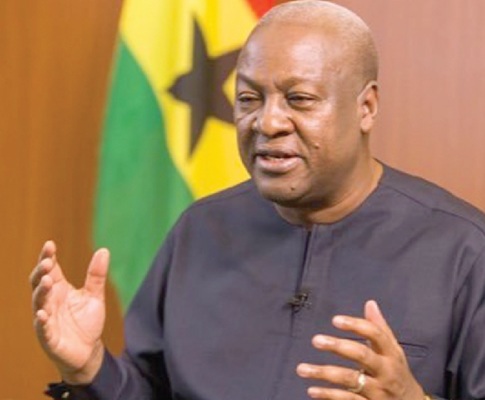
Majority of Ghanaians support President John Dramani Mahama’s handling of the economy and road infrastructure 18 months into his administration, a poll by the Institute of Economic Affairs (IEA), a think tank, has revealed.
“Public assessment of President John Mahama's job performance is positive, with most respondents approving of the way he is handling his job.
When asked whether they approve or disapprove, 58.9 per cent of respondents say they approve, 28.4 per cent say they disapprove and 12.8 per cent report having no opinion.
The gap between approval and disapproval — over 30 percentage points — indicates that positive assessments of the President's performance remain well ahead of critical ones.
The findings were the outcome of a nationwide poll in all 16 regions to gauge public sentiment on President Mahama's stewardship since taking office.
The poll covered over 1,000 people across all 16 regions of Ghana and revealed the following key findings:
“Since assuming office in January 2025, key economic indicators have moved in the right direction.
Between January 2025 and April 2026, inflation has fallen from 23.5 per cent to around 3.4 per cent, the cedi has appreciated by 26 per cent against major currencies, the Bank of Ghana's policy rate has been cut from 27 per cent to 14 per cent and average commercial bank lending rates have declined from around 32 per cent to approximately 20 per cent.
“Ghana's debt-to-GDP ratio has also declined from 61.8 per cent at end-2024 to 45.3 per cent by end-2025.
These gains have been recognised by international credit rating agencies, with Fitch, Moody's and S&P all upgrading Ghana's sovereign credit rating — the first triple upgrade in many years — in acknowledgement of the country's improved fiscal outlook.
It said among those who approve, 73.5 per cent cite the economy, while 16.0 per cent point to road infrastructure.
However, it said 30.9 per cent of those who disapprove also cite the economy, while 29.9 per cent cite electricity.
The poll further noted that approval had nonetheless slipped from 68 per cent in December 2025 to 58.9 per cent in May 2026, reflecting a public that remains broadly supportive but increasingly expectant that the gains of the past 16 months will reach their daily lives.
Approval
“When it comes to why Ghanaians approve of President Mahama's job performance, the economy tells the story.
Nearly three in four approvers (73.5 per cent) credit the government's handling of the economy as their main reason, a direct reflection of the administration's achievements in stabilising prices, strengthening the cedi and restoring investor confidence.
“Thus, the data confirm that the government's economic record is its most powerful source of public goodwill.
Road infrastructure (16.0 per cent) and energy and electricity (2.7 per cent) rank as the second and third reasons for approval, respectively.
Slippages
It said 30.9 per cent of those who disapprove also cite the economy as their main reason for disapproval.
“This is not necessarily a rejection of the government's macroeconomic achievements but may instead reflect the lived experience of Ghanaians for whom falling inflation and a stronger cedi have not yet fully translated into lower cost of living, more jobs or higher household incomes.
It said electricity supply was also cited by 29.9 per cent of disapprovers, a finding that comes as no surprise, given that the poll was conducted in the wake of a temporary power supply constraint in May 2026, which saw frequent outages affecting homes and businesses across the country.
“Corruption is cited by 19.1 per cent of disapprovers, a signal that the government's anti-corruption rhetoric has yet to convince a significant portion of the public fully.
Visible action on corruption remains an expectation many Ghanaians hold firmly.
“The findings suggest that Ghanaians are broadly supportive of the President's leadership but are expectant that the progress recorded at the macro level will increasingly be felt in their daily lives,” it stated.
