
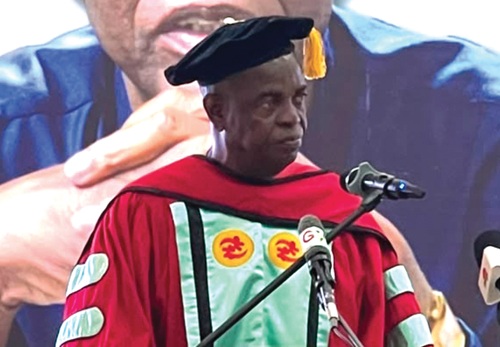
Veteran journalist and Pan-Africanist, Kwesi Pratt Jnr., has cautioned that Ghana’s persistent constitutional problems cannot be attributed solely to weaknesses in the 1992 Constitution, saying the deeper challenge lies in how political leaders and state institutions operate around the document.
He said although genuine defects in the Constitution needed to be corrected, no constitutional amendment could, on its own, protect the poor and marginalised from abuse by powerful interests.
Mr Pratt made the statement at the University of Cape Coast (UCC) when he was delivering the first of the 15th Kwame Nkrumah Memorial Lectures on the theme, “Kwame Nkrumah, Yesterday, Today and Tomorrow: Perspectives on Constitutionalism, Development and Pan-Africanism.”
He said there was a constant tension between Ghana’s economic realities and the ideals contained in the Constitution, and that “in that tension, the poor and the marginalised always lose out.”
“No formulation of words on a piece of paper will protect the poor against rapacious elites.
No constitution enforces itself. No constitution in the world enforces itself,” he said.
Mr Pratt said calls for constitutional review could sometimes divert attention from the conduct of those exercising political power, although he acknowledged that shortcomings in the constitutional text existed and required attention.
“Continual constitutional crisis cannot be explained by poor drafting and review, although defects in the text are real and must be corrected,” he said.
He identified what he described as the conduct of the political class and state institutions around the Constitution as the deeper concern.
According to him, successive presidents since 1992 have overreached, tolerated the dissipation of national resources and ignored abuses of citizens’ rights.
He further said Parliament has, on several occasions, failed to effectively check the Executive, while the Supreme Court has not always approached constitutional law as a means through which the powerless could challenge the excesses of the powerful.
Nkrumah’s constitutional strategy
Mr Pratt said the experience of the Nkrumah era demonstrated that constitutional change could not be separated from the broader struggle for political and economic transformation.
He said Dr Kwame Nkrumah understood constitutional change as a strategic instrument for moving the Gold Coast from colonial rule to self-government and eventually full sovereignty.
He said Nkrumah transformed the nationalist movement from one dominated by an educated elite into a mass movement involving workers, farmers, market women, youth, students and other sections of the population.
According to Mr Pratt, the Convention People’s Party (CPP), formed in 1949, organised branches, rallies, political campaigns and other forms of mobilisation to build pressure for immediate self-government.
He said Nkrumah’s positive action campaign was based on disciplined non-violence, involving strikes, boycotts, press campaigns and non-cooperation with colonial authority.
“Nonviolence was not a weakness. It required courage, organisation and restraint. It was not passive. It was active resistance,” he said.
Mr Pratt said Nkrumah did not reject constitutional reform but opposed reforms that maintained colonial control while delaying self-government.
He said the constitutional developments of 1951, 1954 and 1956, together with successive electoral victories by the CPP, created the conditions that eventually led to independence on March 6, 1957.
He said Nkrumah’s constitutional strategy could therefore be understood as a gradual process in which mass mobilisation was used to force constitutional change, after which constitutional authority was used to advance the country towards full sovereignty.
Development
Mr Pratt also devoted a substantial part of the lecture to Nkrumah’s economic development strategy, rejecting what he described as the simplistic claim that Nkrumah merely destroyed Ghana’s economy.
He said Ghana inherited a colonial economy structured mainly around the export of cocoa, gold, timber and other raw materials and the importation of manufactured goods.
Nkrumah, he said, recognised that political independence without transforming that economic structure would be incomplete.
Mr Pratt said Nkrumah’s seven-year development plan sought to transform the economy through industrialisation, economic diversification, agricultural modernisation, infrastructure development, human-capacity development and a broader African economic orientation.
He said investments in factories, electricity, roads, schools, universities, hospitals, housing and ports were intended to create the productive capacity required for national development.
He acknowledged that the development programme faced serious difficulties, including the collapse of world cocoa prices in the mid-1960s, increased external debt and repayment obligations, shortages, inflation and limitations in the state’s administrative and financial capacity.
However, he said those difficulties did not justify reducing Nkrumah’s economic record to a claim that he simply destroyed Ghana’s economy.
“The claim, repeated by Nkrumah’s ideological opponents, that he simply destroyed Ghana’s economy, is too crude to survive any serious examination,” he said.
He argued that the more important question was whether investments created productive capacity, whether they were efficiently managed and whether the country could meet the financial obligations arising from them.
Mr Pratt said the continued dependence on raw material exports, limited industrialisation, foreign exchange pressures, debt, unemployment and reliance on imported manufactured goods showed that the structural weaknesses of the economy had persisted beyond Nkrumah’s government.
Preventive detention
Touching on the Preventive Detention Act introduced under Nkrumah, Mr Pratt acknowledged that the law gave the government significant powers to detain people without ordinary criminal trial.
He said the Nkrumah government justified the measure on the basis of bombings, attempted assassinations, violent conspiracies and threats to the stability of the newly independent state.
Mr Pratt, however, said detention without trial was a significant state power and that any government using it has to accept responsibility for its human consequences.
He also noted that Nkrumah faced violent opposition and assassination attempts, saying such violence should not be erased from discussions about his government.
The lecture forms part of UCC’s 15th Kwame Nkrumah Memorial Lectures, held from September 17 to 18, 2026.
The university instituted the lecture series in 1974 and inaugurated it in 1976.
Mr Pratt is scheduled to focus the second lecture on Nkrumah as a Pan-Africanist strategist and the continuing relevance of his ideas to African unity. UCC is also holding a special congregation as part of the programme to confer an honorary Doctor of Letters degree on him.
