
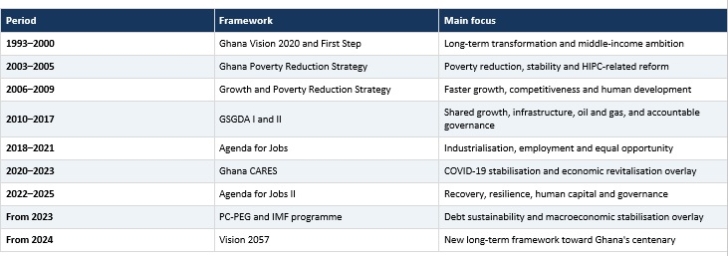
From Ghana Vision 2020 to Vision 2057, the country has repeatedly changed direction. Ghanaians need a national plan that survives elections without tying the hands of an elected government.
Every new government arrives with promises, slogans and flagship programmes. Some changes are necessary. Others leave unfinished roads, abandoned projects, renamed initiatives and public institutions trying to follow a moving target. Since the Fourth Republic began in 1993, Ghana has moved through a long-term vision, two poverty-reduction strategies, two shared-growth agendas, two jobs programmes and several emergency recovery plans. The problem has not been a shortage of plans. It has been the difficulty of keeping useful national commitments alive when governments change or a crisis strikes.
This is why development planning belongs in the constitutional debate. Ghana needs rules that protect a shared national direction while leaving every elected government free to choose its own policies, priorities and budgets.
From Vision 2020 to poverty reduction
The vision was to be implemented through successive medium-term steps. In practice, only the First Step received a detailed framework. The change of government in 2001 brought a different policy emphasis, and the remaining stages were not produced as contemplated.
Ghana then adopted the Ghana Poverty Reduction Strategy for 2003 to 2005 amid high poverty, debt pressures and participation in the Highly Indebted Poor Countries initiative.
The Growth and Poverty Reduction Strategy followed for 2006 to 2009. The shift in name was significant. Policy moved from poverty reduction as the primary organising idea toward accelerated growth, private-sector competitiveness, human-resource development and good governance. The country had therefore moved from a twenty-five-year vision to a succession of medium-term frameworks within a decade.
Shared growth and the jobs agendas
GSGDA I and II governed the period from 2010 to 2017. Agenda for Jobs then took effect in 2018, followed by Agenda for Jobs II for 2022 to 2025. The organising language moved from shared growth toward industrialisation, employment, recovery and resilience.
These frameworks did not operate in calm conditions. COVID-19 led to the Ghana CARES Obaatan Pa programme from 2020 to 2023. Fiscal and debt distress then produced the Post-COVID-19 Programme for Economic Growth and an IMF-supported recovery programme from 2023. Both interventions responded to genuine emergencies, but they also overlaid the formal development frameworks and redirected public finance toward immediate stabilisation.
In 2024, the NDPC introduced Vision 2057 as a long-term framework leading to Ghana's centenary. It sought to anchor medium-term plans in enduring priorities such as human capital, science and technology, infrastructure, land reform, clean energy and macroeconomic stability. By 2025, another political transition was preparing the next medium-term policy framework.
What the changes cost Ghana
Not every change was wrong. Elections allow citizens to choose new priorities. COVID-19 demanded an emergency response, and the debt crisis required painful economic repair.
The problem begins when a change of course becomes an excuse to abandon earlier commitments without explaining the cost. A project may be renamed, delayed or stopped after public money has already been spent. A new programme may duplicate an existing institution. Parliament and citizens are then left wondering which promises still stand and who should answer for failure.
Constant changes also drain the public service. Officials must redirect staff and money toward the latest flagship programme. Contractors cannot know whether approved projects will survive the next election. District assemblies may prepare plans under one framework and carry them out under another.
Ghana's closely fought elections make the pressure worse. Governments want visible results before the next vote. That can favour quick projects over reforms that take ten years to produce benefits. It can also tempt a new administration to reject a useful programme simply because its political rival introduced it.
The people are the owners
The basic democratic principle is simple. Citizens own the state. They lend power to a government for four years and provide the taxes that finance its programmes. Government therefore acts on their behalf, not the other way round.
Yet an election victory can be treated as ownership of the national agenda. A plan begins to look like the property of the party that announced it. When another party wins, it feels free to replace that plan with its own. The people who paid for both plans have little power to demand continuity.
A citizen-owned national plan would set the outcomes that should endure: good schools, reliable healthcare, productive jobs, sound infrastructure, environmental protection and public finances that the country can sustain. Governments would still decide how to reach those goals. One might rely more on private investment, while another may prefer direct public provision.
The important requirement is accountability. A government should show how its budget supports the national goals, publish results and explain any major departure. Parliament should examine those explanations. The National Development Planning Commission should independently monitor progress and report it in language the public can understand.
What should be protected
The Constitution should not list projects, spending figures or one government's economic policies. Those decisions must remain flexible and should be made through laws, development programmes and annual budgets.
What the Constitution should protect is the process. Ghana should always have a long-term national plan prepared with meaningful public participation. Each government should publish a four-year programme showing how it supports that plan. Annual budgets should connect public spending to measurable national results. The NDPC should have enough independence and information to assess progress. A government that changes an important national goal should give reasons, disclose the financial consequences and face parliamentary scrutiny.
This arrangement would not force a new government to implement its predecessor's manifesto. It would separate the destination from the route. Citizens would own the long-term goals, while governments would compete over the best way to achieve them.
Emergencies would still require flexibility. A government facing a pandemic, natural disaster or financial crisis must act quickly. But it should tell the country what has changed, why the change is necessary, what it will cost, how long it will last and how Ghana will return to its longer-term path.
A constitutional opportunity
The period from 1993 to 2025 shows both Ghana's ability to plan and the weakness of its planning system. Each framework addressed real needs. Yet the repeated changes made it difficult to connect national aspirations, government policy, public spending and measurable results.
Constitutional reform should not prevent policy change. It should make governments explain change, support it with evidence and account for the public money already invested.
Ghana does not need a Constitution that chooses economic policy for future governments. It needs one that reminds every government that power is borrowed from the people. National development should be a continuing public project, not a new political project every four years.
By Valentin Kwasi Mensah, PhD
