
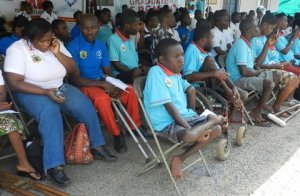
 Government is arranging with the Ministry of Education to provide
permanent employment to 2,500 Persons With Disabilities (PWDs) under the
basic school computerization project.
Government is arranging with the Ministry of Education to provide
permanent employment to 2,500 Persons With Disabilities (PWDs) under the
basic school computerization project.
They will be attached to schools to assist in technical challenges like
repairs and teaching while RLG Communications has also agreed to offer
employment to an additional 2,500 PWDs.
The out-going Brong-Ahafo Regional Minister, Eric Opoku said this in a
speech read for him during a graduation ceremony of 2,100 PWDs from the
northern sector.
Participants were from the Ashanti, Brong-Ahafo, Northern, Upper East
and Upper West regions who had successfully undergone six months
Information and Communication Technology (ICT) training.
The programme, organized jointly by government through the Ministry of
Employment and Labour Relations and the RLG Institute of Technology,
forms part of government’s interventions to integrate PWDs into society
and make them economically useful and independent.
The RLG Institute of Technology began the first phase of the project to
train 5000 PWDs nationwide with ICT knowledge and skills.
The southern sector beneficiaries, comprising 2,500 PWDs from the
Greater Accra, Volta, Eastern, Western and Central regions, graduated in
September 2012 in Accra.
Each beneficiary was given a certificate and a set of tools and kits
comprising magnifying lens, a set of screw drivers, rework station and
tweezers free of charge to facilitate the setting-up their own
businesses for economic gains.
He said government took a decision that no segment of the population
should be left behind in this era of ICT, hence Cabinet gave approval
for the rolling out of this initiative, the first of its kind, and
specifically tailored at PWDs.
Mr Opoku therefore urged them to take good care of the tools by putting
them into good use for their own benefits and others in their respective
communities.
The Executive Secretary of the National Council on Persons with
Disability (NCPD), Max Vardon reminded beneficiaries that the training
programme was meant to promote and support them for the socio-economic
transformation of their lives.
He emphasized that the journey to enhance their lives had started with
their graduation where “each of them was expected to take ownership of
the challenge of deploying the training and tools they had received for
their own advantage and survival.
Mr Vardon said that could be realized in either manufacturing products,
supporting school ICT departments or providing value-added business
services to their communities.
The Chief Executive Officer of RLG, Roland Agambire in an address read
for him by Isaac Appiah, Head of Training, RLG Communications, said the
six months training was intensive.
He said beneficiaries were taken through a lot of subject areas
including hardware, software, entrepreneurship, repair and assembling of
mobile phones and computers and expressed the hope that they would
effectively apply the lessons learnt to make life meaningful to
themselves, their families and communities.
Mr Agambire said the second phase of the project was on-going with the
training of 10,000 PWDs nationwide and indicated the continuous desire
of RLG to partner government to alleviate the plight of all
socially-disadvantaged persons in the society.
